This is a very rough draft of an article I’m working on. It still needs a re-write (or two) but as I like working in the open, I thought getting a version online would be in keeping with my intent. Feel free to comment and point out weaknesses and inconsistencies (but be kind!). Praise is also always appreciated, but only if warranted…

Introduction
Most classical film schools harbour an intuitive aversion to the term ‘pedagogy’. It has too much of a ring of kindergarten circle time and school lessons with good behaviour and right and wrong answers, contrasted with the ideal of an artistic process of creation that is essentially irrational, unpredictable, personal and uncompromising.[1]
This quote, by former head of the Danish National Film School Vinca Wiedeman, addresses the challenge of developing a pedagogical framework for a practice-based film school. In fact, the book in which her chapter appears, The 21st Century Film, TV & Media School: Challenges, Clashes, Changes, is illustrative of the issue. There are 18 chapters over 472 pages, and they cover a large variety of approaches to curriculum and teaching—but almost completely overlook educational theory and philosophy.
The only other chapter in that volume to delve into pedagogical theory is the contribution from Nicholas Oughton and Jean-Paul Jarry.[2] Here the authors apply theories of experiential learning as articulated by David Kolb to argue for the continued use of celluloid as the primary medium used in cinematography education.
Similarly, in their influential Educating Film-makers: Past, Present and Future, Duncan Petrie and Rod Stoneman[3] discuss in depth the relationship between film theory and filmmaking practice. But despite analysing different film school models and teaching approaches, they do not discuss film school pedagogy in the light of educational theory and practice. Other publications[4] show similar biases.
These are not failings of the referenced publications. As a body of work, they represent invaluable insights into the inner workings of film schools since VGIK in Moscow opened its doors in 1919. Much of what has been written is in the form of “how to”, and aimed at filmmakers a toolkit to use for transforming their experience into classroom instruction for the next generation, or in the form of surveys, examining the different approaches different film schools have had over the decades.
In my career working at film schools, which spans nearly 30 years and 3 different schools,[5] I have found, however, that the methods, structures, and forms of teaching we do can benefit from being related to existing bodies of pedagogical theory and educational philosophy. Filmmaking is both a highly technical and skilled craft and a complex and collaborative art form, and prospective filmmakers need to learn to balance the two in a way that will make sense for their own visions, careers, and ambitions. In schools like the three I have worked at, and many of the schools the Norwegian Film School compares itself to, the teaching staff are themselves primarily filmmakers who come from outside academics, and seldom identify themselves as primarily teachers or researchers.
In such an environment, with a wealth of experience and expertise, the challenge becomes to enable the teaching staff to have at their disposal the tools to turn their own artistry and tacit knowledge into educational situations for the students. In some cases, this means teacher-filmmakers must combat their own instincts to “make the day” at all costs and provide opportunities for students to test themselves and their own limits, even at the cost of failure.
My approach has been to attempt to answer the questions that are articulated in the Sourcebook of Experiential Education:
- “What is learning” and “how do people learn?”
- “What is teaching” and “how should teachers teach?”
- “What is the purpose of education” and “what is worth knowing and studying?”
- “What is the relationship of the schools to society at large and to the world?”[6]
While all 4 of these questions are interconnected, for the purposes of this paper I’ll be concentrating on the first two.
Experience as teacher
In his 1910 work, How We Think, John Dewey writes,
Eagerness for experience, for new and varied contacts, is found where wonder is found. Such curiosity is the only sure guarantee of the acquisition of the primary facts upon which inference must base itself.[7]
For Dewey, and subsequently those of us who work with hands-on, practice-based education, experience, and the motivation to have experience, is the very core of learning and growth. From the very start of Dewey’s career, he emphasized the connection between experience, knowledge, and learning as summarized in the well-known maxim, “Learn to know by doing, and to do by knowing.”[8]
For filmmakers, this seems intuitive. Filmmaking, like any art form that requires physical interaction with the world,[9] is learned through practice. While the approaches to practice may vary from film school to film school—in some cases driven by ideology, in others by available resources—the basic premise holds true. One learns to make film through making film and through practical exercises designed to introduce different aspects of filmmaking, in what Ben Gibson calls the “conservatory” model for filmmaking education.[10] While Gibson primarily writes about conservatory schools outside of universities, there are also schools inside universities—like the Norwegian Film School at the University of Inland Norway—that follow a conservatory model and are “… structured, like working studios, in departments of practice that bring those charged with ‘technical support’ or ‘equipment instruction’ into units with shared cultures of endeavour, led by senior teachers of that specialization.”[11]
While far from the only way of organizing filmmaking education, this conservatory model most closely mimics the professional film industry. This way of structuring education places the emphasis on practical work, and learning to apply the various tools and methods of filmmaking in situations that the teaching staff, who (as Gibson observes) come primarily from the industry, have created based on their own professional experience. And works such as Training the Trainers[12] give filmmakers practical advice on how to construct workshops that will enable filmmakers to turn their own professional experience into workshops for students.
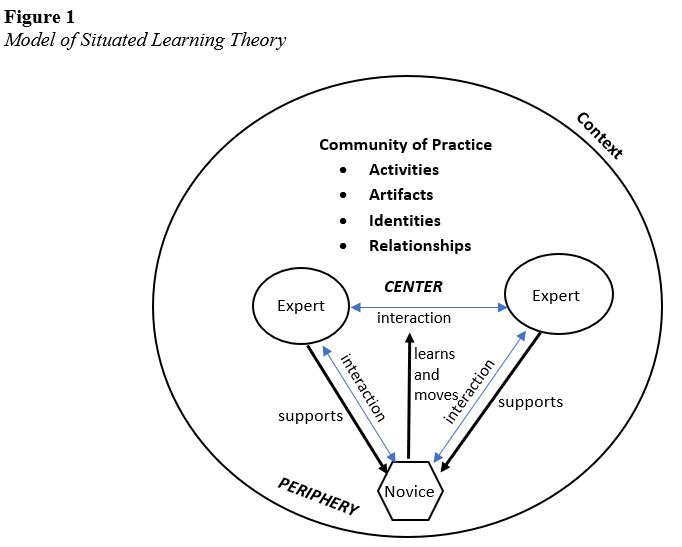
Jean Lave and Etienne Wenger describe this form of education, where experienced practitioners consciously and deliberately introduce less experienced ones to the norms, processes, and methods of the field as a community of practice.[13] In a community of practice, the “…practice of the community creates the potential ‘curriculum’ in the broadest sense—that which may be learned by newcomers with legitimate peripheral access.”[14] Not only does this notion of legitimate peripheral participation in a community of practice emphasize the experiential nature of learning, it also removes it from the realm of individualism and anchors it in a community.[15]
Elkjær also ties this to Dewey’s notion of experience and reflection, and makes the point that, “… Dewey’s notion of experience is both a way of being in the world and experiencing the world, and knowledge is just one part of experience alongside emotion, aesthetics and ethics”,[16] and in this way “connects persons and worlds, action and thinking”.[17] In a film school constructed after the conservatory model, or, more specifically, a “six pack” model[18] like the Norwegian Film School, both the Deweyan idea of experience and the community of practice emphasized by Lave and Wenger are central.
In Democracy and Education, Dewey writes,
We analyze to see just what lies between so as to bind together cause and effect, activity and consequence. This extension of our insight makes foresight more accurate and comprehensive. The action which rests simply upon the trial and error method is at the mercy of circumstances; they may change so that the act performed does not operate in the way it was expected to. But if we know in detail upon what the result depends, we can look to see whether the required conditions are there. The method extends our practical control.[19]
In this section, he highlights the necessary connection between experience as learning and the conscious act of reflection or thinking about the elements of the experience and how they relate to an intended outcome. This, for him, is the difference between the experience and mere activity.[20] His points will resonate with anyone involved in practice-based arts education, especially when he writes,
To “learn from experience” is to make a backward and forward connection between what we do to things and what we enjoy or suffer from things in consequence. Under such conditions, doing becomes a trying; an experiment with the world to find out what it is like; the undergoing becomes instruction—discovery of the connection of things.
Two conclusions important for education follow. (1) Experience is primarily an active-passive affair; it is not primarily cognitive. But (2) the measure of the value of an experience lies in the perception of relationships or continuities to which it leads up. It includes cognition in the degree in which it is cumulative or amounts to something, or has meaning.[21]
This approach is in part illustrated by Donald Schön, when he writes,
When practitioners respond to the indeterminate zones of practice by holding a reflective conversation with the material of their situations, they remake a part of their practice world and thereby reveal the usually tacit processes of worldmaking that underlie all of their practice.[22]
Not only is this descriptive of filmmaking education; it is also prescriptive. The challenge for film educators is to create learning experiences where students are able to make the backward and forward connections Dewey writes about as they engage with the materials and conditions of their practice. As both Dewey and Schön point out, this engagement is reflective. It requires a progression where the challenges and situations that emerge build on the ones that have passed, and at the same time allow the students to consciously engage in controlled experimentation and discovery.
Lave and Wenger touch on this when they write, “[M]astery resides not in the master but in the organization of the community of practice where the master is part”[23] and go on to point out that the teacher/master “is, after all, as much a product of the conventional, centered theory of learning as is the individual learner.”[24] This too is a reminder to both educators and learners that in an education like industry-focussed, practice-based filmmaking, there exists both a large community of practice the educators are part of and this community of practice has norms and traditions the students need to understand—even should they go on to challenge them—as they emerge from their education. Furthermore, the educators are themselves a product of education, training, and apprenticeships leading to their professional careers, and cannot separate themselves from this personal history.
The nature of this challenge is multi-faceted. Not only must film educators use their professional and pedagogic experience to create learning situations that will challenge the students and stimulate experimentation; they must also understand and interpret the “powers, interests, and habits”[25] of their students in order to create learning experiences that challenge and motivate their students where they are at. (I will return to this in the next section.) And finally, they must be aware of their own path into a professional filmmaking practice and make this transparent enough that their students will be able to gain their own experiences and chose their own path.
Scaffolding the emergent professional
Lebert and Vilarroya define scaffolding as,
derived from Vygotsky’s zone of proximal development, which is a learning zone where a more knowledgeable person’s guidance can enhance learning. The term scaffolding was originally used as a metaphor to explain the role that adults can play in joint problem-solving activities with children, and now it is applied to mean temporary support provided for the completion of a task that learners otherwise might not be able to complete.[26]
This definition of scaffolding has its origin in a 1976 article by Wood, Bruner, and Ross which examines the role of tutoring in the development and education of children.[27] And it further refers to Lev Vygotsky’s zone of proximal development, which he developed to describe “the distance between the actual developmental level as determined by independent problem solving and the level of potential development as determined through problem solving under adult guidance or in collaboration with more capable peers.”[28]
While both Vygotsky and Wood, Bruner, and Ross focussed primarily on young children, and how their learning can be facilitated by the conscious application of timely support or tutoring, many have since taken the step illustrated by Lebert and Vilarroya above, and applied the same principles to different age groups—including adults. In their 2010 review of scaffolding literature, van de Pol et.al. highlight scaffolding at many levels, and show that effective scaffolding involves a gradual withdrawal of teachers’ instruction as students gradually gain expertise and independence.[29] They also point out that “for scaffolding to occur, the teacher must apply scaffolding strategies that are clearly contingent (i.e., based upon student responses)”[30] which evokes Dewey’s emphasis on the “powers, interests, and habits” of students (see above). In their review, van de Pol et.al. do point to the correlation between different scaffolding methods and approaches and the ultimate effectiveness of the scaffolding, although they also point out that “studying scaffolding in a rigorous and systematic way appears to be especially complex probably because of the complexity of a dynamic concept such as scaffolding.”[31]
The practice of scaffolding in film schools was first identified by Danish researcher Heidi Philipsen, in her landmark study of the Danish National Film School in the late 1990s / early 2000s.[32] Philipsen identifies three categories of scaffolding from her study:
- Institutional scaffolding
- Team scaffolding
- Individual scaffolding[33]
She discusses limits her discussion of scaffolding to the constraints placed on the students as a method of stimulating creativity, and elaborates; “creativity is often defined as a talent to be able to think “outside the box.” I would like to stress that in order to be able to think outside the box, it actually helps to have a metaphorical box (constraints).”[34] A full discussion of creativity in filmmaking education is outside the scope of this article, but the three categories of scaffolding nonetheless warrant closer examination.
In institutional scaffolding, Philipsen specifically refers to the rules that the school sets for a particular film exercise. She uses examples like “the natural story”,[35] time constraints, conditions using actors, camera, thematic constraints, etc.[36] She quotes one of her interview subjects, a screenwriter, who argues that “the use of constraints in a writing process actually produces a feeling of relief because he has been partly relieved of the responsibility, which apparently frees up energy enabling him to use his imagination in new ways.”[37]
Team scaffolding, for Philipsen, refers to the support and learning that happens between students, both in a cohort as a whole and in the various constellations they find themselves in.[38] One might also connect it with one of the features of a community of practice, where Lave and Wenger observe that often “apprentices learn mostly in relation with other apprentices. There is anecdotal evidence that where the circulation of knowledge between peers and near-peers is possible, it spreads exceedingly rapidly and effectively.”[39] This also references Vygotsky, who “suggested that through the process of working with others, learners create an environment of shared meanings with peers.”[40] My observations of intra-student dynamics at the Norwegian Film School support these claims, even extending to alumni welcoming new graduates into the industry.
Philipsens third category of scaffolding, individual scaffolding, is perhaps more problematic. She identifies this as occuring “when filmmakers define their own rules for a film process and product.”[41] The fact that individual filmmakers can—and do—impose their own rules and constraints on their own artistic processes and creative work, however, hardly seems to meet an approach to scaffolding “construed as support given by a teacher to a student when performing a task that the student might otherwise not be able to accomplish.”[42] As van de Pol et.al. observe, while definitions of scaffolding can vary, a relationship between teacher (or more experienced peer) and student / learner is common for all,[43] starting with scaffolding as a method for supporting Vygotskys zone of proximal development.
Without getting in to a broad discussion of creativity, it is worth emphasising that one purpose of educational scaffolding in filmmaking education is to foster the students’ development of their creativity and imagination. If one accepts that “everything the imagination creates is always based on elements taken from reality, from a person’s previous experience”,[44] and that “imagination draws on and co-operates with cognitive processes that arise from and span our physical and sociocultural resources and environments”[45] then creative education can be based on “design principles that could guide the crafting of creative experiences in education and beyond, e.g., repositioning and perspective taking, sustaining uncertainty, making the familiar unfamiliar, tinkering and embodied experimentation, use of analogies and metaphors, “as if” and “what if” thinking, pretend play, and so on.”[46] I will return to this in the conclusion.
4E and the phenomenological understanding of cognition
In his 2013 book Making, anthropologist Tim Ingold writes, “the drawing is not the visible shadow of a mental event; it is a process of of thinking, not the projection of a thought.”[47] In this, he also refers to the “active externalism” as developed by Andy Clark and David Chalmers in their 1998 essay, “The Extended Mind”. Active externalism, they claim, means that,
the relevant external features are active, playing a crucial role in the here-and-now. Because they are coupled with the human organism, they have a direct impact on the organism and on its behaviour. In these cases, the relevant parts of the world are in the loop, not dangling at the other end of a long causal chain.[48]
Lebert and Vilarroya further elaborate on this,
the extended-mind approach proposes that cognition is a process that is distributed across the individual and their environment, including objects, tools, and other individuals. By focusing on the ways in which external resources and environmental factors contribute to a concrete experience, the extended-mind feature seeks to provide a more expansive and inclusive view of a concrete experience, one that recognizes the complex interplay between the individual, their environment, and their tools and resources.[49]
This understanding of cognition is also crucial for educators, as it highlights that students do not only learn through rational understanding, logical thinking, and application of knowledge. Rather, learning is an holistic activity that acknowledges the students place in an environment that includes their bodies, the physical surroundings, the tools they use, and their classmates and peers.
The extended mind theory is part of a broader movement in cognitive—and thus also educational—sciences that collect under the term “4E cognition”.[50] 4E refers to cognition being extended, embodied, embedded, and enactive, and collectively they are framed as a response and in opposition to a Cartesian mind-body dualism or separation.[51] In their summary of the “Philosophical and Psychological Influences on Embodied Cognition”, Macrine and Fugate cite a number of influences, including John Dewey’s suggestion “that higher-order cognitive functions are adaptations generated by interactions with the world.”[52] They also emphasise the connection to Phenomenology, specifically to Merleau-Ponty who “maintained that thinking was a fully embodied event: people perceive the world first and foremost through their bodies. [Merleau-Ponty] argued that cognition cannot be understood without the body’s engagement with the world.”[53] Finally, they draw on James Gibson’s ‘ecological theory’ which claimed “argued that perception was direct and the environment meaningful […], Gibson suggested that there was no mind between perception and action, and that action was based in the body, supported through evolution and the environment.”[54]
In making these connections, Macrine and Fugate draw on the book that introduced the concept of embodiment to cognitive theory, The Embodied Mind from 1991. Here the authors write,
We hold with Merleau-Ponty that Western scientific culture requires that we see our bodies both as physical structures and as lived, experiential structures—in short, as both “outer” and “inner”, biological and phenomenological. These two sides of embodiment are obviously not opposed. Instead, we continuously circulate back and forth between them. […] For Merleau-Ponty, as for us, embodiment has this double sense: it encompasses both the body as a lived, experiential structure and the body as the context or milieu of cognitive mechanisms.[55]
This emphasis on the ‘body as a lived, experiential structure’ will resonate with filmmakers and most artistic practitioners. Ingold picks up on this when he observes,
In the act of making, the artisan couples his own movements and gestures—indeed his very life—with the becoming of his materials, joining with and following the forces and flows that bring his work to fruition. It is the artisan’s desire to see what the material can do, by contrast to the scientist’s desire to know what it is, that […] enables the former to discern a life in the material and thus, ultimately, to ‘collaborate more productively’ with it.[56]
Miranda Anderson connects this directly to the arts and artistic practice, by examining the connections between the artist, the body, and materials when describing a work by Nikolaus Gansterer from 2017:
His hands forming and reforming of physical materials, linguistic concepts and diagrammatic symbols, all amidst the random interruptions of living creatures, show the fluidly diverse concert of conceptual and diagrammatic, and embodied and environmental processes in action, and explore the interplay of structured patterns and chance in thinking.[57]
The challenge for education in any practice-based art form is that the students often do not yet have the experience to engage with the materials of their art in an embodied, extended way. Filmmaking, particularly, is (most often) a highly technical art form that combines complex and advanced technologies with logistical puzzles, challenging teamwork and collaboration, restrictions involving time, budget, etc., and the gap between the imagined result and the resources available to achieve it. Filmmakers-turned-educators are faced with the challenge of creating learning situations for students where they will gain the experience and expertise necessary to work in professional productions after graduation. This involves acknowledging that, “Deep and meaningful learning indeed involves the integration of cognitive processes, social interactions, and affective dimensions, fostering active engagement and personal relevance in knowledge acquisition.”[58]
Implications for filmmaking education
In this article, I have attempted to highlight some of the key elements of Dewey’s notion of experiential learning, illuminate some aspects of scaffolding in education, and introduce the concept of 4E cognition as it relates to education. Each of these is, in isolation, worthy of a more in-depth analysis. At this point, it seems most relevant to have lifted them into the consciousness of film schools, and I will now make som concluding observations on how filmmaker-educators can use some of the concepts in a discourse around their own teaching practice.
A core issue for film schools is that we are teaching both a highly technical craft and creativity, and we are doing so in a setting where the individual cannot work in isolation but is part of an extended cognitive reality. Bruce Sheridan sums it up as consisting of
three key points: 1) collaboration is the default process by which individual creative vision is realized in screen arts, 2) collaboration will be central to the work our students undertake beyond graduation, and 3) discrete individual contributions to screen art are rendered porous through, and ineluctably modified by, dynamic and contingent interactions amongst individuals and creative sub-groups, such as teams dedicated to writing, design, cinematography, editing, sound etc..[59]
Further to this, “experiences are not just based on abstract, decontextualized information but are also deeply influenced by the specific social, cultural, and environmental contexts in which they occur”[60] and it necessitates an awareness of these contexts by planners and educators at film schools. The key to a successful practice-based arts education like a film school is to create opportunities for the students to have concrete learning experiences. Here, a “concrete experience refers to an embodied, embedded, extended, and enactive engagement of an individual with their environment”,[61] where the environment includes the physical surroundings, the analogue and digital tools used, the constraints placed by the institution, other students and collaborators, as well as the student’s own prior knowledge and experiences, goals and ambitions, fears and uncertainties, and emotional state.
Dewey highlights the social, extended and enactive aspects of this when he writes,
not only does social life demand teaching and learning for its own permanence, but the very process of living together educates. It enlarges and enlightens experience; it stimulates and enriches imagination; it creates responsibility for accuracy and vividness of statement and thought.[62]
This is also well-summarised by Elkjær,
Experience occurs when habitual action and thinking are disturbed and calls for inquiry. Inquiry begins with emotion, but may develop into new experience and knowledge when language (ideas, concepts and theories) is used to define and resolve the disruption. This process may be supported by education and teaching. The process of inquiry concerns the consequences of different ways to define and resolve uncertainties. Inquiry is an experimental process in which ideas, hypotheses, concepts and theories are used instrumentally as ‘tools to think with’, and are as such a playful, creative and potentially innovative process. The result of inquiry, the new experience or ‘warranted assertibilities’ (knowledge), is therefore open-ended (fallible) and can be re-interpreted in light of new experiences.[63]
And so, to return to the questions in the introduction: 1. How do people learn? has been the focus of this article. There is no single answer, but the key is that we learn through the conscious, reflective interpretation of embodied, extended, enactive, and embedded experiences. We make films, we find ways to collaborate with others in achieving a common vision, we reflect on the relationship between the film we wanted to make, the film we ended up with, and the process and decisions that led us there, and, at the Norwegian Film School at least, we watch the films and reflect on these things together so the experiences of one can be shared and understood by all.
And 2. How do we teach? As best we can to create a positive and scaffolded environment for students to have and reflect on the experiences they have while in our care.
Endnotes
- Wiedeman, Vinca. ‘Educating for Innovation: Ten Tips for (Future) Film-School Heads’. The 21st Century Film, TV & Media School: Challenges, Clashes, Changes, edited by Maria-Dora Mourão et al., CILECT – The International Association of Film and Television Schools, 2016, pp. 95-96.↩︎
- Oughton, Nicholas, and Jean-Paul Jarry. ‘Learning Cinematography at Film School: Old Ways, New Directions’. The 21st Century Film, TV & Media School: Challenges, Clashes, Changes, edited by Maria-Dora Mourão et al., CILECT – The International Association of Film and Television Schools, 2016, pp. 280–315. 21st Century Film, TV & Media School 1.↩︎
- Petrie, Duncan, and Rod Stoneman. Educating Film-Makers: Past, Present and Future. Intellect Ltd, 2014, https://www.intellectbooks.com/educating-film-makers.↩︎
- See, for example, the newsletter archive kept by CILECT (The International Association of Cinema, Audiovisual and Media Schools) at https://cilect.org/archives/newsletter/ and the CILECT-supported publication: Ross, Dick. Training the Trainers. The Norwegian Film School, 2005.↩︎
- I have worked at Vancouver Film School (1997-2001), the Canadian Film Centre (2002-2006), and the Norwegian Film School (2009 – present day).↩︎
- Smith, Thomas E., Clifford E. Knapp, ´Part I: Philosophers and Educational Theorists´. In Smith, Thomas E and Clifford E. Knapp (eds.), Sourcebook of Experiential Education. Routledge, 2011. p. 13.↩︎
- Dewey, John. How We Think. D.C. Heath & Co., 1910. Reprint, Anson Street Press, 2025. p. 24.↩︎
- McLellan, J. A., and John Dewey. Applied Psychology: An Introduction to the Principles and Practice of Education. Archive.org digital facsimile. Educational Publishing Company, 1889. https://archive.org/details/appliedpsycholog00mclerich/. p. 182. In fact, the maxim is so central to McLellan and Dewey that they include it on the title page.↩︎
- Whether or not this would also hold true for AI filmmaking is a subject for a different discussion. For the context of this paper, I am talking about traditional filmmaking with physical cameras, sound recording equipment, lights, sets, actors, crew, etc.↩︎
- Gibson, Ben. ‘What Is “Conservatory Training” for Film and Television?’ In The 21st Century Film, TV & Media School: Challenges, Clashes, Changes, edited by Maria-Dora Mourão, Stanislav Semerdjiev, Cecília Mello, and Alan Taylor. 21st Century Film, TV & Media School Project 1. CILECT – The International Association of Film and Television Schools, 2016.↩︎
- Ibid.↩︎
- Ross, Dick. Training the Trainers. The Norwegian Film School, 2005.↩︎
- Lave, Jean, and Etienne Wenger. Situated Learning: Legitimate Peripheral Participation. Cambridge University Press, 1991. See especially chapter 4.↩︎
- Ibid. p. 93.↩︎
- See Elkjær, Bente. ‘Pragmatism: Learning as Creative Imagination’. In Contemporary Theories of Learning: Learning Theorists … in Their Own Words, 2nd edn, edited by Knud Illeris. Routledge, 2018. p. 67↩︎
- Ibid. p. 70.↩︎
- Ibid. p. 71.↩︎
- The six pack model grew out of a desire to create a film school structure where the different heads of department are empowered to be artists and storytellers in their own right, rather than playing a supporting role for an auteur director. At the Norwegian Film School, the six pack consisted 6 specializations—screenwriting, directing, producing, cinematography, editing, and sound (subsequently expanded to include production design)—with 6 students in each. This means that whenever the students make a film exercise, the team will consist of 1 student from each specialization. In between the film exercises, the students of each specialization receive discipline-specific education designed to increase their skill and artistry.↩︎
- Dewey, John. Democracy and Education: An Introduction to the Philosophy of Education. The MacMillan Company, 1916. E-Book. Standard Ebooks, 2023. https://standardebooks.org/ebooks/john-dewey/democracy-and-education. Chpt. 11, “Experience and Thinking”.↩︎
- Ibid.↩︎
- Ibid. Emphasis in original.↩︎
- Schön, Donald A. Educating the Reflective Practitioner: Toward a New Design for Teaching and Learning in the Professions. The Josey-Bass Higher Education Series. Jossey-Bass, 1987. p. 36.↩︎
- Lave and Wenger, 1991. p 94.↩︎
- Ibid, ibid.↩︎
- Dewey, John. ‘My Pedagogic Creed’. School Journal 54 (January 1897). 2009 Digital edition released under a Creative Commons Public Domain Declaration on archive.org.↩︎
- Lebert, Angélique, and Óscar Vilarroya. ‘The Links between Experiential Learning and 4E Cognition’. Annals of the New York Academy of Sciences 1541, no. 1 (2024): 37–52. https://doi.org/10.1111/nyas.15238. p. 44.↩︎
- Wood, David, Jerome Bruner, and Gail Ross. ‘The Role of Tutoring in Problem Solving’. Journal of Child Psychology and Psychiatry 17 (1976): 89–100. https://doi.org/10.1111/j.1469-7610.1976.tb00381.x.↩︎
- Vygotsky, L. S. Mind in Society: Development of Higher Psychological Processes. Edited by Michael Cole, Vera John-Steiner, Sylvia Scribner, and Ellen Souberman. Harvard University Press, 1978. http://ebookcentral.proquest.com/lib/hilhmr-ebooks/detail.action?docID=3301299. p. 86.↩︎
- van de Pol, Janneke, Monique Volman, and Jos Beishuizen. ‘Scaffolding in Teacher—Student Interaction: A Decade of Research’. Educational Psychology Review 22, no. 3 (2010): 271–96. p. 275.↩︎
- Ibid. ibid.↩︎
- Ibid. p. 282.↩︎
- Philipsen, Heidi. ‘Dansk films nye bølge: Afsæt og aftryk fra Den Danske Filmskole’. Syddansk Universitet (SDU), 2004. https://portal.findresearcher.sdu.dk/da/publications/dansk-films-nye-b%C3%B8lge-afs%C3%A6t-og-aftryk-fra-den-danske-filmskole/.↩︎
- Philipsen, Heidi. ‘Constraints in Film Making Processes Offer an Exercise to the Imagination – A Pleading Based on Experiences from Denmark’. Seminar.Net 5, no. 1 (2009). https://doi.org/10.7577/seminar.2470.↩︎
- Ibid, p. 3.↩︎
- Ibid. p. 5↩︎
- Ibid. pp. 4-5↩︎
- Ibid. p. 5↩︎
- Ibid. p. 6↩︎
- Lave and Wenger, 1991. p. 93.↩︎
- Lebert and Vilarroya, 2024. p. 38.↩︎
- Philipsen, 2009. p. 3.↩︎
- van de Pol et.al., 2010. p. 274.↩︎
- Ibid.↩︎
- Vygotsky, Lev Semenovich. ‘Imagination and Creativity in Childhood’. Translated by M. E. Sharpe. Journal of Russian & East European Psychology 42, no. 1 (2004): 7–97. https://doi.org/10.1080/10610405.2004.11059210. p. 13.↩︎
- Anderson, Miranda. ‘4E Cognition and the Mind-Expanding Arts’. European Journal of Philosophy in Arts Education 7, no. 02 (2024): 7–64. https://doi.org/10.5281/zenodo.7451462. p. 51↩︎
- Glăveanu, Vlad P., and Ronald A. Beghetto. ‘Creative Experience: A Non-Standard Definition of Creativity’. Creativity Research Journal 33, no. 2 (2021): 75–80. https://doi.org/10.1080/10400419.2020.1827606. p. 79↩︎
- Ingold, Tim. Making: Anthropology, Archaeology, Art and Architecture. Routledge, 2013. https://doi.org/10.4324/9780203559055. p. 128.↩︎
- Clark, Andy, and David Chalmers. ‘The Extended Mind’. Analysis 58, no. 1 (1998): 7–19. p. 9.↩︎
- Lebert and Vilarroya, 2024. p. 46.↩︎
- A good introduction to the breadth and scope of 4E can be found in Newen, Albert, Shaun Gallagher, and Leon De Bruin. ‘4E Cognition: Historical Roots, Key Concepts, and Central Issues’. In The Oxford Handbook of 4E Cognition, edited by Albert Newen, Leon De Bruin, and Shaun Gallagher. Oxford University Press, 2018. https://doi.org/10.1093/oxfordhb/9780198735410.013.1.↩︎
- Ibid. This claim can be found in all the literature I have come across on 4E cognition.↩︎
- Macrine, Sheila L., and Jennifer M. B. Fugate. ‘Embodied Cognition and Its Educational Significance’. In Movement Matters: How Embodied Cognition Informs Teaching and Learning, edited by Sheila L. Macrine and Jennifer M. B. Fugate. The MIT Press, 2022. https://direct.mit.edu/books/oa-edited-volume/5306/Movement-MattersHow-Embodied-Cognition-Informs. p. 16↩︎
- Ibid. ibid.↩︎
- Ibid. ibid.↩︎
- Varela, Francisco J., Evan Thompson, and Eleanor Rosch. The Embodied Mind: Cognitive Science and Human Experience. 1991. Revised edition. The MIT Press, 2017. https://doi.org/10.7551/mitpress/9780262529365.001.0001. pp. lxi-lxii.↩︎
- Ingold, 2013. p. 31.↩︎
- Anderson, 2024. p. 18.↩︎
- Lebert and Vilarroya, 2024. p. 43.↩︎
- Sheridan, Bruce. ‘Creativity, Physical Space, and Teaching Screen Directors’. In The 21st Century Film, TV & Media School: Directing the Future, edited by Maria-Dora Mourão, Stanislav Semerdjiev, Cecília Mello, and Alan Taylor. 21st Century Film, TV & Media School Project 2. CILECT – The International Association of Film and Television Schools, 2019. p. 203.↩︎
- Lebert and Vilarroya, 2024. p. 46.↩︎
- Ibid. ibid.↩︎
- Dewey, 1916 / 2023, Chpt. 2 “Education as a Social Function”.↩︎
- Elkjær, 2018. p. 79.↩︎