
KI-retningslinjer for norsk film?

I mai i år publiserte British Film Instutute sin KI-veileder, AI in the Screen Sector: Perspectives and Paths Forward. Rapporten ble utviklet for BFA av CoSTAR Foresight Lab og tar for seg mange sider av KI-utviklingen, både det som skjer (og har skjedd lenge) i bruk av maskinlæring og automatisering i verktøy og programvare som brukes daglig i film og tv-produksjon og de nyere, generative verktøyene som har tatt mye oppmerksomhet de siste 3-4 årene. Rush Print oppsummerer noen av reaksjonene her hjemme i sin artikkel “– Vi trenger en oppdatert og tydelig KI-veiviser.” (bak betalingsmur).

En ting som påpekes i Rush Print-artikkelen er at mye av den offentlige responsen og diskursen virker reaktiv. Vi er tatt på senga, og famler litt rundt for å finne ut hvordan vi skal håndtere den (sannsynligvis) store omveltningen som kommer vaskende over oss som en flodbølge.

Samtidig ser vi andre deler av verden responderer på helt andre måter. I sommer har vi kunnet lese at et indisk produksjonsselskap har brukt KI for å lage en ny versjon av en spillefilm de opprinnelig ga ut i 2013. Den opprinnelige filmen, et romantisk drama, hadde en tragisk slutt. Den nye versjonen har en KI-skapt lykkelig slutt. I vår ga Netflix ut den argentinske science fiction dramaserien El Eternauta. Her har produsentene brukt generativ KI for å skape en storslått VFX-scene som ellers hadde vært utenfor økonomisk rekkevidde for dem. Og fra Hollywood kan vi lese rapporter om økende bruk av KI til å analysere og forbedre manus, hvor menneskelige script doctors og ghost writers erstattes av generative språkmodeller.

Disse tre eksemplene, og utallige andre, viser med all tydelighet at KI ikke er noe som kommer; det er her og i større utstrekning enn de fleste er klar over. Det er en del av hverdagen vi beveger oss i, både i norsk film og i samfunnet forøvrig. Og selv om jeg tør påstå at det store flertallet av skapende filmfolk kanskje blir forferdet over de tre eksemplene jeg trekker frem vil de fleste av oss, mer eller mindre motvillig, innse at dette er en del av fremtiden for store deler av bransjen.

Eksemplet med El Eternauta peker mot at det sannsynligvis blir VFX-bransjen som merker effekten at KI brukes i større skala først. Det er mange tidskrevende og dyre prosesser som relativt enkelt kan automatiseres med KI. Dette vil produksjonsselskaper og distributører ta i bruk, selv om bilder skapt av generativ KI ikke kan manipuleres like nøyaktig og presist som menneskeskapte.

Og med dette kommer også spørsmålet om autentisitet inn. Det virker naturlig å tenke at autentisitet er noe forbeholdt menneskelig kreativitet. For at et kunstverk skal kunne berøre, skal kunne si noe autentisk, vil de fleste av oss mener det må ligge en menneskelig intensjon og kreativitet bak. Men nå begynner forskning å vise at når publikum ikke vet om det de ser eller hører på er menneskeskapt eller ikke så er det ikke så opplagt at de vil foretrekke det menneskeskapte. Det er først når vi gjøres oppmerksom på at det vi har opplevde er skapt av en kunstner eller en KI at vi klart foretrekker det menneskeskapte.

Jeg tenker disse spørsmålene er for store og overgripende til at vi kan — eller bør — forvente at NFI lager en veiledning, et sett med regler, norsk film skal forholde seg til. Samtidig er det klart at Filminstituttet må være viktig del av slike retningslinjer. NFI bør se til BFI, og bestille en rapport med retningslinjer fra de kompetansemiljøene som finnes på dette området. Her må både utdanning — gjennom Den norske filmskolen, TV-skolen og Spillskolen på INN, samt fagmiljøene ved Høgskolen Kristiania og Universitet i Tromsø (filmkunstskolen i Kabelvåg) og flere — bransje gjennom organisasjoner, produksjonsselskap, interesseorganisasjoner og nettverk (som AIAIAI og Oslo Kreativ AI), samt regionale filmsentre og deres samarbeidspartnere på banen. Hvis slike retningslinjer skal speile bredden av behovene i norsk film må de også produseres av en større bredde aktører enn de som sitter i Dronningens gate i Oslo.

I denne sammenheng tror jeg også MishMash — Centre for AI and Creativity vil spille en viktig rolle. MishMash representerer hele bredden av kunstfelt i Norge, og film er representert både gjennom Filmskolen og Høgskolen Kristiania. Senteret skal startes opp i løpet av høsten, og har et viktig oppdrag i å lede utvikling og forståelse for bruk av KI i kunst og kreative næringer, samt beslektede områder. I denne sammenheng vil det også bli åpninger her for flere aktører fra kunstfeltet og bransjen.

Utover dette peker BFIs rapport på noe vesentlig, som også er tilfelle i Norge: manglende ferdigheter og kompetanse. Vi trenger etter- og videreutdanning for både erfarne og nye filmarbeidere. Produsenter, regissører, forfattere, alle trenger mulighet for opplæring innenfor KI. Men også de som vil se jobbene endres eller forsvinne totalt trenger et tilbud som kan gi omskolering; et tilbud som sikrer norsk film ikke mister sårt tiltrengt erfaring og kompetanse men samtidig sikrer at jobbene som gjennomføres er relevante også i fremtiden.

Som undervisningsleder ved Den norske filmskolen er det naturlig for meg å tenke at her skal og må Filmskolen ha en sentral rolle. Men vi kan ikke gjøre dette alene, og vi trenger et konsortium som bringer sammen utdanninger, offentlige instanser, produksjonsselskap, bransjeorganisasjoner og mange flere for å møte disse utfordringene sammen — et konsortium som ansvarliggjør oss alle for å bidra til å løse utfordringene vi står over for og sikrer en felles styrke som gjør det umulig for myndighetene å ignorere.
Why We Ar/t/

I have worked in and around the arts for most of my adult life, primarily music, theatre, and film. I know art is important, not jut for me but for most of us — and for a healthy, functioning society. At the same time, art is not instrumental. It does not provide easily quantifiable benefits, where a «return on investment» can be calculated and presented in a spreadsheet. The benefits we — both individually and as a society — accrue from art is valuable precisely because it’s not quantifiable. It is intangible, but at the same time foundational.

One of the most damaging effects of neoliberal new public management has been the increasing emphasis on the measurable and the quantifiable. In our eagerness to ensure the taxpayers money is spent «wisely», we have become unable to judge value, choosing instead to focus exclusively on costs. And in so doing, we forget what makes us human, we forget what makes us grow and reach for the unknown.

As Alva Noë points out in The Entanglement, humans have been making art for as long as we have existed. Cave art dated to over 50,000 years ago, musical instruments created by Neanderthals from around the same time demonstrate that the need to express ourselves is part of who we are. One cannot separate art from humanity and still retain that which makes us human.

Artistic expression is not just the domain of artists — it is integral to our daily lives, and we all demonstrate this through the myriad of choices we make each day as we decide how to present ourselves to the word. Brian Eno and Bette A. show this clearly in What Art Does.

Recent cognitive science also shows that art is not just an isolated aspect of our humanity, but has profound impacts on all aspects of our existence.[^1] That the practice of creating art is profoundly important to the artist is obvious. Perhaps less obvious is that the act of viewing art and participating in cultural activities is also profoundly important to every member of society. Here we come back to Noë, and can see that since (one of) the function(s) of art is to both make us aware of social and cultural norms and to challenge them, art is crucially important for both personal and societal development. Without it, we would be trapped in another essential aspect of our nature, the desire for continuity and predictability, and would stagnate.

In higher education in Norway, there is also a paradox at the moment: like many countries, the Norwegian government wants to support education that “meets the need of the future workforce” and at the same time encourage innovation and entrepreneurship. They do this using the logic of the spreadsheet and the quantifiable, and thus believe that funding programmes tied to jobs there is demand for today will somehow ensure we are also preparing ourselves for meeting the challenges of tomorrow. And in this worldview, there is no reason to emphasize education in the arts, and so funding for arts programmes can be cut drastically.

The problem, of course, is that newer research shows[^2] that the benefits of the arts extend far beyond the cultural and creative industries — in fact, the research shows that having a vibrant and active artistic and cultural sector feeds innovation and growth in many, if not all, sectors of society. And thus, cutting public funding for the arts and culture, reducing investment in fine arts education will, over time, reduce the innovative and growth potential of all sectors of society.

Footnotes

[^1]: See, Anderson, Miranda. “4E Cognition and the Mind-Expanding Arts.” European Journal of Philosophy in Arts Education 7, no. 02 (March 22, 2024): 7–64. https://doi.org/10.5281/zenodo.7451462.
[^2]: Sacco, Pier Luigi, Piotr Bialowolski, and Dorota Weziak-Bialowolska. “Culture and Creativity, Skills Building, and Growth: What Have We Missed?” Humanities and Social Sciences Communications 12, no. 1 (February 21, 2025): 236. https://doi.org/10.1057/s41599-024-04200-0.

A brief overview

This past academic year, I participated in running our internal pedagogy course for the fourth time. Each time has been different, and this time I used the opportunity to introduce more formal educational theory than previous occasions.

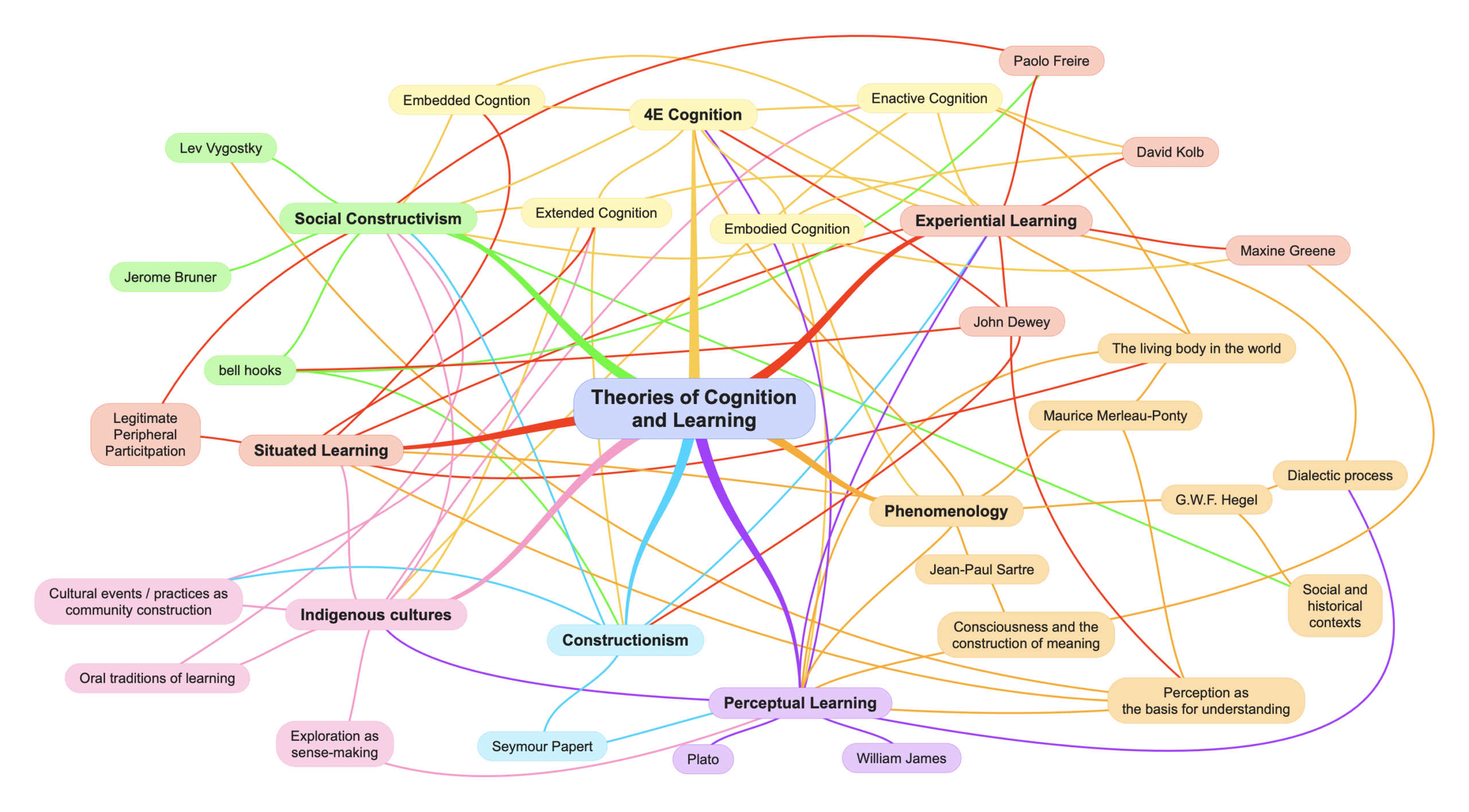
One of the last lectures I did include an illustration showing the mind map of where I was at in my research at that time. It might look confusing to others, but it makes sense to me! Pasted image 20250722174739.png
It’s not intended to be used in any academically rigorous setting, but represents some associations I was making at the time (this was around March of this year). I’ve added some new links and eliminated others since then, but still find this map a useful illustration of what I’ll be researching this fall.

Thinking out loud v.01

I have a feeling there will be several of these…

This fall term I will be on a research leave. I am temporarily (and voluntarily!) relieved of all my regular duties in order to spend time doing research — the research I would normally do in my free time, in the moments between meetings, on the weekends… Suddenly that is my main job; I’m not quite sure how I’ll respond once the term starts again, but I’ll do my best to manage.

And what will I be researching? A couple of things:

  1. For the past 15+ years, I’ve been looking at fine arts pedagogy, specifically fine arts pedagogy in film schools. It’s a field where very little research has been done, and while more people have started writing the past 5 or so years, much of what there is is from a an outside and theoretical perspective and not do much from the practitioner perspective. My primary aim is to give practicing filmmakers and film artists a vocabulary to use when discussing what it is they do in the classroom.
  2. The other thing is AI and filmmaking education. I have long been fascinated by they way filmmakers — and all artists — use new technologies in their practice; often in ways that are innovative and surprising. While AI is completely different, in some ways it is no different: filmmakers will use AI, and they will use it in ways that the creators of the tools perhaps did not intend or foresee…

For the pedagogical research: I’ve been reading and thinking a lot over the past few years. Dewey is, of course, a major influence. The statement, «One does not learn from experience. One learns from reflecting on experience.» sums up the ethos I have been trying to enact at the Norwegian Film School ever since I started. It is a practically-oriented school, where the students learn to make film through the practice of making film — but constant reflection on the relationship between process and outcome is an essential part for both individual and collective development.

Vygotsky is another major influence. Filmmaking is a social and collaborative art form, and students (and professionals!) become each other’s most important teachers over time. At the same time, the key challenge for the teaching staff is to create an appropriate Zone of Proximal Learning, where students who come to the school with different backgrounds and experiences can be given challenges that enable their development.

More recently, I’ve been investigating 4E cognition. I firmly subscribe to the idea that cognition is not something limited to the brain, but that our bodies and senses, the tools and technologies we use, and the environments in which we are embedded are part of our cognitive processes. We are not brains in a vat processing input, but are living, breathing bodies in a physical world — and this informs how we interpret our surroundings and how we learn to live in and with the world around us.

I’ve also been reading phenomenology and related philosophy, not to mention perceptual learning. Our bodies, our senses, are our «interface» with the world and each other, and in order to understand how we learn, we need to understand how we sense and how we live. And further from that, how our senses develop and change over time.

Anyway, this is a first brain dump; I intend — or, should I say, hope — to blog regularly about this. I plan to share what I have learned, what I am thinking and see how it changes over time. It’s still July now, so there’s still summer holidays to be had — but by mid-August I should be starting to work at this more dilligently.

css.php