
Review of my research into a philosophy of film and media arts pedagogy so far

These are notes from a talk i gave at a one-day conference at the University of Inland Norway, “INN-puf” (pedagogisk utvikling og filosofi / pedagogical development and philosophy). The audience was primarily teaching faculty from the departments of film, TV, and games, and I tried to pitch it so it would be accessible to practitioners who do not necessarily have a background in either pedagogy or philosophy.

These notes will form the core of an article I am writing, and hope to have done before the summer. This talk was loosely chronological; I am not sure if I will keep that in the artcle, structure it another way.

Film school pedagogy

  • My research has showed there is material on «how to»—for example, Training the Trainers from 2005 (Dick Ross, published by the Norwegian Film School & CILECT).
  • There is a great deal of material written about the content of what is taught to the students but very little material that related film school teaching to educational theory in general.
  • My intro to film school pedagogy: Danish researcher Heidi Philipsen conducted pedagogy lectures for staff at NFS in 2010.
  • Her study of the Danish Film School of the late 1990s and early 2000s revealed the key role of scaffolding and constraints in their teaching model.

Areas of investigation

  • Vygotsky and the Zone of proximal development and Dewey’s focus on the connection between experience, reflection, and learning.
  • 4E Cognition: the embodied, extended, and enactive mind.
  • Phenomenology and perceptual learning give us a better understanding our sensory interactions with the world.
  • Situated learning examines how learners are integrated into professional fellowships.
  • The nature of imagination, emotion, and creativity. And the role of art in human evolution…
  • From tacit to explicit…micro-phenomenology, focussing and deep analysis of the particular, specific experience.

Experiential learning–Dewey

  • John Dewey (1859-1952) was an American philosopher and psychologist, and the originator of modern theories of experiential learning.
  • For Dewey, experience was essential to understanding ourselves and to how philosophy is done. Experience is the result of us engaging with the world, of living.

Give the pupils something to do, not something to learn; and the doing is of such a nature as to demand thinking; learning naturally results. (Democracy and Education, 1916)

  • Believed that we learn “…to know by doing, and to do by knowing.” (An Introduction to the Principles and Practice of Education, 1889)
  • Many of his ideas continue to resonate in contemporary theories of enactive cognition.

As long as our activity glides smoothly along from one thing to another, or as long as we permit our imagination to entertain fancies at pleasure, there is no call for reflection. Difficulty or obstruction in the way of reaching a belief brings us, however, to a pause. In the suspense of uncertainty, we metaphorically climb a tree; we try to find some standpoint from which we may survey additional facts and, getting a more commanding view of the situation, may decide how the facts stand related to one another. (How We Think, 1910)

Experiential learning

  • David Kolb (1939- ) — see Kolbs learning cycle. A useful model, but also limited in the way it separates thinking / reflecting from action and experience, rather than integrating them.
  • Donald Schön (1939-1997) wrote extensively about reflection-in-action: the ability to reflect while in a situation, showing experiential learning as a continuous process—what can be colloquially called “thinking on our feet”.

Pedagogy of the Oppressed

  • Paolo Freire (1921-1997). Brazilian educator who conceived of education as a process of liberation. For education to function as a liberating force, there must be a democratic relationship between the students and teacher.
  • Very critical of the “banking model of education”, where teachers “deposit” knowledge in the student, that the student will utilise later. This perpetuates a rigid power dynamic, with the teacher cast as the infallible expert.

For apart from inquiry, apart from the praxis, individuals cannot be truly human. Knowledge emerges only through invention and re-invention, through the restless, impatient, continuing, hopeful inquiry human beings pursue in the world, with the world, and with each other. (Pedagogy of the Oppressed, 1970)

Engaged pedagogy

  • bell hooks (Gloria Watkins, 1952-2021) was an American writer, feminist, activist, and educator. Inspired by Freire and education as a tool for liberation.

To enter classroom settings in colleges and universities with the will to share the desire to encourage excitement, was to transgress. Not only did it require movement beyond accepted boundaries, but excitement could not be generated without a full recognition of the fact that there could never be an absolute set agenda governing teaching practices. Agendas had to be flexible, had to allow for spontaneous shifts in direction. Students had to be seen in their particularity as individuals […] and interacted with according to their needs. (Teaching to Transgress, 1994)

Experiential learning and art

  • Maxine Greene (1917-2014) was a pioneer for women in the field of philosophy of education.
  • Wrote about the connection between artistic practice and experiential learning; focussed on the arts as a method for us to find our own voice in society.
  • Pioneered the concept, “wide-awakeness”.

Informed encounters with works of art are always new beginnings. New perspectives open in experience; new possibilities of seeing, hearing, feeling are revealed. When individuals are released to be personally present to paintings or poems or sonatas, when they learn how to let their energies go out to the works in an enlarging perception and a focusing of attention, the fields over which their imaginations can play deepen, diversify, and expand. (“The Spaces of Aesthetic Education”, 1986)

Scaffolding – Vygotsky

  • Lev Vygotsky (1896-1934) was a Soviet psychologist who worked extensively with children’s development.
  • Fell out of favour with Stalin, and his works were suppressed until 1956; not well known in the west until the 1970s.
  • Did extensive studies of how we learn language.
  • Best known for the “Zone of proximal development” (ZPD).
  • ZPD emphasises the social aspect of learning.
  • The term “scaffolding” was coined by Jerome Bruner, David Wood, and Gail Ross in 1976 as a metaphor for what educators do to enable the ZPD.
  • A scaffold is a temporary structure that is adjusted and adapted to serve the needs of the construction—analogous to what educators do to support the students appropriate to their skill level.
  • 5 criteria for effective scaffolding:
    • Student ownership of the learning event
    • Appropriateness of the instructional task
    • A structured learning environment
    • Shared responsibility
    • Transfer of control
    • (Applebee, A. N. 1986. ‘Problems in process approaches: Towards a reconceptualization of process instruction’)

Phenomenology

  • Examines our perceptions and how they inform our experience of and interaction with the world we inhabit.
  • Maurice Merleau-Ponty (1908-61), wrote, “Perception is not a science of the world, it is not even an act, a deliberate taking up of a position; it is the background from which all acts stand out, and is presupposed by them.” (Phenomenology of Perception, 1945/1962)
  • Wrote about the overlapping and intertwining between the artist and the world and the artwork as the representation of this relationship.

Cognitive science

  • 4E Cognition: Embodied, Enactive, Embedded, Extended—emerged from psychology and philosophy in the 1990s as a response to computational theories of mind.
    • Embodied cognition is the claim that cognition is routinely shaped in fundamental ways by bodily forms, movements, states and processes.
    • Enactivism claims that cognition is enacted (unfolds) through looping sensorimotor interactions between the agent and its environment, implying both a close relationship between perception and action, and that there is continuity between the properties of life and of mind. (ref. Dewey)
    • Embedded cognition is the claim that external factors (such as resources or environments) act as noncognitive aids to an internal thinking system located in the brain; so, while the external factors enable cognition, they are not themselves counted as cognitive.
    • Extended cognition instead argues that cognition can involve a coupled system of brain, bodily and external factors: all of which count as cognitive.
    • (Definitions from “4E Cognition and the Mind-Expanding Arts”, Miranda Anderson, 2022)
  • 4E cognition gained prominence after the publication of The Embodied mind (1991 / 2017) (Francisco J. Varela, Evan Thompson, and Eleanor Rosch).
  • Further developed by Andy Clark and David Chalmers in their article “The Extended Mind” (1998), which introduced the concept of the tools we use being part of our cognition as well.
  • The notion of “embodiment” comes naturally for the arts. Using 4E cognition as a framework for understanding how to teach artists has particularly been prevalent in music teaching.

[We] are thoroughly permeated by emotion and by readiness for action. Emotion, cognition, and preparation for action here form a single whole, self-organized around precision weighted, prediction-error minimizing interactions that span cortical and sub-cortical circuits. These interactions couple the active body to the predictive brain. (Miller, Mark and Andy Clark, «Happily entangled: prediction, emotion, and the embodied mind», 2018)

4E and the arts

[…] embracing enactivism in the idea that embodiment and culture are integrated to form a whole, [we] propose to regard aesthetic experience as a “double attunement” toward the objects: immediate and affective, re-organisational and reflective at once. [W]ithin a 4E perspective “[b]ody, brain and environment form one system in which aesthetic experience can be simultaneously and variously characterized as sensory-motor, affective, cultural, and cognitive” (Batisti, Filippo & Elena Valeri, “Embodiment and Aesthetics: Cognition Going Wider”, 2020)

  • Anthropologist Tim Ingold invokes Clark and Chalmers’ extended mind theory and describes making (sketching, for example) as thinking, not just the product of thinking.
  • Shows how art and creativity are an essential part of humanity throughout history and across cultures.

Perception

  • 3rd Century Greek philosopher Diogenes Laertius wrote about how a lay person will see something different than a sculptor will when looking at a statue.
  • Perceptual Learning (developed by psychologist Eleanor J. Gibson, 1910-2002) describes long-term changes in our perception—our senses—as a result of practice or experience.
  • Classic example: the sommelier, who has trained their sense of taste to perceive details of grapes, terroir, vintage, etc. that the ordinary wine-loving amateur cannot sense. These changes in perception are significant, permanent, and the result of practice.

Micro-phenomenology

  • Micro-phenomenology builds on the phenomenological idea of the relationship of the consciousness, the body, and the world and applies it to a particular experience.

The specificity of the micro-phenomenological interview method is that it focuses on a singular experience. […] This act enables us to leave our “natural attitude” of absorption into the content of experience (the “what”), to reorient our attention towards the way this experience appears to us (the “how”), and notably towards the usually prereflective micro-acts through which this appearance is constituted. (Claire Petitmengin, ‘Discovering the Structures of Lived Experience’. Phenomenology and the Cognitive Sciences, vol. 18, no. 4, Sept. 2019)

  • Can be used as a technique for helping the individual understand what happens in the moment of intuition, inspiration, or creation and thus learn to both anticipate the moment as well as more reliably create the conditions for these moments in the future.

Embodied critical thinking

  • Arises both from micro-phenomenology and from the American philosopher and psychologist Eugene Gendlin, who wrote about “focussing” and the “felt sense”.

Focusing is an experiential, embodied and evidence-based practice of self-reflection. During Focusing , your attention will open up to multiple layers and aspects of living.  It’s called Focusing because it requires a special kind of focus to notice what is not yet clear, fuzzy and vague, implicit in how you interact with your situations and environment.  This fuzzy dimension of experience is called the “felt sense.”  Focusing on the felt sense allows an in-depth clarification process to happen. (‘What Is Focusing?’ The International Focusing Institute, https://focusing.org/felt-sense/what-focusing)

  • There is currently an international research project on embodied critical thinking coordinated by the University of Iceland, involving several European institutions: Training embodied critical thinking and understanding. (https://www.trainingect.com/)
Some notes on the role of art

All the archaeological evidences […] conclude that the first necessity as a human species is aesthetics […]. Outside the needs of the reptilian brain, the human needs something that is not apparently useful, but that fills the soul, art.[1]

Increasingly, archaeological evidence shows that humans — and our hominid ancestors — have been engaging it what could be interpreted as aesthetic or artistic activity for as long as we have existed. There is some evidence that as long as 3 million years ago, a hominid ancestor of ours picked up a pebble reminiscent of a face from a river and brought it to their settlement.[2] We will never know why, or what went through the mind of that individual, but it indicates a recognition of the face in the pebble and a subsequent will to carry this item, which has no purpose for survival, with them.

More recently, there is evidence our species, homo sapiens, created beaded necklaces as early as 142 000 years ago. And, thousands of years before our species began to inhabit Europe (often considered to have happened around 45 000 years ago), Neanderthals were creating art on the walls of caves. Around the same time period (50-60 000 years ago), they were also creating musical instruments.

Other studies show that our artistic activities predate any items unearthed, as

The brain activation detected by positron emission tomography during tool-making included both visuomotor and language circuits, suggesting that tool-making and language share a basis in the human capacity for complex goal-directed manual activity. As this includes artistic creativity, evidence of the increasing sophistication of tool technology, as well as evidence from crania of increasing brain size, suggests that our ancestors had the ability to create art or proto-art much earlier in evolution than is suggested by current knowledge of art-related artefacts.[3]

In short, without going into the full scale of the research on this, art-making is an ingrained part of being human—and was, in fact, an ingrained part of being a hominid long before Homo Sapiens evolved. From my perspective, it is plausible to believe that the ability to create art and to enjoy art from both a personal and a social perspective is what makes us human. Further to that, art and the development of art drives development and change.

One perspective on this comes from Lev Vygotsky, who wrote in 1925,

Art is the social within us, and even if its action is performed by a single individual, it does not mean that its essence is individual. It is quite naive and inappropriate to take the social to be collective, as with a large crowd of persons. The social also exists where there is only one person with his individual experiences and tribulations. This is why the action of art, when it performs catharsis and pushes into this purifying flame the most intimate and important experiences, emotions, and feelings of the soul, is a social action. But this experience does not happen as described in the theory of contamination (where a feeling born in one person infects and contaminates everybody and becomes social), but exactly the other way around. The melting of feelings outside us is performed by the strength of social feeling, which is objectivized, materialized, and projected outside of us, then fixed in external objects of art which have become the tools of society. A fundamental characteristic of man, one that distinguishes him from animals, is that he endures and separates from his body both the apparatus of technology and that of scientific knowledge, which then become the tools of society. Art is the social technique of emotion, a tool of society which brings the most intimate and personal aspects of our being into the circle of social life. It would be more correct to say that emotion becomes personal when every one of us experiences a work of art; it becomes personal without ceasing to be social.[4]

Alva Noë picked up on this a hundred years later when he wrote,

Art lets us catch ourselves in the act of bringing the world into focus for consciousness, and this is surely one of the sources of art’s value.[5]

And on the next page,

Whatever other sources of value art has, one of its sources is that it affords us an opportunity for aesthetic work, and aesthetic work changes us. These changes in us in turn make it necessary for artists to make new kinds of work. And so on. Art changes us, which drives art to change, which in turn changes us more, and on and on. We have a history, it turns out, in part because of the fact that there is an art history.[6]

From this, I get the following thoughts:

  1. The capacity to recognize aesthetic qualities and create items that seemingly exist for primarily aesthetic reasons (as opposed to being necessary for survival) can be traced to the hominid ancestors of Homo sapiens.
  2. The ability to create art and the sophistication of art created has evolved in parallel with the evolution of human society.
  3. There are indications that art is a prerequisite for innovation and development; both creating art and being exposed to art allows us to see the world in new ways and thus create the new and unexpected, also in non-artistic endeavours.
  4. Art is necessary for our emotional and personal integration into society, as it gives us access to the emotions and thoughts of others in ways that no other means can.

Footnotes


  1. From the Conclusion in Araceli Giménez Lorente (2020). “The Origin of Art: An Approximation through Archaeological Evidences.” Sociology and Anthropology, 8(3), 82 – 91. DOI: 10.13189/sa.2020.080304.
  2. Ibid.
  3. Morriss-Kay, G.M. (2010), The evolution of human artistic creativity. Journal of Anatomy, 216: 158-176. doi.org/10.1111/j.1469-7580.2009.01160.x.
  4. Vygotsky, Lev Semenovich. The Psychology of Art. The MIT Press, 1974.
  5. Noë, Alva. The Entanglement. Princeton University Press, 2025. p. 170. https://press.princeton.edu/books/paperback/9780691249575/the-entanglement.
  6. Ibid. p. 171.

Draft overview: Dewey, Vygotsky, Micro-phenomenology

‘Film needs theory’ said Alan Parker, ‘like it needs a scratch on the negative.’[1]

The origin of this project is my experience with the training and education provided for filmmakers who become film educators within the confines of a formal educational programme. And the Alan Parker quote above is representative of filmmakers (no, not all filmmakers…) both in their artistic and educational practice. And no, this is not a case of anti-intellectualism but rather a distrust of any theory[2] that might distract filmmakers from focussing on both their craft and their intuition.

Perhaps as a result of this, or perhaps because of other traditions, filmmakers tend not to look for the theoretical basis for their teaching, but are more preoccupied with learning “how to”. Nowhere is this more clear, perhaps, than in the groundbreaking guide Training the Trainers (2005)[3], which, in a series of 10 booklets and accompanying DVD, gives filmmakers a step-by-step guide on how to use their own practice, understand students, structure workshops, assignments, and grading, and so on — all very practical and useful. And all presented without reference to extant educational theory and philosophy.

Around the same time as Training the Trainers was being completed, a Danish researcher was completing her PhD thesis, which analysed the Danish Film School of the late 1990s and early 2000s.[4] In her research, Heidi Philipsen studied teaching methods at the Danish Film School in the late90, also conducting interviews with students, teachers, and colleagues from affiliated film schools. Presenting her work at a conference in 2008, Philipsen states, “My research has illustrated, that the terms ’scaffolding’ (Wood, Bruner & Ross, 1976) and ’the zone of proximal development’ (Vygotsky, 1935) are indeed very useful in explaining for instance the methods used at the National Film School in Denmark.”[5]

In her thesis and other writings, Philipsen elaborates on the role and meaning of educational scaffolding DFS with reference to both Wood et.al. and to Vygotsky, and shows how the teaching methods at the school led to the emergence of Dogma ’95, the radical renewal of Danish film of the 1990s. In the process, she highlights the importance of constraints for creativity[6] and goes on to argue that “…to be able to think out of the box (= to be creative) it helps you to have a box.”[7]

Philipsen’s work has been crucial for understanding the mechanisms of how scaffolding can support the development of unique artistic talents in a film school setting. But understanding the role of scaffolding and the function of the zone of proximal development are not sufficient for understanding film school pedagogy. In the following paragraphs, I’ll try to show how a variety of educational theories and philosophies can combine to provide a more complete picture of how film education works.

While many philosophers through the ages have engaged with education and attempted to explain how children and adults learn, for my purposes here the story begins with John Dewey and Lev Vygotsky.

Dewey and experience

Dewey developed formative theories of education and the role of education in society, and showed the close relationship between knowledge, reflection, and experience. Already in 1889, Dewey had formulated one of the idioms he became best known for: “Learn to do by knowing and to know by doing”[8] In his later work, How We Think, (first published in 1910; revised and re-released in 1933) he specified, “We do not learn from experience. We learn from reflecting on experience.”[9]

While Dewey was not the first philosopher to examine the importance of experience, and many have built on his work since[10], he remains the key figure in contemporary educational theory for understanding this. There is also no end of material written that references Dewey and his influence on education.

For the purposes of a practice-based film school education, the key is the combination of reflection and experience. Dewey examines this closer in his Art As Experience, where he observes, “The artist does his thinking in the very qualitative media he works in, and the terms lie so dose to the object that he is producing that they merge directly into it.”[11] This observation is echoed by Tim Ingold in his description of sketching and drawing in Making, where he writes, “… the drawing is not the visible shadow of a mental event; it is a process of thinking, not the projection of a thought.”[12] (emphasis in original)

This means that in the context of practice-based fine arts education, the emphasis is just as much on developing reflection during experience as it is on developing reflection on experience. The latter half of that formulation—reflecting on experience—is a staple of education everywhere. Teachers give an assignment of some form, and when it is complete, lead an assessment of this assignment. Ideally, this assessment will include a great deal of emphasis on the process—why did this result end up as it did, and what steps and decisions did you, the student, undertake that led to this result. Properly done, the realizations gained through this sort of assessment will enable the student to make choices next time that can lead to a better result.

Reflection in or during experience is what Donald Schön called “reflection in action”,[13] where the emphasis is on the ability of the practitioner to reflect while in the middle of experiencing, and use their previously acquired knowledge and expertise to make decisions and adjust course while in activity. This is something we all do, every day, but that is absolutely essential for artists and professionals who are constantly facing the unexpected where they have to rely on their best judgement in order to achieve a desired goal.

And back to scaffolding

The question of how to teach students to reflect while in activity, and to use their previous experience and developed skills to make qualified decisions on how to handle a new or unexpected situation is a key question for film schools. And it brings us back to the description of scaffolding from Philipsen (above).

In her research, Philipsen identified 3 levels of scaffolding: institutional scaffolding, team scaffolding, and individual scaffolding.[14] For her, these connect closely to the constraints the Danish Film School set for the students in their “pen test” film exercises, and, in fact, the key element in the institutional scaffolding is the set of rules, or constraints, the school presented the students with for their films.

Institutional scaffolding

Institutional scaffolding is more than this, however. Some constraints are easy to see, and they consist of things like budgets, physical facilities and equipment, availability of permanent and temporary teaching staff, dates for start and end of term, etc. These will be constraints that are common to all film schools, even though the details will vary. All of these will affect how the curriculum is organized, including the placement and design of film production exercises.

These are imposed constraints, that come from outside the film school itself. They affect how the school is organized and provide the limits to the freedom of the school—and they in turn are passed on to the students through the way their classes are planned, teaching and mentoring are organized, the budgetary and time limits placed on the film exercises, and so on.

In terms of the film production exercises, institutional scaffolding is the way in which the school—through academic leadership, pedagogical traditions, and staff input—creates constraints for specific exercises. The Norwegian Film School has some general constraints that apply to all exercises; these have to do with the pedagogical approach to the exercises as vehicles for learning and not as finished films. One consequence of this is that the school will set budgets, the amount of time allocated to development, production, and post-production, the length of the final projects, the balance between studio and location, the date for final screenings, and so on.

In addition to these general constraints, the teaching staff will design constraints that aim to challenge the students skills and creativity. This is an application of Vygotsky’s zone of proximal development (ZPD)[15]; a framework he developed to show that in every educational situation, the learner comes in with existing skills and knowledge, and the challenge of the educator is to create a learning situation where they have to stretch beyond what they already know but not so far as to make the task of learning insurmountable. ZPD is the “sweet spot”, where the challenge is achievable but requires effort and new learning.

In their article “The Role of Tutoring in Problem Solving”, Wood, Bruner, and Ross introduced the term scaffolding[16] as the metaphor for what tutors and teachers do in order to create and maintain the ZPD. At the Norwegian Film School, the scaffolding elements include the teaching the students have had before they start an exercise and the mentoring / tutoring they receive during their work, the specific creative challenges given to the group and the individual for the exercise in question, the limits placed on which production challenges they should focus on, and so on. The students are actively followed up through the entire process, and the constraints they work under become less and less visible as they become more expert and confident as filmmakers.

Team scaffolding

The structure of the Norwegian Film School determines the composition of the teams in film production exercises. The school accepts students into 7 disciplines at the BFA-level: screenwriting, directing, producing, cinematography, production design, editing, and sound. Each discipline has 6 students, meaning that every production exercise consists of 6 teams with 7 members (one from each discipline) of each team. As the student group progresses through their studies, they gain more influence over who they work with, but initially this is wholly decided by the teaching staff. Even on the final examination projects, the teaching staff have the final word in order to ensure each of the 42 students will have a satisfactory learning experience.

These teams of 7 people who may or may not have wanted to work together are where the students become practitioners, where they have an opportunity to test their creativity, the skills and techniques they’ve learned along the way, and to experience their role as an artist working in a defined field in a team working towards a common artistic goal.

Team scaffolding here works in several ways. There are the constraints the team set for themselves, in terms genre and story, visual style, locations and settings, characters, editing style (which will affect how the film i shot), sound design, etc. They will also determine if they are going to work along traditional roles or if they will—within the constraints of their disciplines—challenge traditional ways of working and explore alternative hierarchies. In short, the team has some leeway to set their own rules. In this process, they will explore the balance between their own ambitions and abilities, and create a form of scaffolding for themselves where they become each other others peer support (i.e. scaffold each other). In high-functioning teams, this is very effective.

Another function for the team scaffolding is in the creative process itself. In most processes, there will come a time when students enter a state of flow. Csikszentmihalyi describes a number of psychological, sensory, and experiential conditions for entering flow, which revolve around enjoyment of an activity, understanding the purpose of that activity, having the desire to enter into the activity, and the challenge being presented by the activity being beyond current abilities but not so far as to make achieving a result frustrating or impossible.[17]

In a collective artistic process such filmmaking, this may also develop into a state of group flow, where the individuals function as a cohesive group while in the state of flow. Keith Sawyer examined group flow in 2015 through a study of jazz improv ensembles, and concluded that an added element for groups is that the group members is that the group must know each other well enough to be comfortable experimenting together, but not so well as to be predicable to each other. There needs to be an element of uncertainty for flow to exist.[18] In his study of group flow in the bands Black Sabbath and Joy Division, Steve Taylor found that in these groups, which were defined by fairly rigid rules around the sound and structure of their music (unlike improv jazz), a highly cooperative creative process and a lack of conscious deliberation were also key factors.[19]

Because group flow is so dependent on the interplay between individuals and the creative “contract” they have made with each other, team scaffolding is essential to enable the students to enter this state in their team exercises. They must both agree on a set of constraints or common rules for their projects, and be willing and able to enter into a collaborative and experimental state together.

Individual scaffolding

In her article, “Constraints in film making processes…”, Heidi Philipsen defines individual scaffolding as “…the level at which the filmmaker dictates his/her own rules for the film process.”[20] and gives some examples of filmmakers continuing to apply rules and constraints to their own work after they started their professional careers (with the most obvious example being Lars von Trier). And that filmmakers (and other artists) set themselves constraints is a well-known phenomenon. One can make an argument that individual artists in this way create the conditions for their own ZPD, by defining their own conditions that will challenge them.

At the Norwegian Film School, a tool for this kind of individual-centred scaffolding is called a statement of intent (intensjonserklæring in Norwegian). This is primarily used in film production exercises, but some instructors use them in other settings too. The description of this statement is that in it the student defines their personal learning outcomes and artistic ambitions for the given exercise, within the given constraints of the exercise.[21] Ideally, this document should function as a set of self-imposed constraints, designed by the student to be personal ZPD that also can be conducive to flow.

Another set of methods and tools are described by the Thinking at the edge approach to embodied critical thinking described by a number of researchers from the TECTU (Training Embodied Critical Thinking and Understanding) project.[22] Among the techniques examined in this project are focusing, as developed by the psychologist Eugene Gendlin and described as, “…an experiential, embodied and evidence-based practice of self-reflection. […] It’s called Focusing because it requires a special kind of focus to notice what is not yet clear, fuzzy and vague, implicit in how you interact with your situations and environment.  This fuzzy dimension of experience is called the “felt sense.”  Focusing on the felt sense allows an in-depth clarification process to happen.”[23] Several of the researchers and educators involved in the TECTU project describe how they applied focussing as a tool for self-scaffolding and teaching others how to self-scaffold.[24]

Micro-phenomenology

Related to this, and also touched on by the TECTU researchers, is the method called “micro-phenomenology”. This is, among other things, an interview method described as follows,

The specificity of the micro-phenomenological interview method is that it focuses on a singular experience. The premise of the method is indeed that only the exploration of a singular concrete experience makes it possible to practice an épochè: to “bracket” or suspend our preconceptions and theorizations about experience, and notably our implicit belief in the existence of an objective world independent of experience. This act enables us to leave our “natural attitude” of absorption into the content of experience (the “what”), to reorient our attention towards the way this experience appears to us (the “how”), and notably towards the usually prereflective micro-acts through which this appearance is constituted.[25]

In the same article, she goes on to state,

[… A]t the core of singular experiences, what we discover is not private features proper to the history and peculiarities of each individual, but the shared intimate structures through which the world appears to us, as well as the shared intimate processes through which these structures arise, and eventually vanish. Surprisingly, if universal structures were to be discovered, it seems that it would be in the most invisible and the most intimate.

Petitmengin also applied micro-phenomenology in a study of intuition, in an effort to see if the subjects would become able to describe and understand the moment of “immediate” knowledge, where the insight or inspiration arrived as if by magic.[26]

One of the challenges for filmmakers, and thus those who teach filmmakers, is the challenge of how to mine the deeply personal and intimate to create stories that feel universal. For those who succeed, this is often an intuitive process. As Petitmengin and others have observed, the intuitive is usually characterized by tacit knowledge, the kind of embodied and sensory knowledge that seems to transcend words and explanation.

Micro-phenomenological interview techniques that illuminate the intensely subjective and enable the exploration of very specific experiences can work especially well to illuminate tacit knowledge and give the subject the language to explain what was tacit.[27] As such, teaching these interview techniques to students (and staff!) can enable a much more precise and illuminating dialogue around the process of artistic creation.

Footnotes


  1. Lapsley, Robert, and Michael Westlake. Film Theory: An Introduction. 2nd edn, Manchester University Press, 2006, JSTOR, http://www.jstor.org.ezproxy.inn.no/stable/jj.17842197. p.iv
  2. Whether that distrust has any basis in reality is a question far beyond what I am examining here. Film theorists have written volumes attempting to show that film does need theory, but the distrust and distancing remains. Even at (some) film schools. Also, this distrust is not universal. The French novelle vague grew out of a group of filmmakers who were very interested in film criticism (or critics who were also interested in filmmaking, depending on which director one studies).
  3. Ross, Dick. Training the Trainers. The Norwegian Film School, 2005.
  4. Philipsen, Heidi. Dansk films nye bølge: Afsæt og aftryk fra Den Danske Filmskole. 2004, https://portal.findresearcher.sdu.dk/da/publications/dansk-films-nye-b%C3%B8lge-afs%C3%A6t-og-aftryk-fra-den-danske-filmskole/. Syddansk Universitet (SDU).
  5. Philipsen, Heidi. ‘Rules Can Inspire Creative Processes’. 2008, Digital Content Creation.
  6. Philipsen, Heidi. ‘Constraints in Film Making Processes Offer an Exercise to the Imagination – A Pleading Based on Experiences from Denmark’. Seminar.Net, vol. 5, no. 1, Nov. 2009, https://doi.org/10.7577/seminar.2470.
  7. Philipsen, Heidi. ‘Rules Can Inspire Creative Processes’. 2008, Digital Content Creation.
  8. McLellan, J.A., and John Dewey. An Introduction to the Principles and Practice of Education. Educational Publishing Company, 1889. Applied Psychology.
  9. Dewey, John. How We Think. 2025 edn, Creative Media Partners, LLC, 1933.
  10. A small handful of relevant educational theorists to further examine the relationship between experience, reflection, and learning are David Kolb, Paolo Freire, bell hooks, Maxine Greene, Donald Schön. I’ll be be touching on many of them in later writings.
  11. Dewey, John. Art As Experience. Perigree Trade Paperback, The Berkley Publishing Group, 1934.
  12. Ingold, Tim. Making: Anthropology, Archaeology, Art and Architecture. Routledge, 2013, https://doi.org/10.4324/9780203559055.
  13. Introduced in Schön, Donald A. The Reflective Practitioner: How Professionals Think in Action. Routledge, 1983, https://doi.org/10.4324/9781315237473.
  14. Philipsen, Heidi. ‘Constraints in Film Making Processes Offer an Exercise to the Imagination – A Pleading Based on Experiences from Denmark’. Seminar.Net, vol. 5, no. 1, Nov. 2009, https://doi.org/10.7577/seminar.2470.
  15. See the chapter “Interaction between learning and development” in Vygotsky, L. S. Mind in Society: Development of Higher Psychological Processes. Edited by Michael Cole et al., Harvard University Press, 1978. ProQuest Ebook Central, http://ebookcentral.proquest.com/lib/hilhmr-ebooks/detail.action?docID=3301299.
  16. Wood, David, et al. ‘The Role of Tutoring in Problem Solving’. Journal of Child Psychology and Psychiatry, vol. 17, 1976, pp. 89–100. ResearchGate, https://doi.org/10.1111/j.1469-7610.1976.tb00381.x.
  17. See Csikszentmihalyi, Mihaly. Flow: The Pyschology of Happiness. Rider, 1992.
  18. Sawyer, Keith. ‘Group Flow and Group Genius’. NAMTA Journal, vol. 40, no. 3, 2015, pp. 29–52.
  19. Taylor, Steve. ‘Channelling the Darkness: Group Flow and Environmental Expression in the Music of Black Sabbath and Joy Division’. Metal Music Studies, vol. 7, no. 1, Mar. 2020, pp. 85–102.https://doi.org/10.1386/mms_00033_1.
  20. Philipsen, Heidi. ‘Constraints in Film Making Processes Offer an Exercise to the Imagination – A Pleading Based on Experiences from Denmark’. Seminar.Net, vol. 5, no. 1, Nov. 2009, https://doi.org/10.7577/seminar.2470.
  21. Summarized and translated from an internal document at the Norwegian Film School written by the author in 2018.
  22. Schoeller, Donata, et al., editors. Practicing Embodied Thinking in Research and Learning. Routledge, 2024, https://doi.org/10.4324/9781003397939.
  23. ‘What Is Focusing?’ The International Focusing Institute, https://focusing.org/felt-sense/what-focusing. Accessed 14 Jan. 2026.
  24. See, for example, Jóhannesdóttir, Guðbjörg R. ‘Sensing and Thinking from within: Aesthetic Perception and Embodied Thinking’. ; Sandberg, Ole Martin. ‘Focusing on Emotions in Climate Education: A Felt Sense of the Climate’.; Sauka, Anne. ‘Embodied Critical Thinking and Environmental Embeddedness: The Sensed Knots of Knowledge’.; and Eisenberg, Ramio. ‘Focusing in the School of Architecture’. All in Practicing Embodied Thinking in Research and Learning, Routledge, 2024.
  25. Petitmengin, Claire, et al. ‘Discovering the Structures of Lived Experience’. Phenomenology and the Cognitive Sciences, vol. 18, no. 4, Sept. 2019, pp. 691–730. Springer Link, https://doi.org/10.1007/s11097-018-9597-4.
  26. Petitmengin-Peugeot, Claire. ‘The Intuitive Experience’. Journal of Consciousness Studies, vol. 6, nos 2–3, 1999, pp. 2–3.
  27. See Petitmengin, Claire. ‘Micro-Phenomenology as Coming into Contact with Experience: Subtilisation, Surprises, and Liberation’. Practicing Embodied Thinking in Research and Learning, Routledge, 2024.

Towards a personal theory of creativity

Towards a personal theory of creativity

A continuation from my last post.

Creative activity is […] what makes man a creature focused on the future, capable of shaping it and changing his current situation.[1]

In 2012, Mark Runco and Garrett Jaeger wrote a piece for the Creativity Research Journal entitled “The Standard Definition of Creativity”.[2] In it, they review historical and contemporary accounts of creativity and support a definition that requires two criteria for defining creativity: originality and usefulness. They also acknowledge that many (including Margaret Boden, who I referred to in my last post) require surprise as a third criterion.

In my previous post, I expressed scepticism over this inclusion of “value” as a criterion, as it focusses attention on the product of creativity, rather than the process. When I examine creativity, I am interested in the process both in individual creativity and group creativity.

A brief overview of creativity research

I have found support for this in an article from 2015 where Robert Weisberg quite thoroughly debunks the argument for using “value” as a criterion.[3] He does this by showing how value judgements have changed over time, thus leading to absurd conclusions such as Van Gogh not being creative during his lifetime as his art was not valued by the accepted gatekeepers of the day but subsequently “became” creative after death.

Weisberg goes on to argue for using «intentional novelty» as a measure for creativity. It is an improvement over the standard definition, but still looks primarily at the product. When he writes about «novelty», he is clear that this is about measuring the novelty of the results of a creative process and using this as a way of measuring whether or not it is a result of creativity.

An article that takes issue with the standard definition for the same reasons I do — the traditional emphasis on product or result rather than process — is «Creative Experience: A Non-standard Definition of Creativity» by Vlad Glăveanua and Ronald Beghetto.[4] In it, they define 4 necessary criteria for creativity (although they open up for others as well):

  • Open-endedness,
  • Non-linearity,
  • Pluri-perspectival, and
  • Future-orientation.

A very useful take on creativity is from Chetan Walia, in the article “A Dynamic Definition of Creativity”.[5] Walia starts with a very good overview over the different definitions and discussions around creativity from the past several decades. He identifies “…three distinctive dynamics at play: creativity, creation, and creator.” [emphasis in original] and goes on to show how the so-called standard definition, with it’s emphasis on novelty and usefulness, applies to only one of those: the creation.

Walia elaborates on this further:

Herein lies the problem in studying creativity as synonymous with creation, because creation can be judged only when it has concluded, whereas creativity is active throughout the process and may not even end after having led to creation. (p. 239)

He further breaks creativity into 4 elements:

  1. It is an act that brings forth something new. Here he refers to several researchers’ findings that creativity involves both action and that it (as implied by the name) leads to the creation of something.
  2. It is a production, not a reproduction. In other words, the creation is new and unique, and not a copy of something that already exists.[6]
  3. It acknowledges a disequilibrium; in other words there must be some challenge or incentive that calls for a creative solution.
  4. It is about sensitivity in perceiving a problem. For many (and here Walia cites Csikszentmihalyi), the origin of the creative act lies in identifying a problem that needs a solution.

He also specifies that creativity is an ongoing act, independent of the creation. From this, he arrives at what he calls a “dynamic definition of creativity”:

Creativity is an act arising out of a perception of the environment that acknowledges a certain disequilibrium, resulting in productive activity that challenges patterned thought processes and norms, and gives rise to something new in the form of a physical object or even a mental or an emotional construct. (p. 242)

It is also worth looking at Vygotsky; while he is better known for his work on child psychology and learning, leading to social constructivist learning theories, he wrote The Psychology of Art (1930 / trans. 1971) early in his career. In an article first published (in English) in 2004, he writes, “It is precisely human creative activity that makes the human being a creature oriented toward the future, creating the future and thus altering his own present.”[7] In this article, he also emphasizes the crucial part played by imagination: “…imagination, as the basis of all creative activity, is an important component of absolutely all aspects of cultural life, enabling artistic, scientific, and technical creation alike.”

Vygotsky goes on to highlight the social aspect of creativity, and point out that human development owes its existence to tiny individual acts of creativity and creations that combine to become crucial for society, innovation, and art. He also relates that imagination and creativity are a necessary condition for existence. He places imagination at the centre of creativity, and points out that imagination primarily consists of recombining in new ways the products of our past experience and is thus inseparable from reality. This process also requires emotion, which becomes the motor for both selecting elements to combine and for interpreting the products of imagination: “Feeling as well as thought drives human creativity” (p. 21).

Putting the parts together

Where does all this lead me in my attempt to define creativity? After all, being responsible for educational programmes in the art means that we are, by definition, preoccupied with creativity. We are teaching people, if not to become creative, then at the very least to develop their own creativity.

First, I think it’s key for me to understand that in the triad creator — creativity — creation, it’s the middle one — creativity — that interests me in this context. I think it’s also a useful place to focus on in education. The individual, or, in this context, creator, must in large part be responsible for themselves. As an educational programme, we need to provide a stimulating and supportive environment, but I am a firm believer in the necessity of intrinsic motivation for learning and development. The question of whether one can educate people to be creative is not uncontroversial, but I think in this case Berys Gaut makes a good case for education in his essay “Educating for Creativity”,[8] and in many ways becoming a creator involves being motivated to become a creator and to do the work — because learning is hard work — to develop yourself.

As for the creation, this is less interesting to me as an educator. We live in a society where we are judged by results on a daily basis in most parts of our lives. I believe this is often detrimental to learning, and perhaps especially in fields where discovery and creativity are key. By focussing on the process — creativity — we can provide our students with the space and encouragement to expand their own creative horizons, to learn to examine their experiences and knowledge and how to use this as raw material in their creations, and the freedom to test and experiment knowing they will not be judged based on the success or failure of their artistic result.

And so where does this leave my definition? Or, as the title of this blog post indicates, my personal theory of creativity? I think that in the end, creativity can be explained through 4 elements:

  • Original stimulus
  • Intention
  • Novelty or originality
  • Action

Original stimulus

There needs to be something that begs the question; something that calls for a solution. This can be an internal drive brought about through some dissatisfaction with the world as it is. It can be a practical obstacle or problem that needs to be overcome. It can be a scientific, logistical, or aesthetic puzzle that needs solving.

In short, what in traditional film dramaturgy is called the “inciting incident“.

Intention

Given that there needs to be some stimulus for creativity to arise, another key element is intention — someone (or group of someones) needs to consciously decide to address this stimulus. From what I can see, and what I have read, the fact that it is a conscious intent is key. While it might be possible to produce a creative result through serendipity, a creative process requires both will and intent in order to exist.

John Dewey writes about this in Art as Experience[9] when he states,

Because interest is the dynamic force in selection and assemblage of materials, products of mind are marked by individuality, just as products of mechanism are marked by uniformity. No amount of technical skill and craftsmanship can take the place of vital interest; “inspiration” without it is fleeting and futile. A trivial and badly ordered mind accomplishes things like unto itself in art as well as elsewhere, for it lacks the push and centralizing energy of interest. Works of art are measured by display of virtuosity when criteria are carried over from the field of technical invention. (p. 266)

Novelty, or originality

I suppose I also could have called this “imagination”. Regardless, the key here is the ability to create with the intention of it being new or original. This does not mean conjuring something from nothing, but looking at the world, searching through ones own experience and finding elements that can be used and combined in new and innovative ways.

Vygotsky (cited above) wrote about this. Dewey also points out the central place of imagination in combination with experience when he writes about imagination:

It is the large and generous blending of interests at the point where the mind comes in contact with the world. When old and familiar things are made new in experience, there is imagination. When the new is created, the far and strange become the most natural inevitable things in the world. There is always some measure of adventure in the meeting of mind and universe, and this adventure is, in its measure, imagination. (p. 267)

and,

[… W]hile the roots of every experience are found in the interaction of a live creature with its environment, that experience becomes conscious, a matter of perception, only when meanings enter it that are derived from prior experiences. Imagination is the only gateway through which these meanings can find their way into a present interaction; or rather, as we have just seen, the conscious adjustment of the new and the old is imagination. (p. 272)

Action

A fourth element of creativity is action. Creativity does not just happen, but must be driven forward. This is closely related to the intent point above, but while intent signals a conscious decision to do something, the action point is the actual doing. They must go together for a creative process to occur.


These four elements are not a linear process. Creativity, like life itself, is messy and full of stops and starts. The elements may all occur simultaneously or they may exist in different combinations at different times. Even the “original stimulus” does not need to be a one-time occurrence, but may recur several times during a creative process.

Footnotes


  1. Vygotsky, L.S. Imagination and Creativity in Childhood (1995), quoted in Lindqvist, Gunilla. ‘Vygotsky’s Theory of Creativity’. Creativity Research Journal, vol. 15, no. 2/3, Apr. 2003, p. 245. EBSCOhost, https://doi.org/10.1080/10400419.2003.9651416.
  2. Runco, Mark A., and Garrett J. Jaeger. ‘The Standard Definition of Creativity’. Creativity Research Journal, vol. 24, no. 1, Jan. 2012, pp. 92–96. Taylor and Francis+NEJM, https://doi.org/10.1080/10400419.2012.650092.
  3. Weisberg, Robert W. ‘On the Usefulness of “Value” in the Definition of Creativity’. Creativity Research Journal, vol. 27, no. 2, Apr. 2015, pp. 111–24. EBSCOhost, https://doi.org/10.1080/10400419.2015.1030320.
  4. Glăveanu, Vlad P., and Ronald A. Beghetto. ‘Creative Experience: A Non-Standard Definition of Creativity’. Creativity Research Journal, vol. 33, no. 2, Apr. 2021, pp. 75–80. EBSCOhost, https://doi.org/10.1080/10400419.2020.1827606.
  5. Walia, Chetan. ‘A Dynamic Definition of Creativity’. Creativity Research Journal, vol. 31, no. 3, July 2019, pp. 237–47. EBSCOhost, https://doi.org/10.1080/10400419.2019.1641787.
  6. Although, this begs the question: is there no time when a reproduction can be a work of creativity? Take Gus Van Sant’s shot-by-shot remake of Psycho, for example. While more an experiment than a successful film, is it not also a product of creativity…?
  7. Vygotsky, Lev Semenovich. ‘Imagination and Creativity in Childhood’. Journal of Russian & East European Psychology, vol. 42, no. 1, Feb. 2004, pp. 7–97. EBSCOhost, https://doi.org/10.1080/10610405.2004.11059210.
  8. Gaut, Berys. ‘Educating for Creativity’. The Philosophy of Creativity: New Essays, edited by Elliot Samuel Paul and Scott Barry Kaufman, Oxford University Press, 2014, https://doi.org/10.1093/acprof:oso/9780199836963.001.0001.
  9. Dewey, John. Art As Experience. 23rd edn, Perigee Books, 1980 (1934).

Fumbling my way forward

Progress. I think.

I’ve spent some time processing the feedback and reflections from my visit to the Netherlands Film Academy in September. Aside from the input the participants in my workshop and lecture so generously shared with me, the main outcome from the week is that I was challenged to write a book tying together film school education with contemporary educational theory and philosophy.

This week, I’ve been on a writing retreat, which has given me both the possibility of discussing the contents and structure of such a book as well as lots of time to write.

And so, I’ve developed a first draft outline, which looks like this:

  • Introduction
    • Background for this handbook
      • my pedagogic history
      • the field of film school pedagogy, such as it is
      • the need to expand our understanding of arts pedagogy and understand why we (can) organize teaching the way we do
      • artistic research
    • Content and structure of this handbook
      • from filmmaker to film educator
      • some theoretical pegs:
        • Dewey & Greene
        • Freire & hooks
        • Kolb, Schön, etc. and the transformation of experience to practice through reflection
        • Vygotsky & Bruner
        • Phenomenology; Merleau-Ponty
        • E. Gibson, Connolly & perceptual learning
        • Lave & Wenger; situational learning
        • 4E cognition: Varela, Clark, etc.
        • Contemporary neuroscience & cognitive sciences
  • Teaching / learning
    • Why education? Education as schooling vs. education as life
    • Creating the conditions for learning
    • How do we learn?
    • Lave & Wenger and forms of learning “in situ”
    • Friere, hooks and transformative education
  • The artist as (film school) teacher
    • What makes an artist unlike an academic
      • What art is (cf. Noë), What art does (cf. Eno)
      • Embracing intuition and emotion as integrated parts of a process
      • Both arts and sciences rely on creativity, but when does creativity come in?
      • Truth and lies. Honesty and authenticity. Reality and unreality
    • What makes an artist like an academic
      • Teaching, research (both artistic and academic), and the responsibility to a field
      • Professional ethics
      • Transforming research and experience to teaching and practice
      • curriculum planning
      • the bad things: European (& national) qualifications frameworks (EQF) and how to navigate them
    • From tacit to explicit knowledge, and how to talk about it
      • Moving from “show, don’t tell” to “show, observe, and tell”.
      • A vocabulary toolkit for educators to talk to each other and discuss and share teaching practice
      • theory+practice=❤️
  • Teamwork
    • Learning at different paces and from different starting conditions
      • Vygotsky’s zone of proximal development
      • tutoring and scaffolding. Cf. Wood et.al.
    • Teaching co-creation
    • Collaboration in variable conditions
      • construction of different types of exercises
      • collaboration between artists on a common artistic vision
      • tools for communication
    • Learning together and from each other
      • peer learning
      • the student-teacher and teacher-student (Freire)
  • Creativity as process
    • Moving from intuition to awareness and back again
    • What is creativity?
    • Flow; or, how to create the conditions for creativity
  • The importance of reflection
    • Dewey “One does not learn from experience. One learns from reflecting on experience”
    • Reflecting alone and reflecting together
    • Forms of reflection
    • Reflection on, in, as, and through practice
    • Practice as reflection
  • The nature of practice-based arts education
    • The learning is in the doing. Or…?
    • Learning to fail; or, learning from failure
    • Failing to learn; or, fear of failure
  • Learning as a journey
    • Learning to learn
    • How is it that as I teach, I become a better artist myself?
    • Moving the students from passive to active learning
  • Cognitive processes
    • Against Descartes: 4E cognition — embodied / extended / enactive / embedded
    • Practice is not the result of thinking; practice is thinking
    • The plastic brain, and it’s relationship to the body
  • Perception and senses
    • Perceptual learning and sensory development
    • Phenomenology of senses; how do we know the world
    • Embodied cognition
  • Emotion
    • Seeing the whole person
    • Landing and being in a situation when coming from somewhere else
    • Art and emotion — Art is emotion
  • Constraints
    • Scaffolding — institutional, group, and individual. What is it, and how can it work?
    • Focussing creativity and artistic exploration
    • The zone of proximal development
  • The artist and art in a societal context
    • Why do humans make art?
    • What does art do to us?
    • Situating the artist in the world — do artists have social responsibility?
    • Science / Art. Reality / Non-reality. Explains the world / Expands the world

It’s not finished, but I feel like it’s a good start. I’m sure it’ll change as I move forward and start filling out more text and details under each point. Already I can see some potential for repetition which perhaps is unnecessary — or perhaps may end up being a good way to dig deeper into topics introduced earlier.

I only have 2.5 months left of my research leave, and so I am pretty damn sure I’ll need more time…

Potential AI workshop

I’m visiting a European film school in a couple of weeks, as part of my pedagogy research. They’ve invited me to hold an AI workshop during my visit, and so I’ve sketched the following as some notes for such a workshop.


While AI has existed in one form or another for several decades, and the term "artificial intelligence" was coined in 1956, it is only since 2022 with the public release of models like Midjourney, Dall-E, and ChatGPT, that the combination of computing power and commercial interests have made it an inescapable part of our everyday lives.

In late 2023, the Norwegian government announced the establishment of national Centres for AI through the Norwegian Research Council, and in June 2025 MishMash was announced as one of 6 national Centres. MishMash represents a consortium covering the fine arts, humanities, law, engineering, and cultural industries and will formally start during the fall of 2025 and have a 5-year duration. This workshop will include a more detailed introduction to MishMash, including some of the potentials for international collaboration.

The bulk of the workshop will be discussion-based. Arts institutions around the world are facing the question of how to prepare our graduates for a world where AI-generated content is becoming more prevalent and AI technologies are becoming more accepted and normalized in an increasing number of professions. Like it or not, we have a responsibility to prepare ourselves and our students for this world. But how?

For some, the key is to embrace the meeting of art and technology, as described in a recent report from the British Council. In fact, AI will enable artists to realize their visions in ways that were simply not possible before. This represents a hopeful approach, where artists continue to embrace new technologies in ways that both create new art and new technologies. This approach affirms the central role the arts play in the evolution and development of our societies, and the importance of human creation and creativity for our future.

But for others, AI represents an existential threat; perhaps not in the science fictional way so frighteningly portrayed in works like Terminator, but as a more subtle, insidious threat towards creativity, authenticity, and, indeed, our humanity as "AI slop" envelops us and our workplaces become an arena where workers serve the needs of AI. If we can no longer tell the difference between what is created by humans and what is created by AI, what happens to trust and authenticity? If we come to rely on AI as a cognitive crutch, what happens to our cognitive abilities and independent judgement?

Ultimately, AI is a human creation, and can be one of the most powerful tools available to us. Will it be a tool for creating a new golden era of creative work, or will it become a tool for keeping us entertained, docile, and obedient?

The way the arts meet this challenge will be a key in how society can answer this question.

Thinking out loud v.02

Towards the end of Making[^1], Tim Ingold describes the act of drawing: "…drawing is not the visible shadow of a mental event; it is a process of thinking, not the projection of a thought." (p.128, emphasis in original). He describes the interplay between the artist (both their skill and their intention), the tool (the pencil), the material (the paper) and how the drawing is an artifact that comes into being through the active interaction of these things. He makes a point of emphasizing that it is not the case that the artist conceives of the finished drawing, and then utilizes the available tools (the hand, the pencil, the paper) but rather that all the elements that go into making a drawing are necessary for the act of creation itself.

While Ingold does not refer to 4E cognition directly, it is clear to me that this is what he is talking about — the interplay of the creative impulse, the skilled hand, the pencil, the paper are all part of the artists extended mind, where all the elements go together to create the drawing. Furthermore, the act of creation is not the result of a singular moment of inspiration but rather a process where the artwork is in a state of becoming over time.

Drawing, like all art — and indeed, most human activities — involves and engages the body (ie. the embodied mind) through the senses. While one aspect of my research this fall will be to explore the phenomenology of Merleau-Ponty and our sensory experience of the world, I am also fascinated by the notion of perceptual learning, as described by Kevin Connolly in his Perceptual Learning: the Flexibility of the Senses.[^2]

Connolly, following the research of Eleanor Gibson and others, defines perceptual learning as "…long-lasting changes in perception that result from practice or experience." In the case of drawing, this is relevant in that an experienced artist will feel the movements and pressure necessary to achieve the desired effects in the drawing in a completely different way than I — who can, at best, create the occasional doodle — will. The sense- and motor memory of the body has been attuned through practice and experience. The example used by Connelly (and attributed to William James) is that of the expert wine taster who through long practice and experience has trained her taste buds to identify the origin, the grape, the vintage of the wine with a precision that the wine-loving amateur cannot hope to match.

Another element this brings to mind for me is Dewey: I have yet to read Art as Experience, but have it on my reading list for the fall. Dewey’s ideas of experience in education are foundational for the programmes at the Norwegian Film School (and, I believe, for all education). The interplay between experience and reflection is essential for learning to become an artist. The viewer of a work of art has an experience that is both limited to the time which they are viewing the work, but also ongoing, where the impact of the work can be lasting and permanent.

As much as the artist becomes altered through experience, through cognitive development, and through perceptual learning, so too the audience becomes altered through their experience of art. In film, we often talk about how the audience has developed different sensibilities. We talk about things like attention span, the tolerance for graphic scenes, the expectations of tempo and how these are different today than they were 20, 40, 60 years ago.

Many stray thoughts in this one, but it will tie together in the end — I hope! And the end result should be a better understanding of how artists (and, indeed, all humans) learn and how we can design educational programmes that give emerging artists the tools to embark on long and successful careers.

Footnotes

[^1]: Ingold, Tim. Making: Anthropology, Archaeology, Art and Architecture. Routledge, 2013, https://doi.org/10.4324/9780203559055.
[^2]: Connolly, Kevin. Perceptual Learning: The Flexibility of the Senses. Oxford University Press, 2019. academic.oup.com, https://doi.org/10.1093/oso/9780190662899.001.0001.

Utdanning, arbeidslivsrelevans og samfunnsnytte

En gjenganger i debatten om høyere utdanning er begrepet «samfunnsrelevans», ofte satt i sammenheng med begrepet «arbeidslivsrelevans». Hva som legges i disse begrepene er litt fleksibelt; som oftest gjenspeiler det prioriteringene til den som bruker dem og refererer sjelden til noe verifiserbart. For tiden snakkes det mye om gamle favoritter som helsefag, ingeniørfag og lærerutdanning, men også forsvar, IKT (som nå ofte skal bety kunstig intelligens) og grønn omstilling.

Det er lett å være enig om at disse fagområdene er viktig. Samtidig er de samlet sett (med unntak av lærerutdanning) veldig rettet mot anvendt naturvitenskap og teknologi, og de som løfter dem gjør det ofte samtidig som de sier at andre fagområder, spesielt innenfor humaniora og relaterte fag, er mindre viktig for de kan ikke anvendes for å «løse fremtidens utfordringer».

Men stemmer dette? Nå har heldigvis den pågående diskusjonen om «tullefag» unngått de sedvanlige sleivsparkene mot kunstfaglig utdanning, men spørsmålet som ligger og vaker er: Er kunst og kunstfaglig utdanning uvesentlig når vi tross alt skal løse klimakrisen, forsvare oss i en urolig verden og bygge industri vi kan «leve av etter oljen»?

Det å skape kunst er kanskje noe av det som kjennetegner oss mennesker, og skiller oss fra andre dyr. Arkeologien viser mennesker har holdt på med billedkunst og musikk i minst 50 000 år — så lenge at det er utenkelig å skille menneskelig utvikling fra menneskelig kunst.

En ting som kunsten gir oss er innblikk i det som ikke finnes. Kunst viser det umulige, det fantasifulle, det irrasjonelle samtidig som den binder dette sammen med den menneskelige og naturlige verden vi befinner oss i. Dermed muliggjør kunsten at vi strekker oss mot det ukjente — at vi utvikler både oss selv og samfunnet vi lever i. Fordi kunsten er nyskapende muliggjør den nyskaping også på andre områder.

Denne effekten av kunsten gavner ikke bare kunstnerne selv, men alle som opplever kunst. Etterhvert begynner også forskning å vise at kunsten har positive effekter for de fleste samfunnsområder, og bidrar til å skape kultur for innovasjon, kreativ problemløsing, nysgjerrighet og flere av de ferdighetene World Economic Forum har identifisert som de viktigste ferdighetene i fremtidens økonomi.

Sett i dette lyset er det paradoksalt at dagens Regjering velger å nedprioritere kunstutdanning nettopp når vi som samfunn trenger som mest det kunsten gir oss. At opposisjonspartier i valgkampmodus velger å prioritere det instrumentelle i stedet for å sette samfunnets behov først. Jeg etterlyser politikere som makter å løfte blikket, og tør å satse på det som kanskje ikke gir kvantitativ avkastning i morgen men heller bygger et innovativt, kreativt og tilpasningsdyktig samfunn for årene som kommer.

Why We Ar/t/

I have worked in and around the arts for most of my adult life, primarily music, theatre, and film. I know art is important, not jut for me but for most of us — and for a healthy, functioning society. At the same time, art is not instrumental. It does not provide easily quantifiable benefits, where a «return on investment» can be calculated and presented in a spreadsheet. The benefits we — both individually and as a society — accrue from art is valuable precisely because it’s not quantifiable. It is intangible, but at the same time foundational.

One of the most damaging effects of neoliberal new public management has been the increasing emphasis on the measurable and the quantifiable. In our eagerness to ensure the taxpayers money is spent «wisely», we have become unable to judge value, choosing instead to focus exclusively on costs. And in so doing, we forget what makes us human, we forget what makes us grow and reach for the unknown.

As Alva Noë points out in The Entanglement, humans have been making art for as long as we have existed. Cave art dated to over 50,000 years ago, musical instruments created by Neanderthals from around the same time demonstrate that the need to express ourselves is part of who we are. One cannot separate art from humanity and still retain that which makes us human.

Artistic expression is not just the domain of artists — it is integral to our daily lives, and we all demonstrate this through the myriad of choices we make each day as we decide how to present ourselves to the word. Brian Eno and Bette A. show this clearly in What Art Does.

Recent cognitive science also shows that art is not just an isolated aspect of our humanity, but has profound impacts on all aspects of our existence.[^1] That the practice of creating art is profoundly important to the artist is obvious. Perhaps less obvious is that the act of viewing art and participating in cultural activities is also profoundly important to every member of society. Here we come back to Noë, and can see that since (one of) the function(s) of art is to both make us aware of social and cultural norms and to challenge them, art is crucially important for both personal and societal development. Without it, we would be trapped in another essential aspect of our nature, the desire for continuity and predictability, and would stagnate.

In higher education in Norway, there is also a paradox at the moment: like many countries, the Norwegian government wants to support education that “meets the need of the future workforce” and at the same time encourage innovation and entrepreneurship. They do this using the logic of the spreadsheet and the quantifiable, and thus believe that funding programmes tied to jobs there is demand for today will somehow ensure we are also preparing ourselves for meeting the challenges of tomorrow. And in this worldview, there is no reason to emphasize education in the arts, and so funding for arts programmes can be cut drastically.

The problem, of course, is that newer research shows[^2] that the benefits of the arts extend far beyond the cultural and creative industries — in fact, the research shows that having a vibrant and active artistic and cultural sector feeds innovation and growth in many, if not all, sectors of society. And thus, cutting public funding for the arts and culture, reducing investment in fine arts education will, over time, reduce the innovative and growth potential of all sectors of society.

Footnotes

[^1]: See, Anderson, Miranda. “4E Cognition and the Mind-Expanding Arts.” European Journal of Philosophy in Arts Education 7, no. 02 (March 22, 2024): 7–64. https://doi.org/10.5281/zenodo.7451462.
[^2]: Sacco, Pier Luigi, Piotr Bialowolski, and Dorota Weziak-Bialowolska. “Culture and Creativity, Skills Building, and Growth: What Have We Missed?” Humanities and Social Sciences Communications 12, no. 1 (February 21, 2025): 236. https://doi.org/10.1057/s41599-024-04200-0.

A brief overview

This past academic year, I participated in running our internal pedagogy course for the fourth time. Each time has been different, and this time I used the opportunity to introduce more formal educational theory than previous occasions.

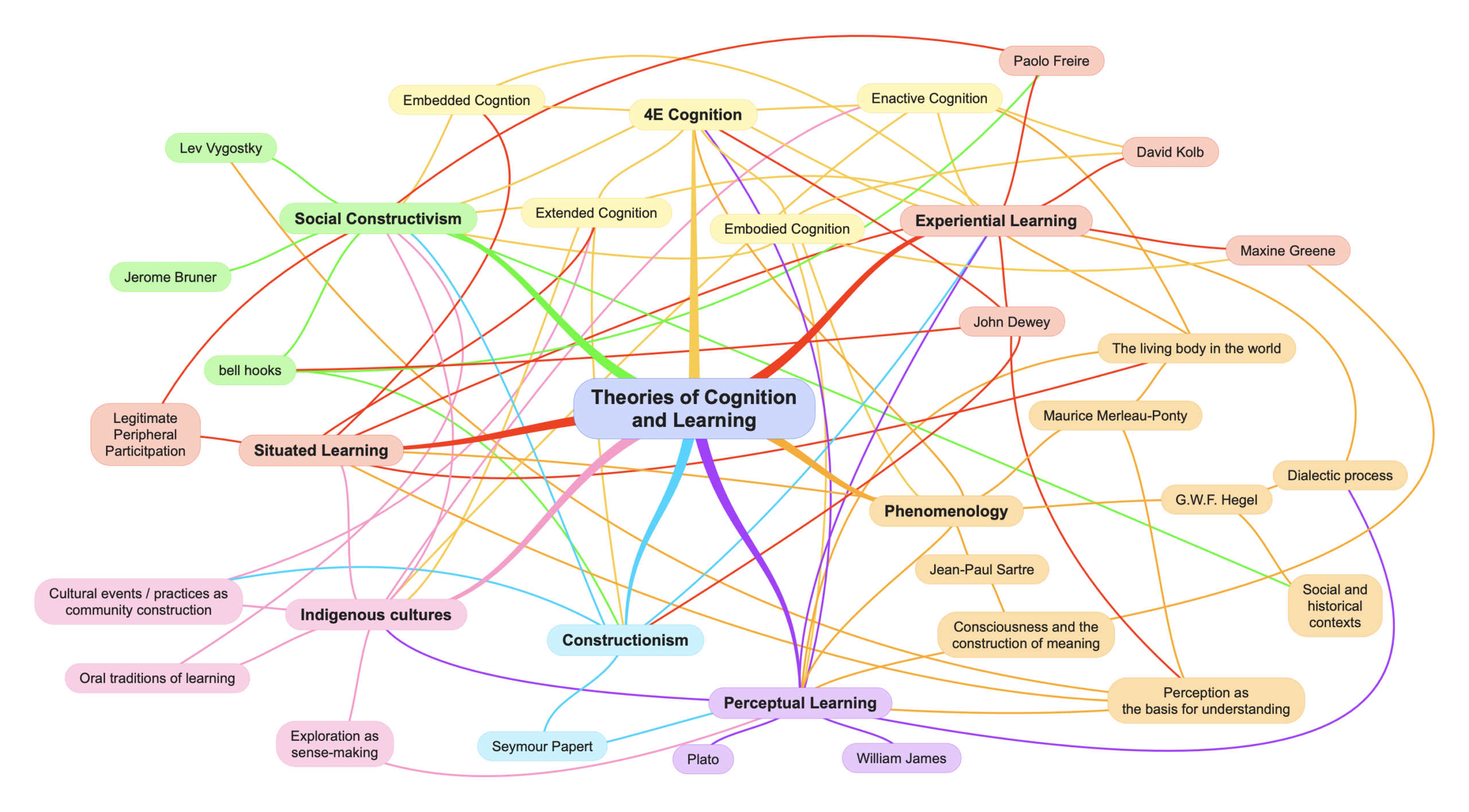
One of the last lectures I did include an illustration showing the mind map of where I was at in my research at that time. It might look confusing to others, but it makes sense to me! Pasted image 20250722174739.png
It’s not intended to be used in any academically rigorous setting, but represents some associations I was making at the time (this was around March of this year). I’ve added some new links and eliminated others since then, but still find this map a useful illustration of what I’ll be researching this fall.

css.php