A philosophical-theoretical perspective on teaching in practice-based film school

This is a very rough draft of an article I’m working on. It still needs a re-write (or two) but as I like working in the open, I thought getting a version online would be in keeping with my intent. Feel free to comment and point out weaknesses and inconsistencies (but be kind!). Praise is also always appreciated, but only if warranted…

Introduction

Most classical film schools harbour an intuitive aversion to the term ‘pedagogy’. It has too much of a ring of kindergarten circle time and school lessons with good behaviour and right and wrong answers, contrasted with the ideal of an artistic process of creation that is essentially irrational, unpredictable, personal and uncompromising.[1]

This quote, by former head of the Danish National Film School Vinca Wiedeman, addresses the challenge of developing a pedagogical framework for a practice-based film school. In fact, the book in which her chapter appears, The 21st Century Film, TV & Media School: Challenges, Clashes, Changes, is illustrative of the issue. There are 18 chapters over 472 pages, and they cover a large variety of approaches to curriculum and teaching—but almost completely overlook educational theory and philosophy.

The only other chapter in that volume to delve into pedagogical theory is the contribution from Nicholas Oughton and Jean-Paul Jarry.[2] Here the authors apply theories of experiential learning as articulated by David Kolb to argue for the continued use of celluloid as the primary medium used in cinematography education.

Similarly, in their influential Educating Film-makers: Past, Present and Future, Duncan Petrie and Rod Stoneman[3] discuss in depth the relationship between film theory and filmmaking practice. But despite analysing different film school models and teaching approaches, they do not discuss film school pedagogy in the light of educational theory and practice. Other publications[4] show similar biases.

These are not failings of the referenced publications. As a body of work, they represent invaluable insights into the inner workings of film schools since VGIK in Moscow opened its doors in 1919. Much of what has been written is in the form of “how to”, and aimed at filmmakers a toolkit to use for transforming their experience into classroom instruction for the next generation, or in the form of surveys, examining the different approaches different film schools have had over the decades.

In my career working at film schools, which spans nearly 30 years and 3 different schools,[5] I have found, however, that the methods, structures, and forms of teaching we do can benefit from being related to existing bodies of pedagogical theory and educational philosophy. Filmmaking is both a highly technical and skilled craft and a complex and collaborative art form, and prospective filmmakers need to learn to balance the two in a way that will make sense for their own visions, careers, and ambitions. In schools like the three I have worked at, and many of the schools the Norwegian Film School compares itself to, the teaching staff are themselves primarily filmmakers who come from outside academics, and seldom identify themselves as primarily teachers or researchers.

In such an environment, with a wealth of experience and expertise, the challenge becomes to enable the teaching staff to have at their disposal the tools to turn their own artistry and tacit knowledge into educational situations for the students. In some cases, this means teacher-filmmakers must combat their own instincts to “make the day” at all costs and provide opportunities for students to test themselves and their own limits, even at the cost of failure.

My approach has been to attempt to answer the questions that are articulated in the Sourcebook of Experiential Education:

  1. “What is learning” and “how do people learn?”
  2. “What is teaching” and “how should teachers teach?”
  3. “What is the purpose of education” and “what is worth knowing and studying?”
  4. “What is the relationship of the schools to society at large and to the world?”[6]

While all 4 of these questions are interconnected, for the purposes of this paper I’ll be concentrating on the first two.

Experience as teacher

In his 1910 work, How We Think, John Dewey writes,

Eagerness for experience, for new and varied contacts, is found where wonder is found. Such curiosity is the only sure guarantee of the acquisition of the primary facts upon which inference must base itself.[7]

For Dewey, and subsequently those of us who work with hands-on, practice-based education, experience, and the motivation to have experience, is the very core of learning and growth. From the very start of Dewey’s career, he emphasized the connection between experience, knowledge, and learning as summarized in the well-known maxim, “Learn to know by doing, and to do by knowing.”[8]

For filmmakers, this seems intuitive. Filmmaking, like any art form that requires physical interaction with the world,[9] is learned through practice. While the approaches to practice may vary from film school to film school—in some cases driven by ideology, in others by available resources—the basic premise holds true. One learns to make film through making film and through practical exercises designed to introduce different aspects of filmmaking, in what Ben Gibson calls the “conservatory” model for filmmaking education.[10] While Gibson primarily writes about conservatory schools outside of universities, there are also schools inside universities—like the Norwegian Film School at the University of Inland Norway—that follow a conservatory model and are “… structured, like working studios, in departments of practice that bring those charged with ‘technical support’ or ‘equipment instruction’ into units with shared cultures of endeavour, led by senior teachers of that specialization.”[11]

While far from the only way of organizing filmmaking education, this conservatory model most closely mimics the professional film industry. This way of structuring education places the emphasis on practical work, and learning to apply the various tools and methods of filmmaking in situations that the teaching staff, who (as Gibson observes) come primarily from the industry, have created based on their own professional experience. And works such as Training the Trainers[12] give filmmakers practical advice on how to construct workshops that will enable filmmakers to turn their own professional experience into workshops for students.

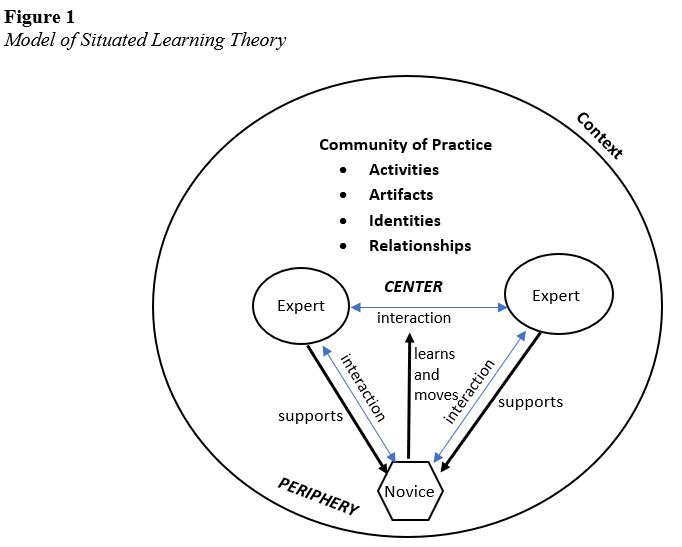
Jean Lave and Etienne Wenger describe this form of education, where experienced practitioners consciously and deliberately introduce less experienced ones to the norms, processes, and methods of the field as a community of practice.[13] In a community of practice, the “…practice of the community creates the potential ‘curriculum’ in the broadest sense—that which may be learned by newcomers with legitimate peripheral access.”[14] Not only does this notion of legitimate peripheral participation in a community of practice emphasize the experiential nature of learning, it also removes it from the realm of individualism and anchors it in a community.[15]

Elkjær also ties this to Dewey’s notion of experience and reflection, and makes the point that, “… Dewey’s notion of experience is both a way of being in the world and experiencing the world, and knowledge is just one part of experience alongside emotion, aesthetics and ethics”,[16] and in this way “connects persons and worlds, action and thinking”.[17] In a film school constructed after the conservatory model, or, more specifically, a “six pack” model[18] like the Norwegian Film School, both the Deweyan idea of experience and the community of practice emphasized by Lave and Wenger are central.

In Democracy and Education, Dewey writes,

We analyze to see just what lies between so as to bind together cause and effect, activity and consequence. This extension of our insight makes foresight more accurate and comprehensive. The action which rests simply upon the trial and error method is at the mercy of circumstances; they may change so that the act performed does not operate in the way it was expected to. But if we know in detail upon what the result depends, we can look to see whether the required conditions are there. The method extends our practical control.[19]

In this section, he highlights the necessary connection between experience as learning and the conscious act of reflection or thinking about the elements of the experience and how they relate to an intended outcome. This, for him, is the difference between the experience and mere activity.[20] His points will resonate with anyone involved in practice-based arts education, especially when he writes,

To “learn from experience” is to make a backward and forward connection between what we do to things and what we enjoy or suffer from things in consequence. Under such conditions, doing becomes a trying; an experiment with the world to find out what it is like; the undergoing becomes instruction—discovery of the connection of things.
Two conclusions important for education follow. (1) Experience is primarily an active-passive affair; it is not primarily cognitive. But (2) the measure of the value of an experience lies in the perception of relationships or continuities to which it leads up. It includes cognition in the degree in which it is cumulative or amounts to something, or has meaning.[21]

This approach is in part illustrated by Donald Schön, when he writes,

When practitioners respond to the indeterminate zones of practice by holding a reflective conversation with the material of their situations, they remake a part of their practice world and thereby reveal the usually tacit processes of worldmaking that underlie all of their practice.[22]

Not only is this descriptive of filmmaking education; it is also prescriptive. The challenge for film educators is to create learning experiences where students are able to make the backward and forward connections Dewey writes about as they engage with the materials and conditions of their practice. As both Dewey and Schön point out, this engagement is reflective. It requires a progression where the challenges and situations that emerge build on the ones that have passed, and at the same time allow the students to consciously engage in controlled experimentation and discovery.

Lave and Wenger touch on this when they write, “[M]astery resides not in the master but in the organization of the community of practice where the master is part”[23] and go on to point out that the teacher/master “is, after all, as much a product of the conventional, centered theory of learning as is the individual learner.”[24] This too is a reminder to both educators and learners that in an education like industry-focussed, practice-based filmmaking, there exists both a large community of practice the educators are part of and this community of practice has norms and traditions the students need to understand—even should they go on to challenge them—as they emerge from their education. Furthermore, the educators are themselves a product of education, training, and apprenticeships leading to their professional careers, and cannot separate themselves from this personal history.

The nature of this challenge is multi-faceted. Not only must film educators use their professional and pedagogic experience to create learning situations that will challenge the students and stimulate experimentation; they must also understand and interpret the “powers, interests, and habits”[25] of their students in order to create learning experiences that challenge and motivate their students where they are at. (I will return to this in the next section.) And finally, they must be aware of their own path into a professional filmmaking practice and make this transparent enough that their students will be able to gain their own experiences and chose their own path.

Scaffolding the emergent professional

Lebert and Vilarroya define scaffolding as,

derived from Vygotsky’s zone of proximal development, which is a learning zone where a more knowledgeable person’s guidance can enhance learning. The term scaffolding was originally used as a metaphor to explain the role that adults can play in joint problem-solving activities with children, and now it is applied to mean temporary support provided for the completion of a task that learners otherwise might not be able to complete.[26]

This definition of scaffolding has its origin in a 1976 article by Wood, Bruner, and Ross which examines the role of tutoring in the development and education of children.[27] And it further refers to Lev Vygotsky’s zone of proximal development, which he developed to describe “the distance between the actual developmental level as determined by independent problem solving and the level of potential development as determined through problem solving under adult guidance or in collaboration with more capable peers.”[28]

While both Vygotsky and Wood, Bruner, and Ross focussed primarily on young children, and how their learning can be facilitated by the conscious application of timely support or tutoring, many have since taken the step illustrated by Lebert and Vilarroya above, and applied the same principles to different age groups—including adults. In their 2010 review of scaffolding literature, van de Pol et.al. highlight scaffolding at many levels, and show that effective scaffolding involves a gradual withdrawal of teachers’ instruction as students gradually gain expertise and independence.[29] They also point out that “for scaffolding to occur, the teacher must apply scaffolding strategies that are clearly contingent (i.e., based upon student responses)”[30] which evokes Dewey’s emphasis on the “powers, interests, and habits” of students (see above). In their review, van de Pol et.al. do point to the correlation between different scaffolding methods and approaches and the ultimate effectiveness of the scaffolding, although they also point out that “studying scaffolding in a rigorous and systematic way appears to be especially complex probably because of the complexity of a dynamic concept such as scaffolding.”[31]

The practice of scaffolding in film schools was first identified by Danish researcher Heidi Philipsen, in her landmark study of the Danish National Film School in the late 1990s / early 2000s.[32] Philipsen identifies three categories of scaffolding from her study:

  1. Institutional scaffolding
  2. Team scaffolding
  3. Individual scaffolding[33]

She discusses limits her discussion of scaffolding to the constraints placed on the students as a method of stimulating creativity, and elaborates; “creativity is often defined as a talent to be able to think “outside the box.” I would like to stress that in order to be able to think outside the box, it actually helps to have a metaphorical box (constraints).”[34] A full discussion of creativity in filmmaking education is outside the scope of this article, but the three categories of scaffolding nonetheless warrant closer examination.

In institutional scaffolding, Philipsen specifically refers to the rules that the school sets for a particular film exercise. She uses examples like “the natural story”,[35] time constraints, conditions using actors, camera, thematic constraints, etc.[36] She quotes one of her interview subjects, a screenwriter, who argues that “the use of constraints in a writing process actually produces a feeling of relief because he has been partly relieved of the responsibility, which apparently frees up energy enabling him to use his imagination in new ways.”[37]

Team scaffolding, for Philipsen, refers to the support and learning that happens between students, both in a cohort as a whole and in the various constellations they find themselves in.[38] One might also connect it with one of the features of a community of practice, where Lave and Wenger observe that often “apprentices learn mostly in relation with other apprentices. There is anecdotal evidence that where the circulation of knowledge between peers and near-peers is possible, it spreads exceedingly rapidly and effectively.”[39] This also references Vygotsky, who “suggested that through the process of working with others, learners create an environment of shared meanings with peers.”[40] My observations of intra-student dynamics at the Norwegian Film School support these claims, even extending to alumni welcoming new graduates into the industry.

Philipsens third category of scaffolding, individual scaffolding, is perhaps more problematic. She identifies this as occuring “when filmmakers define their own rules for a film process and product.”[41] The fact that individual filmmakers can—and do—impose their own rules and constraints on their own artistic processes and creative work, however, hardly seems to meet an approach to scaffolding “construed as support given by a teacher to a student when performing a task that the student might otherwise not be able to accomplish.”[42] As van de Pol et.al. observe, while definitions of scaffolding can vary, a relationship between teacher (or more experienced peer) and student / learner is common for all,[43] starting with scaffolding as a method for supporting Vygotskys zone of proximal development.

Without getting in to a broad discussion of creativity, it is worth emphasising that one purpose of educational scaffolding in filmmaking education is to foster the students’ development of their creativity and imagination. If one accepts that “everything the imagination creates is always based on elements taken from reality, from a person’s previous experience”,[44] and that “imagination draws on and co-operates with cognitive processes that arise from and span our physical and sociocultural resources and environments”[45] then creative education can be based on “design principles that could guide the crafting of creative experiences in education and beyond, e.g., repositioning and perspective taking, sustaining uncertainty, making the familiar unfamiliar, tinkering and embodied experimentation, use of analogies and metaphors, “as if” and “what if” thinking, pretend play, and so on.”[46] I will return to this in the conclusion.

4E and the phenomenological understanding of cognition

In his 2013 book Making, anthropologist Tim Ingold writes, “the drawing is not the visible shadow of a mental event; it is a process of of thinking, not the projection of a thought.”[47] In this, he also refers to the “active externalism” as developed by Andy Clark and David Chalmers in their 1998 essay, “The Extended Mind”. Active externalism, they claim, means that,

the relevant external features are active, playing a crucial role in the here-and-now. Because they are coupled with the human organism, they have a direct impact on the organism and on its behaviour. In these cases, the relevant parts of the world are in the loop, not dangling at the other end of a long causal chain.[48]

Lebert and Vilarroya further elaborate on this,

the extended-mind approach proposes that cognition is a process that is distributed across the individual and their environment, including objects, tools, and other individuals. By focusing on the ways in which external resources and environmental factors contribute to a concrete experience, the extended-mind feature seeks to provide a more expansive and inclusive view of a concrete experience, one that recognizes the complex interplay between the individual, their environment, and their tools and resources.[49]

This understanding of cognition is also crucial for educators, as it highlights that students do not only learn through rational understanding, logical thinking, and application of knowledge. Rather, learning is an holistic activity that acknowledges the students place in an environment that includes their bodies, the physical surroundings, the tools they use, and their classmates and peers.

The extended mind theory is part of a broader movement in cognitive—and thus also educational—sciences that collect under the term “4E cognition”.[50] 4E refers to cognition being extended, embodied, embedded, and enactive, and collectively they are framed as a response and in opposition to a Cartesian mind-body dualism or separation.[51] In their summary of the “Philosophical and Psychological Influences on Embodied Cognition”, Macrine and Fugate cite a number of influences, including John Dewey’s suggestion “that higher-order cognitive functions are adaptations generated by interactions with the world.”[52] They also emphasise the connection to Phenomenology, specifically to Merleau-Ponty who “maintained that thinking was a fully embodied event: people perceive the world first and foremost through their bodies. [Merleau-Ponty] argued that cognition cannot be understood without the body’s engagement with the world.”[53] Finally, they draw on James Gibson’s ‘ecological theory’ which claimed “argued that perception was direct and the environment meaningful […], Gibson suggested that there was no mind between perception and action, and that action was based in the body, supported through evolution and the environment.”[54]

In making these connections, Macrine and Fugate draw on the book that introduced the concept of embodiment to cognitive theory, The Embodied Mind from 1991. Here the authors write,

We hold with Merleau-Ponty that Western scientific culture requires that we see our bodies both as physical structures and as lived, experiential structures—in short, as both “outer” and “inner”, biological and phenomenological. These two sides of embodiment are obviously not opposed. Instead, we continuously circulate back and forth between them. […] For Merleau-Ponty, as for us, embodiment has this double sense: it encompasses both the body as a lived, experiential structure and the body as the context or milieu of cognitive mechanisms.[55]

This emphasis on the ‘body as a lived, experiential structure’ will resonate with filmmakers and most artistic practitioners. Ingold picks up on this when he observes,

In the act of making, the artisan couples his own movements and gestures—indeed his very life—with the becoming of his materials, joining with and following the forces and flows that bring his work to fruition. It is the artisan’s desire to see what the material can do, by contrast to the scientist’s desire to know what it is, that […] enables the former to discern a life in the material and thus, ultimately, to ‘collaborate more productively’ with it.[56]

Miranda Anderson connects this directly to the arts and artistic practice, by examining the connections between the artist, the body, and materials when describing a work by Nikolaus Gansterer from 2017:

His hands forming and reforming of physical materials, linguistic concepts and diagrammatic symbols, all amidst the random interruptions of living creatures, show the fluidly diverse concert of conceptual and diagrammatic, and embodied and environmental processes in action, and explore the interplay of structured patterns and chance in thinking.[57]

The challenge for education in any practice-based art form is that the students often do not yet have the experience to engage with the materials of their art in an embodied, extended way. Filmmaking, particularly, is (most often) a highly technical art form that combines complex and advanced technologies with logistical puzzles, challenging teamwork and collaboration, restrictions involving time, budget, etc., and the gap between the imagined result and the resources available to achieve it. Filmmakers-turned-educators are faced with the challenge of creating learning situations for students where they will gain the experience and expertise necessary to work in professional productions after graduation. This involves acknowledging that, “Deep and meaningful learning indeed involves the integration of cognitive processes, social interactions, and affective dimensions, fostering active engagement and personal relevance in knowledge acquisition.”[58]

Implications for filmmaking education

In this article, I have attempted to highlight some of the key elements of Dewey’s notion of experiential learning, illuminate some aspects of scaffolding in education, and introduce the concept of 4E cognition as it relates to education. Each of these is, in isolation, worthy of a more in-depth analysis. At this point, it seems most relevant to have lifted them into the consciousness of film schools, and I will now make som concluding observations on how filmmaker-educators can use some of the concepts in a discourse around their own teaching practice.

A core issue for film schools is that we are teaching both a highly technical craft and creativity, and we are doing so in a setting where the individual cannot work in isolation but is part of an extended cognitive reality. Bruce Sheridan sums it up as consisting of

three key points: 1) collaboration is the default process by which individual creative vision is realized in screen arts, 2) collaboration will be central to the work our students undertake beyond graduation, and 3) discrete individual contributions to screen art are rendered porous through, and ineluctably modified by, dynamic and contingent interactions amongst individuals and creative sub-groups, such as teams dedicated to writing, design, cinematography, editing, sound etc..[59]

Further to this, “experiences are not just based on abstract, decontextualized information but are also deeply influenced by the specific social, cultural, and environmental contexts in which they occur”[60] and it necessitates an awareness of these contexts by planners and educators at film schools. The key to a successful practice-based arts education like a film school is to create opportunities for the students to have concrete learning experiences. Here, a “concrete experience refers to an embodied, embedded, extended, and enactive engagement of an individual with their environment”,[61] where the environment includes the physical surroundings, the analogue and digital tools used, the constraints placed by the institution, other students and collaborators, as well as the student’s own prior knowledge and experiences, goals and ambitions, fears and uncertainties, and emotional state.

Dewey highlights the social, extended and enactive aspects of this when he writes,

not only does social life demand teaching and learning for its own permanence, but the very process of living together educates. It enlarges and enlightens experience; it stimulates and enriches imagination; it creates responsibility for accuracy and vividness of statement and thought.[62]

This is also well-summarised by Elkjær,

Experience occurs when habitual action and thinking are disturbed and calls for inquiry. Inquiry begins with emotion, but may develop into new experience and knowledge when language (ideas, concepts and theories) is used to define and resolve the disruption. This process may be supported by education and teaching. The process of inquiry concerns the consequences of different ways to define and resolve uncertainties. Inquiry is an experimental process in which ideas, hypotheses, concepts and theories are used instrumentally as ‘tools to think with’, and are as such a playful, creative and potentially innovative process. The result of inquiry, the new experience or ‘warranted assertibilities’ (knowledge), is therefore open-ended (fallible) and can be re-interpreted in light of new experiences.[63]

And so, to return to the questions in the introduction: 1. How do people learn? has been the focus of this article. There is no single answer, but the key is that we learn through the conscious, reflective interpretation of embodied, extended, enactive, and embedded experiences. We make films, we find ways to collaborate with others in achieving a common vision, we reflect on the relationship between the film we wanted to make, the film we ended up with, and the process and decisions that led us there, and, at the Norwegian Film School at least, we watch the films and reflect on these things together so the experiences of one can be shared and understood by all.

And 2. How do we teach? As best we can to create a positive and scaffolded environment for students to have and reflect on the experiences they have while in our care.

Endnotes


  1. Wiedeman, Vinca. ‘Educating for Innovation: Ten Tips for (Future) Film-School Heads’. The 21st Century Film, TV & Media School: Challenges, Clashes, Changes, edited by Maria-Dora Mourão et al., CILECT – The International Association of Film and Television Schools, 2016, pp. 95-96.↩︎
  2. Oughton, Nicholas, and Jean-Paul Jarry. ‘Learning Cinematography at Film School: Old Ways, New Directions’. The 21st Century Film, TV & Media School: Challenges, Clashes, Changes, edited by Maria-Dora Mourão et al., CILECT – The International Association of Film and Television Schools, 2016, pp. 280–315. 21st Century Film, TV & Media School 1.↩︎
  3. Petrie, Duncan, and Rod Stoneman. Educating Film-Makers: Past, Present and Future. Intellect Ltd, 2014, https://www.intellectbooks.com/educating-film-makers.↩︎
  4. See, for example, the newsletter archive kept by CILECT (The International Association of Cinema, Audiovisual and Media Schools) at https://cilect.org/archives/newsletter/ and the CILECT-supported publication: Ross, Dick. Training the Trainers. The Norwegian Film School, 2005.↩︎
  5. I have worked at Vancouver Film School (1997-2001), the Canadian Film Centre (2002-2006), and the Norwegian Film School (2009 – present day).↩︎
  6. Smith, Thomas E., Clifford E. Knapp, ´Part I: Philosophers and Educational Theorists´. In Smith, Thomas E and Clifford E. Knapp (eds.), Sourcebook of Experiential Education. Routledge, 2011. p. 13.↩︎
  7. Dewey, John. How We Think. D.C. Heath & Co., 1910. Reprint, Anson Street Press, 2025. p. 24.↩︎
  8. McLellan, J. A., and John Dewey. Applied Psychology: An Introduction to the Principles and Practice of Education. Archive.org digital facsimile. Educational Publishing Company, 1889. https://archive.org/details/appliedpsycholog00mclerich/. p. 182. In fact, the maxim is so central to McLellan and Dewey that they include it on the title page.↩︎
  9. Whether or not this would also hold true for AI filmmaking is a subject for a different discussion. For the context of this paper, I am talking about traditional filmmaking with physical cameras, sound recording equipment, lights, sets, actors, crew, etc.↩︎
  10. Gibson, Ben. ‘What Is “Conservatory Training” for Film and Television?’ In The 21st Century Film, TV & Media School: Challenges, Clashes, Changes, edited by Maria-Dora Mourão, Stanislav Semerdjiev, Cecília Mello, and Alan Taylor. 21st Century Film, TV & Media School Project 1. CILECT – The International Association of Film and Television Schools, 2016.↩︎
  11. Ibid.↩︎
  12. Ross, Dick. Training the Trainers. The Norwegian Film School, 2005.↩︎
  13. Lave, Jean, and Etienne Wenger. Situated Learning: Legitimate Peripheral Participation. Cambridge University Press, 1991. See especially chapter 4.↩︎
  14. Ibid. p. 93.↩︎
  15. See Elkjær, Bente. ‘Pragmatism: Learning as Creative Imagination’. In Contemporary Theories of Learning: Learning Theorists … in Their Own Words, 2nd edn, edited by Knud Illeris. Routledge, 2018. p. 67↩︎
  16. Ibid. p. 70.↩︎
  17. Ibid. p. 71.↩︎
  18. The six pack model grew out of a desire to create a film school structure where the different heads of department are empowered to be artists and storytellers in their own right, rather than playing a supporting role for an auteur director. At the Norwegian Film School, the six pack consisted 6 specializations—screenwriting, directing, producing, cinematography, editing, and sound (subsequently expanded to include production design)—with 6 students in each. This means that whenever the students make a film exercise, the team will consist of 1 student from each specialization. In between the film exercises, the students of each specialization receive discipline-specific education designed to increase their skill and artistry.↩︎
  19. Dewey, John. Democracy and Education: An Introduction to the Philosophy of Education. The MacMillan Company, 1916. E-Book. Standard Ebooks, 2023. https://standardebooks.org/ebooks/john-dewey/democracy-and-education. Chpt. 11, “Experience and Thinking”.↩︎
  20. Ibid.↩︎
  21. Ibid. Emphasis in original.↩︎
  22. Schön, Donald A. Educating the Reflective Practitioner: Toward a New Design for Teaching and Learning in the Professions. The Josey-Bass Higher Education Series. Jossey-Bass, 1987. p. 36.↩︎
  23. Lave and Wenger, 1991. p 94.↩︎
  24. Ibid, ibid.↩︎
  25. Dewey, John. ‘My Pedagogic Creed’. School Journal 54 (January 1897). 2009 Digital edition released under a Creative Commons Public Domain Declaration on archive.org.↩︎
  26. Lebert, Angélique, and Óscar Vilarroya. ‘The Links between Experiential Learning and 4E Cognition’. Annals of the New York Academy of Sciences 1541, no. 1 (2024): 37–52. https://doi.org/10.1111/nyas.15238. p. 44.↩︎
  27. Wood, David, Jerome Bruner, and Gail Ross. ‘The Role of Tutoring in Problem Solving’. Journal of Child Psychology and Psychiatry 17 (1976): 89–100. https://doi.org/10.1111/j.1469-7610.1976.tb00381.x.↩︎
  28. Vygotsky, L. S. Mind in Society: Development of Higher Psychological Processes. Edited by Michael Cole, Vera John-Steiner, Sylvia Scribner, and Ellen Souberman. Harvard University Press, 1978. http://ebookcentral.proquest.com/lib/hilhmr-ebooks/detail.action?docID=3301299. p. 86.↩︎
  29. van de Pol, Janneke, Monique Volman, and Jos Beishuizen. ‘Scaffolding in Teacher—Student Interaction: A Decade of Research’. Educational Psychology Review 22, no. 3 (2010): 271–96. p. 275.↩︎
  30. Ibid. ibid.↩︎
  31. Ibid. p. 282.↩︎
  32. Philipsen, Heidi. ‘Dansk films nye bølge: Afsæt og aftryk fra Den Danske Filmskole’. Syddansk Universitet (SDU), 2004. https://portal.findresearcher.sdu.dk/da/publications/dansk-films-nye-b%C3%B8lge-afs%C3%A6t-og-aftryk-fra-den-danske-filmskole/.↩︎
  33. Philipsen, Heidi. ‘Constraints in Film Making Processes Offer an Exercise to the Imagination – A Pleading Based on Experiences from Denmark’. Seminar.Net 5, no. 1 (2009). https://doi.org/10.7577/seminar.2470.↩︎
  34. Ibid, p. 3.↩︎
  35. Ibid. p. 5↩︎
  36. Ibid. pp. 4-5↩︎
  37. Ibid. p. 5↩︎
  38. Ibid. p. 6↩︎
  39. Lave and Wenger, 1991. p. 93.↩︎
  40. Lebert and Vilarroya, 2024. p. 38.↩︎
  41. Philipsen, 2009. p. 3.↩︎
  42. van de Pol et.al., 2010. p. 274.↩︎
  43. Ibid.↩︎
  44. Vygotsky, Lev Semenovich. ‘Imagination and Creativity in Childhood’. Translated by M. E. Sharpe. Journal of Russian & East European Psychology 42, no. 1 (2004): 7–97. https://doi.org/10.1080/10610405.2004.11059210. p. 13.↩︎
  45. Anderson, Miranda. ‘4E Cognition and the Mind-Expanding Arts’. European Journal of Philosophy in Arts Education 7, no. 02 (2024): 7–64. https://doi.org/10.5281/zenodo.7451462. p. 51↩︎
  46. Glăveanu, Vlad P., and Ronald A. Beghetto. ‘Creative Experience: A Non-Standard Definition of Creativity’. Creativity Research Journal 33, no. 2 (2021): 75–80. https://doi.org/10.1080/10400419.2020.1827606. p. 79↩︎
  47. Ingold, Tim. Making: Anthropology, Archaeology, Art and Architecture. Routledge, 2013. https://doi.org/10.4324/9780203559055. p. 128.↩︎
  48. Clark, Andy, and David Chalmers. ‘The Extended Mind’. Analysis 58, no. 1 (1998): 7–19. p. 9.↩︎
  49. Lebert and Vilarroya, 2024. p. 46.↩︎
  50. A good introduction to the breadth and scope of 4E can be found in Newen, Albert, Shaun Gallagher, and Leon De Bruin. ‘4E Cognition: Historical Roots, Key Concepts, and Central Issues’. In The Oxford Handbook of 4E Cognition, edited by Albert Newen, Leon De Bruin, and Shaun Gallagher. Oxford University Press, 2018. https://doi.org/10.1093/oxfordhb/9780198735410.013.1.↩︎
  51. Ibid. This claim can be found in all the literature I have come across on 4E cognition.↩︎
  52. Macrine, Sheila L., and Jennifer M. B. Fugate. ‘Embodied Cognition and Its Educational Significance’. In Movement Matters: How Embodied Cognition Informs Teaching and Learning, edited by Sheila L. Macrine and Jennifer M. B. Fugate. The MIT Press, 2022. https://direct.mit.edu/books/oa-edited-volume/5306/Movement-MattersHow-Embodied-Cognition-Informs. p. 16↩︎
  53. Ibid. ibid.↩︎
  54. Ibid. ibid.↩︎
  55. Varela, Francisco J., Evan Thompson, and Eleanor Rosch. The Embodied Mind: Cognitive Science and Human Experience. 1991. Revised edition. The MIT Press, 2017. https://doi.org/10.7551/mitpress/9780262529365.001.0001. pp. lxi-lxii.↩︎
  56. Ingold, 2013. p. 31.↩︎
  57. Anderson, 2024. p. 18.↩︎
  58. Lebert and Vilarroya, 2024. p. 43.↩︎
  59. Sheridan, Bruce. ‘Creativity, Physical Space, and Teaching Screen Directors’. In The 21st Century Film, TV & Media School: Directing the Future, edited by Maria-Dora Mourão, Stanislav Semerdjiev, Cecília Mello, and Alan Taylor. 21st Century Film, TV & Media School Project 2. CILECT – The International Association of Film and Television Schools, 2019. p. 203.↩︎
  60. Lebert and Vilarroya, 2024. p. 46.↩︎
  61. Ibid. ibid.↩︎
  62. Dewey, 1916 / 2023, Chpt. 2 “Education as a Social Function”.↩︎
  63. Elkjær, 2018. p. 79.↩︎

Review of my research into a philosophy of film and media arts pedagogy so far

These are notes from a talk i gave at a one-day conference at the University of Inland Norway, “INN-puf” (pedagogisk utvikling og filosofi / pedagogical development and philosophy). The audience was primarily teaching faculty from the departments of film, TV, and games, and I tried to pitch it so it would be accessible to practitioners who do not necessarily have a background in either pedagogy or philosophy.

These notes will form the core of an article I am writing, and hope to have done before the summer. This talk was loosely chronological; I am not sure if I will keep that in the artcle, structure it another way.

Film school pedagogy

  • My research has showed there is material on «how to»—for example, Training the Trainers from 2005 (Dick Ross, published by the Norwegian Film School & CILECT).
  • There is a great deal of material written about the content of what is taught to the students but very little material that related film school teaching to educational theory in general.
  • My intro to film school pedagogy: Danish researcher Heidi Philipsen conducted pedagogy lectures for staff at NFS in 2010.
  • Her study of the Danish Film School of the late 1990s and early 2000s revealed the key role of scaffolding and constraints in their teaching model.

Areas of investigation

  • Vygotsky and the Zone of proximal development and Dewey’s focus on the connection between experience, reflection, and learning.
  • 4E Cognition: the embodied, extended, and enactive mind.
  • Phenomenology and perceptual learning give us a better understanding our sensory interactions with the world.
  • Situated learning examines how learners are integrated into professional fellowships.
  • The nature of imagination, emotion, and creativity. And the role of art in human evolution…
  • From tacit to explicit…micro-phenomenology, focussing and deep analysis of the particular, specific experience.

Experiential learning–Dewey

  • John Dewey (1859-1952) was an American philosopher and psychologist, and the originator of modern theories of experiential learning.
  • For Dewey, experience was essential to understanding ourselves and to how philosophy is done. Experience is the result of us engaging with the world, of living.

Give the pupils something to do, not something to learn; and the doing is of such a nature as to demand thinking; learning naturally results. (Democracy and Education, 1916)

  • Believed that we learn “…to know by doing, and to do by knowing.” (An Introduction to the Principles and Practice of Education, 1889)
  • Many of his ideas continue to resonate in contemporary theories of enactive cognition.

As long as our activity glides smoothly along from one thing to another, or as long as we permit our imagination to entertain fancies at pleasure, there is no call for reflection. Difficulty or obstruction in the way of reaching a belief brings us, however, to a pause. In the suspense of uncertainty, we metaphorically climb a tree; we try to find some standpoint from which we may survey additional facts and, getting a more commanding view of the situation, may decide how the facts stand related to one another. (How We Think, 1910)

Experiential learning

  • David Kolb (1939- ) — see Kolbs learning cycle. A useful model, but also limited in the way it separates thinking / reflecting from action and experience, rather than integrating them.
  • Donald Schön (1939-1997) wrote extensively about reflection-in-action: the ability to reflect while in a situation, showing experiential learning as a continuous process—what can be colloquially called “thinking on our feet”.

Pedagogy of the Oppressed

  • Paolo Freire (1921-1997). Brazilian educator who conceived of education as a process of liberation. For education to function as a liberating force, there must be a democratic relationship between the students and teacher.
  • Very critical of the “banking model of education”, where teachers “deposit” knowledge in the student, that the student will utilise later. This perpetuates a rigid power dynamic, with the teacher cast as the infallible expert.

For apart from inquiry, apart from the praxis, individuals cannot be truly human. Knowledge emerges only through invention and re-invention, through the restless, impatient, continuing, hopeful inquiry human beings pursue in the world, with the world, and with each other. (Pedagogy of the Oppressed, 1970)

Engaged pedagogy

  • bell hooks (Gloria Watkins, 1952-2021) was an American writer, feminist, activist, and educator. Inspired by Freire and education as a tool for liberation.

To enter classroom settings in colleges and universities with the will to share the desire to encourage excitement, was to transgress. Not only did it require movement beyond accepted boundaries, but excitement could not be generated without a full recognition of the fact that there could never be an absolute set agenda governing teaching practices. Agendas had to be flexible, had to allow for spontaneous shifts in direction. Students had to be seen in their particularity as individuals […] and interacted with according to their needs. (Teaching to Transgress, 1994)

Experiential learning and art

  • Maxine Greene (1917-2014) was a pioneer for women in the field of philosophy of education.
  • Wrote about the connection between artistic practice and experiential learning; focussed on the arts as a method for us to find our own voice in society.
  • Pioneered the concept, “wide-awakeness”.

Informed encounters with works of art are always new beginnings. New perspectives open in experience; new possibilities of seeing, hearing, feeling are revealed. When individuals are released to be personally present to paintings or poems or sonatas, when they learn how to let their energies go out to the works in an enlarging perception and a focusing of attention, the fields over which their imaginations can play deepen, diversify, and expand. (“The Spaces of Aesthetic Education”, 1986)

Scaffolding – Vygotsky

  • Lev Vygotsky (1896-1934) was a Soviet psychologist who worked extensively with children’s development.
  • Fell out of favour with Stalin, and his works were suppressed until 1956; not well known in the west until the 1970s.
  • Did extensive studies of how we learn language.
  • Best known for the “Zone of proximal development” (ZPD).
  • ZPD emphasises the social aspect of learning.
  • The term “scaffolding” was coined by Jerome Bruner, David Wood, and Gail Ross in 1976 as a metaphor for what educators do to enable the ZPD.
  • A scaffold is a temporary structure that is adjusted and adapted to serve the needs of the construction—analogous to what educators do to support the students appropriate to their skill level.
  • 5 criteria for effective scaffolding:
    • Student ownership of the learning event
    • Appropriateness of the instructional task
    • A structured learning environment
    • Shared responsibility
    • Transfer of control
    • (Applebee, A. N. 1986. ‘Problems in process approaches: Towards a reconceptualization of process instruction’)

Phenomenology

  • Examines our perceptions and how they inform our experience of and interaction with the world we inhabit.
  • Maurice Merleau-Ponty (1908-61), wrote, “Perception is not a science of the world, it is not even an act, a deliberate taking up of a position; it is the background from which all acts stand out, and is presupposed by them.” (Phenomenology of Perception, 1945/1962)
  • Wrote about the overlapping and intertwining between the artist and the world and the artwork as the representation of this relationship.

Cognitive science

  • 4E Cognition: Embodied, Enactive, Embedded, Extended—emerged from psychology and philosophy in the 1990s as a response to computational theories of mind.
    • Embodied cognition is the claim that cognition is routinely shaped in fundamental ways by bodily forms, movements, states and processes.
    • Enactivism claims that cognition is enacted (unfolds) through looping sensorimotor interactions between the agent and its environment, implying both a close relationship between perception and action, and that there is continuity between the properties of life and of mind. (ref. Dewey)
    • Embedded cognition is the claim that external factors (such as resources or environments) act as noncognitive aids to an internal thinking system located in the brain; so, while the external factors enable cognition, they are not themselves counted as cognitive.
    • Extended cognition instead argues that cognition can involve a coupled system of brain, bodily and external factors: all of which count as cognitive.
    • (Definitions from “4E Cognition and the Mind-Expanding Arts”, Miranda Anderson, 2022)
  • 4E cognition gained prominence after the publication of The Embodied mind (1991 / 2017) (Francisco J. Varela, Evan Thompson, and Eleanor Rosch).
  • Further developed by Andy Clark and David Chalmers in their article “The Extended Mind” (1998), which introduced the concept of the tools we use being part of our cognition as well.
  • The notion of “embodiment” comes naturally for the arts. Using 4E cognition as a framework for understanding how to teach artists has particularly been prevalent in music teaching.

[We] are thoroughly permeated by emotion and by readiness for action. Emotion, cognition, and preparation for action here form a single whole, self-organized around precision weighted, prediction-error minimizing interactions that span cortical and sub-cortical circuits. These interactions couple the active body to the predictive brain. (Miller, Mark and Andy Clark, «Happily entangled: prediction, emotion, and the embodied mind», 2018)

4E and the arts

[…] embracing enactivism in the idea that embodiment and culture are integrated to form a whole, [we] propose to regard aesthetic experience as a “double attunement” toward the objects: immediate and affective, re-organisational and reflective at once. [W]ithin a 4E perspective “[b]ody, brain and environment form one system in which aesthetic experience can be simultaneously and variously characterized as sensory-motor, affective, cultural, and cognitive” (Batisti, Filippo & Elena Valeri, “Embodiment and Aesthetics: Cognition Going Wider”, 2020)

  • Anthropologist Tim Ingold invokes Clark and Chalmers’ extended mind theory and describes making (sketching, for example) as thinking, not just the product of thinking.
  • Shows how art and creativity are an essential part of humanity throughout history and across cultures.

Perception

  • 3rd Century Greek philosopher Diogenes Laertius wrote about how a lay person will see something different than a sculptor will when looking at a statue.
  • Perceptual Learning (developed by psychologist Eleanor J. Gibson, 1910-2002) describes long-term changes in our perception—our senses—as a result of practice or experience.
  • Classic example: the sommelier, who has trained their sense of taste to perceive details of grapes, terroir, vintage, etc. that the ordinary wine-loving amateur cannot sense. These changes in perception are significant, permanent, and the result of practice.

Micro-phenomenology

  • Micro-phenomenology builds on the phenomenological idea of the relationship of the consciousness, the body, and the world and applies it to a particular experience.

The specificity of the micro-phenomenological interview method is that it focuses on a singular experience. […] This act enables us to leave our “natural attitude” of absorption into the content of experience (the “what”), to reorient our attention towards the way this experience appears to us (the “how”), and notably towards the usually prereflective micro-acts through which this appearance is constituted. (Claire Petitmengin, ‘Discovering the Structures of Lived Experience’. Phenomenology and the Cognitive Sciences, vol. 18, no. 4, Sept. 2019)

  • Can be used as a technique for helping the individual understand what happens in the moment of intuition, inspiration, or creation and thus learn to both anticipate the moment as well as more reliably create the conditions for these moments in the future.

Embodied critical thinking

  • Arises both from micro-phenomenology and from the American philosopher and psychologist Eugene Gendlin, who wrote about “focussing” and the “felt sense”.

Focusing is an experiential, embodied and evidence-based practice of self-reflection. During Focusing , your attention will open up to multiple layers and aspects of living.  It’s called Focusing because it requires a special kind of focus to notice what is not yet clear, fuzzy and vague, implicit in how you interact with your situations and environment.  This fuzzy dimension of experience is called the “felt sense.”  Focusing on the felt sense allows an in-depth clarification process to happen. (‘What Is Focusing?’ The International Focusing Institute, https://focusing.org/felt-sense/what-focusing)

  • There is currently an international research project on embodied critical thinking coordinated by the University of Iceland, involving several European institutions: Training embodied critical thinking and understanding. (https://www.trainingect.com/)

Draft overview: Dewey, Vygotsky, Micro-phenomenology

‘Film needs theory’ said Alan Parker, ‘like it needs a scratch on the negative.’[1]

The origin of this project is my experience with the training and education provided for filmmakers who become film educators within the confines of a formal educational programme. And the Alan Parker quote above is representative of filmmakers (no, not all filmmakers…) both in their artistic and educational practice. And no, this is not a case of anti-intellectualism but rather a distrust of any theory[2] that might distract filmmakers from focussing on both their craft and their intuition.

Perhaps as a result of this, or perhaps because of other traditions, filmmakers tend not to look for the theoretical basis for their teaching, but are more preoccupied with learning “how to”. Nowhere is this more clear, perhaps, than in the groundbreaking guide Training the Trainers (2005)[3], which, in a series of 10 booklets and accompanying DVD, gives filmmakers a step-by-step guide on how to use their own practice, understand students, structure workshops, assignments, and grading, and so on — all very practical and useful. And all presented without reference to extant educational theory and philosophy.

Around the same time as Training the Trainers was being completed, a Danish researcher was completing her PhD thesis, which analysed the Danish Film School of the late 1990s and early 2000s.[4] In her research, Heidi Philipsen studied teaching methods at the Danish Film School in the late90, also conducting interviews with students, teachers, and colleagues from affiliated film schools. Presenting her work at a conference in 2008, Philipsen states, “My research has illustrated, that the terms ’scaffolding’ (Wood, Bruner & Ross, 1976) and ’the zone of proximal development’ (Vygotsky, 1935) are indeed very useful in explaining for instance the methods used at the National Film School in Denmark.”[5]

In her thesis and other writings, Philipsen elaborates on the role and meaning of educational scaffolding DFS with reference to both Wood et.al. and to Vygotsky, and shows how the teaching methods at the school led to the emergence of Dogma ’95, the radical renewal of Danish film of the 1990s. In the process, she highlights the importance of constraints for creativity[6] and goes on to argue that “…to be able to think out of the box (= to be creative) it helps you to have a box.”[7]

Philipsen’s work has been crucial for understanding the mechanisms of how scaffolding can support the development of unique artistic talents in a film school setting. But understanding the role of scaffolding and the function of the zone of proximal development are not sufficient for understanding film school pedagogy. In the following paragraphs, I’ll try to show how a variety of educational theories and philosophies can combine to provide a more complete picture of how film education works.

While many philosophers through the ages have engaged with education and attempted to explain how children and adults learn, for my purposes here the story begins with John Dewey and Lev Vygotsky.

Dewey and experience

Dewey developed formative theories of education and the role of education in society, and showed the close relationship between knowledge, reflection, and experience. Already in 1889, Dewey had formulated one of the idioms he became best known for: “Learn to do by knowing and to know by doing”[8] In his later work, How We Think, (first published in 1910; revised and re-released in 1933) he specified, “We do not learn from experience. We learn from reflecting on experience.”[9]

While Dewey was not the first philosopher to examine the importance of experience, and many have built on his work since[10], he remains the key figure in contemporary educational theory for understanding this. There is also no end of material written that references Dewey and his influence on education.

For the purposes of a practice-based film school education, the key is the combination of reflection and experience. Dewey examines this closer in his Art As Experience, where he observes, “The artist does his thinking in the very qualitative media he works in, and the terms lie so dose to the object that he is producing that they merge directly into it.”[11] This observation is echoed by Tim Ingold in his description of sketching and drawing in Making, where he writes, “… the drawing is not the visible shadow of a mental event; it is a process of thinking, not the projection of a thought.”[12] (emphasis in original)

This means that in the context of practice-based fine arts education, the emphasis is just as much on developing reflection during experience as it is on developing reflection on experience. The latter half of that formulation—reflecting on experience—is a staple of education everywhere. Teachers give an assignment of some form, and when it is complete, lead an assessment of this assignment. Ideally, this assessment will include a great deal of emphasis on the process—why did this result end up as it did, and what steps and decisions did you, the student, undertake that led to this result. Properly done, the realizations gained through this sort of assessment will enable the student to make choices next time that can lead to a better result.

Reflection in or during experience is what Donald Schön called “reflection in action”,[13] where the emphasis is on the ability of the practitioner to reflect while in the middle of experiencing, and use their previously acquired knowledge and expertise to make decisions and adjust course while in activity. This is something we all do, every day, but that is absolutely essential for artists and professionals who are constantly facing the unexpected where they have to rely on their best judgement in order to achieve a desired goal.

And back to scaffolding

The question of how to teach students to reflect while in activity, and to use their previous experience and developed skills to make qualified decisions on how to handle a new or unexpected situation is a key question for film schools. And it brings us back to the description of scaffolding from Philipsen (above).

In her research, Philipsen identified 3 levels of scaffolding: institutional scaffolding, team scaffolding, and individual scaffolding.[14] For her, these connect closely to the constraints the Danish Film School set for the students in their “pen test” film exercises, and, in fact, the key element in the institutional scaffolding is the set of rules, or constraints, the school presented the students with for their films.

Institutional scaffolding

Institutional scaffolding is more than this, however. Some constraints are easy to see, and they consist of things like budgets, physical facilities and equipment, availability of permanent and temporary teaching staff, dates for start and end of term, etc. These will be constraints that are common to all film schools, even though the details will vary. All of these will affect how the curriculum is organized, including the placement and design of film production exercises.

These are imposed constraints, that come from outside the film school itself. They affect how the school is organized and provide the limits to the freedom of the school—and they in turn are passed on to the students through the way their classes are planned, teaching and mentoring are organized, the budgetary and time limits placed on the film exercises, and so on.

In terms of the film production exercises, institutional scaffolding is the way in which the school—through academic leadership, pedagogical traditions, and staff input—creates constraints for specific exercises. The Norwegian Film School has some general constraints that apply to all exercises; these have to do with the pedagogical approach to the exercises as vehicles for learning and not as finished films. One consequence of this is that the school will set budgets, the amount of time allocated to development, production, and post-production, the length of the final projects, the balance between studio and location, the date for final screenings, and so on.

In addition to these general constraints, the teaching staff will design constraints that aim to challenge the students skills and creativity. This is an application of Vygotsky’s zone of proximal development (ZPD)[15]; a framework he developed to show that in every educational situation, the learner comes in with existing skills and knowledge, and the challenge of the educator is to create a learning situation where they have to stretch beyond what they already know but not so far as to make the task of learning insurmountable. ZPD is the “sweet spot”, where the challenge is achievable but requires effort and new learning.

In their article “The Role of Tutoring in Problem Solving”, Wood, Bruner, and Ross introduced the term scaffolding[16] as the metaphor for what tutors and teachers do in order to create and maintain the ZPD. At the Norwegian Film School, the scaffolding elements include the teaching the students have had before they start an exercise and the mentoring / tutoring they receive during their work, the specific creative challenges given to the group and the individual for the exercise in question, the limits placed on which production challenges they should focus on, and so on. The students are actively followed up through the entire process, and the constraints they work under become less and less visible as they become more expert and confident as filmmakers.

Team scaffolding

The structure of the Norwegian Film School determines the composition of the teams in film production exercises. The school accepts students into 7 disciplines at the BFA-level: screenwriting, directing, producing, cinematography, production design, editing, and sound. Each discipline has 6 students, meaning that every production exercise consists of 6 teams with 7 members (one from each discipline) of each team. As the student group progresses through their studies, they gain more influence over who they work with, but initially this is wholly decided by the teaching staff. Even on the final examination projects, the teaching staff have the final word in order to ensure each of the 42 students will have a satisfactory learning experience.

These teams of 7 people who may or may not have wanted to work together are where the students become practitioners, where they have an opportunity to test their creativity, the skills and techniques they’ve learned along the way, and to experience their role as an artist working in a defined field in a team working towards a common artistic goal.

Team scaffolding here works in several ways. There are the constraints the team set for themselves, in terms genre and story, visual style, locations and settings, characters, editing style (which will affect how the film i shot), sound design, etc. They will also determine if they are going to work along traditional roles or if they will—within the constraints of their disciplines—challenge traditional ways of working and explore alternative hierarchies. In short, the team has some leeway to set their own rules. In this process, they will explore the balance between their own ambitions and abilities, and create a form of scaffolding for themselves where they become each other others peer support (i.e. scaffold each other). In high-functioning teams, this is very effective.

Another function for the team scaffolding is in the creative process itself. In most processes, there will come a time when students enter a state of flow. Csikszentmihalyi describes a number of psychological, sensory, and experiential conditions for entering flow, which revolve around enjoyment of an activity, understanding the purpose of that activity, having the desire to enter into the activity, and the challenge being presented by the activity being beyond current abilities but not so far as to make achieving a result frustrating or impossible.[17]

In a collective artistic process such filmmaking, this may also develop into a state of group flow, where the individuals function as a cohesive group while in the state of flow. Keith Sawyer examined group flow in 2015 through a study of jazz improv ensembles, and concluded that an added element for groups is that the group members is that the group must know each other well enough to be comfortable experimenting together, but not so well as to be predicable to each other. There needs to be an element of uncertainty for flow to exist.[18] In his study of group flow in the bands Black Sabbath and Joy Division, Steve Taylor found that in these groups, which were defined by fairly rigid rules around the sound and structure of their music (unlike improv jazz), a highly cooperative creative process and a lack of conscious deliberation were also key factors.[19]

Because group flow is so dependent on the interplay between individuals and the creative “contract” they have made with each other, team scaffolding is essential to enable the students to enter this state in their team exercises. They must both agree on a set of constraints or common rules for their projects, and be willing and able to enter into a collaborative and experimental state together.

Individual scaffolding

In her article, “Constraints in film making processes…”, Heidi Philipsen defines individual scaffolding as “…the level at which the filmmaker dictates his/her own rules for the film process.”[20] and gives some examples of filmmakers continuing to apply rules and constraints to their own work after they started their professional careers (with the most obvious example being Lars von Trier). And that filmmakers (and other artists) set themselves constraints is a well-known phenomenon. One can make an argument that individual artists in this way create the conditions for their own ZPD, by defining their own conditions that will challenge them.

At the Norwegian Film School, a tool for this kind of individual-centred scaffolding is called a statement of intent (intensjonserklæring in Norwegian). This is primarily used in film production exercises, but some instructors use them in other settings too. The description of this statement is that in it the student defines their personal learning outcomes and artistic ambitions for the given exercise, within the given constraints of the exercise.[21] Ideally, this document should function as a set of self-imposed constraints, designed by the student to be personal ZPD that also can be conducive to flow.

Another set of methods and tools are described by the Thinking at the edge approach to embodied critical thinking described by a number of researchers from the TECTU (Training Embodied Critical Thinking and Understanding) project.[22] Among the techniques examined in this project are focusing, as developed by the psychologist Eugene Gendlin and described as, “…an experiential, embodied and evidence-based practice of self-reflection. […] It’s called Focusing because it requires a special kind of focus to notice what is not yet clear, fuzzy and vague, implicit in how you interact with your situations and environment.  This fuzzy dimension of experience is called the “felt sense.”  Focusing on the felt sense allows an in-depth clarification process to happen.”[23] Several of the researchers and educators involved in the TECTU project describe how they applied focussing as a tool for self-scaffolding and teaching others how to self-scaffold.[24]

Micro-phenomenology

Related to this, and also touched on by the TECTU researchers, is the method called “micro-phenomenology”. This is, among other things, an interview method described as follows,

The specificity of the micro-phenomenological interview method is that it focuses on a singular experience. The premise of the method is indeed that only the exploration of a singular concrete experience makes it possible to practice an épochè: to “bracket” or suspend our preconceptions and theorizations about experience, and notably our implicit belief in the existence of an objective world independent of experience. This act enables us to leave our “natural attitude” of absorption into the content of experience (the “what”), to reorient our attention towards the way this experience appears to us (the “how”), and notably towards the usually prereflective micro-acts through which this appearance is constituted.[25]

In the same article, she goes on to state,

[… A]t the core of singular experiences, what we discover is not private features proper to the history and peculiarities of each individual, but the shared intimate structures through which the world appears to us, as well as the shared intimate processes through which these structures arise, and eventually vanish. Surprisingly, if universal structures were to be discovered, it seems that it would be in the most invisible and the most intimate.

Petitmengin also applied micro-phenomenology in a study of intuition, in an effort to see if the subjects would become able to describe and understand the moment of “immediate” knowledge, where the insight or inspiration arrived as if by magic.[26]

One of the challenges for filmmakers, and thus those who teach filmmakers, is the challenge of how to mine the deeply personal and intimate to create stories that feel universal. For those who succeed, this is often an intuitive process. As Petitmengin and others have observed, the intuitive is usually characterized by tacit knowledge, the kind of embodied and sensory knowledge that seems to transcend words and explanation.

Micro-phenomenological interview techniques that illuminate the intensely subjective and enable the exploration of very specific experiences can work especially well to illuminate tacit knowledge and give the subject the language to explain what was tacit.[27] As such, teaching these interview techniques to students (and staff!) can enable a much more precise and illuminating dialogue around the process of artistic creation.

Footnotes


  1. Lapsley, Robert, and Michael Westlake. Film Theory: An Introduction. 2nd edn, Manchester University Press, 2006, JSTOR, http://www.jstor.org.ezproxy.inn.no/stable/jj.17842197. p.iv
  2. Whether that distrust has any basis in reality is a question far beyond what I am examining here. Film theorists have written volumes attempting to show that film does need theory, but the distrust and distancing remains. Even at (some) film schools. Also, this distrust is not universal. The French novelle vague grew out of a group of filmmakers who were very interested in film criticism (or critics who were also interested in filmmaking, depending on which director one studies).
  3. Ross, Dick. Training the Trainers. The Norwegian Film School, 2005.
  4. Philipsen, Heidi. Dansk films nye bølge: Afsæt og aftryk fra Den Danske Filmskole. 2004, https://portal.findresearcher.sdu.dk/da/publications/dansk-films-nye-b%C3%B8lge-afs%C3%A6t-og-aftryk-fra-den-danske-filmskole/. Syddansk Universitet (SDU).
  5. Philipsen, Heidi. ‘Rules Can Inspire Creative Processes’. 2008, Digital Content Creation.
  6. Philipsen, Heidi. ‘Constraints in Film Making Processes Offer an Exercise to the Imagination – A Pleading Based on Experiences from Denmark’. Seminar.Net, vol. 5, no. 1, Nov. 2009, https://doi.org/10.7577/seminar.2470.
  7. Philipsen, Heidi. ‘Rules Can Inspire Creative Processes’. 2008, Digital Content Creation.
  8. McLellan, J.A., and John Dewey. An Introduction to the Principles and Practice of Education. Educational Publishing Company, 1889. Applied Psychology.
  9. Dewey, John. How We Think. 2025 edn, Creative Media Partners, LLC, 1933.
  10. A small handful of relevant educational theorists to further examine the relationship between experience, reflection, and learning are David Kolb, Paolo Freire, bell hooks, Maxine Greene, Donald Schön. I’ll be be touching on many of them in later writings.
  11. Dewey, John. Art As Experience. Perigree Trade Paperback, The Berkley Publishing Group, 1934.
  12. Ingold, Tim. Making: Anthropology, Archaeology, Art and Architecture. Routledge, 2013, https://doi.org/10.4324/9780203559055.
  13. Introduced in Schön, Donald A. The Reflective Practitioner: How Professionals Think in Action. Routledge, 1983, https://doi.org/10.4324/9781315237473.
  14. Philipsen, Heidi. ‘Constraints in Film Making Processes Offer an Exercise to the Imagination – A Pleading Based on Experiences from Denmark’. Seminar.Net, vol. 5, no. 1, Nov. 2009, https://doi.org/10.7577/seminar.2470.
  15. See the chapter “Interaction between learning and development” in Vygotsky, L. S. Mind in Society: Development of Higher Psychological Processes. Edited by Michael Cole et al., Harvard University Press, 1978. ProQuest Ebook Central, http://ebookcentral.proquest.com/lib/hilhmr-ebooks/detail.action?docID=3301299.
  16. Wood, David, et al. ‘The Role of Tutoring in Problem Solving’. Journal of Child Psychology and Psychiatry, vol. 17, 1976, pp. 89–100. ResearchGate, https://doi.org/10.1111/j.1469-7610.1976.tb00381.x.
  17. See Csikszentmihalyi, Mihaly. Flow: The Pyschology of Happiness. Rider, 1992.
  18. Sawyer, Keith. ‘Group Flow and Group Genius’. NAMTA Journal, vol. 40, no. 3, 2015, pp. 29–52.
  19. Taylor, Steve. ‘Channelling the Darkness: Group Flow and Environmental Expression in the Music of Black Sabbath and Joy Division’. Metal Music Studies, vol. 7, no. 1, Mar. 2020, pp. 85–102.https://doi.org/10.1386/mms_00033_1.
  20. Philipsen, Heidi. ‘Constraints in Film Making Processes Offer an Exercise to the Imagination – A Pleading Based on Experiences from Denmark’. Seminar.Net, vol. 5, no. 1, Nov. 2009, https://doi.org/10.7577/seminar.2470.
  21. Summarized and translated from an internal document at the Norwegian Film School written by the author in 2018.
  22. Schoeller, Donata, et al., editors. Practicing Embodied Thinking in Research and Learning. Routledge, 2024, https://doi.org/10.4324/9781003397939.
  23. ‘What Is Focusing?’ The International Focusing Institute, https://focusing.org/felt-sense/what-focusing. Accessed 14 Jan. 2026.
  24. See, for example, Jóhannesdóttir, Guðbjörg R. ‘Sensing and Thinking from within: Aesthetic Perception and Embodied Thinking’. ; Sandberg, Ole Martin. ‘Focusing on Emotions in Climate Education: A Felt Sense of the Climate’.; Sauka, Anne. ‘Embodied Critical Thinking and Environmental Embeddedness: The Sensed Knots of Knowledge’.; and Eisenberg, Ramio. ‘Focusing in the School of Architecture’. All in Practicing Embodied Thinking in Research and Learning, Routledge, 2024.
  25. Petitmengin, Claire, et al. ‘Discovering the Structures of Lived Experience’. Phenomenology and the Cognitive Sciences, vol. 18, no. 4, Sept. 2019, pp. 691–730. Springer Link, https://doi.org/10.1007/s11097-018-9597-4.
  26. Petitmengin-Peugeot, Claire. ‘The Intuitive Experience’. Journal of Consciousness Studies, vol. 6, nos 2–3, 1999, pp. 2–3.
  27. See Petitmengin, Claire. ‘Micro-Phenomenology as Coming into Contact with Experience: Subtilisation, Surprises, and Liberation’. Practicing Embodied Thinking in Research and Learning, Routledge, 2024.

Exploring Situated Learning

I no longer remember when I first came across the term «situated learning» — likely it was in connection to my exploration of theories of experiential learning, starting with Dewey, and continuing through Kolb and Schön & Argyris. But in the past few days I’ve been reading more closely, starting with the excellent introduction on Infed, Jean Lave, Etienne Wenger and communities of practice.

The notion that learning occurs when the learner is placed in situations that closely resemble the situations where the learning is later to be applied, and that this furthermore is part of bringing the learner into a community of practice resonates with my approach to film school education. Effective education at any practice-based film school will always create situations for the students to learn different aspects of filmmaking through practical work in real-world problems. Furthermore, a school such as ours, where the faculty are also active filmmakers, will ensure the students are not only learning through instruction but also by being included in what is most definitely a community of practice.

One question I am wanting to explore further is how this relates to the other educational theories and pedagogical approaches we employ at the school.

[image from “Situated Learning Theory” by Sandra P. Mina Herrera, https://opentext.wsu.edu/theoreticalmodelsforteachingandresearch/chapter/situated-learning-theory/]

Picking up some threads — film school pedagogy

I’ve got some time on my hands these days, and it’s time to pick up the film school pedagogy thread again. As I’ve posted earlier, I worked with a group of faculty from Nordic film schools in 2015 & 16 to develop a training programme for filmmakers teaching at film schools. Subsequently, I translated this to Norwegian, and completed a first cohort among our own staff in the school year 2018-19. I am now working on taking that experience and developing a curriculum for a second cohort.

The intro module from the Nordic version is still a good starting point, and so I’m posting it here and will endeavour to follow up with some thoughts and new ideas.

The intro module looked like this:

The Artist as (Film School) Teacher

Pedagogical development for filmmakers teaching in higher education

MODULE 1

Introduction to the training programme
mandatory for all participants
1,5 ECTS – 5 weeks – approx. time usage (including own time) is 8-10 hrs. per week.

Introduction

This module will introduce all the participants in the “The Artist as (Film School) Teacher” pedagogical course to several aspects of film school pedagogy, basics of online learning, principles of peeragogy, and to the approaches to teaching practiced at the participating Nordic film schools. The module will combine video hangouts and webconferencing, synchronous and asynchronous online discussions with readings, videos and reflection assignments.

Module 1 is not a standalone course, but serves as the introduction for all the filmmakers working at the NORDICIL schools who need – either due to formal requirements or personal interest – insight into and practice with pedagogy and didactic methods designed for film schools. This first module will introduce the series of modules that make up “The Artist as (Film School) Teacher” and, most importantly, ensure that all the participants have the same level of comfort with the online environments, the vocabulary of film school pedagogy, and the principles of peeragogy.

Completion of this module is a prerequisite for participating in further modules.

Learning outcomes.

By the conclusion of the module, the candidates will have achieved the following learning outcomes:

Knowledge: The candidates will have attained

  • An overview of the approaches to pedagogy practiced at the participating film schools
  • An overview of various tools for online learning and interaction
  • An understanding of peeragogy and the importance of personal learning networks in online instruction.
  • A good understanding of “pedagogy” and “didactics”, “scaffolding”, pragmatist educational practice, constructivist educational practice, other commonly used educational practices.

Skills: The candidates will be able to:

  • Critically reflect over and place own personal approach to education and training within a larger context
  • Choose, setup, and maintain online identities for use in future training modules
  • Build and use a personal learning network (PLN) and personal learning environment (PLE)
  • Support other participants in a PLN
  • Understand the uses of pedagogy and didactics.

General competence:

At the conclusion of this first module, the participants will be prepared for further participation in “The Artist as (Film School) Teacher” by both enabling them to attain a level of comfort with the online tools and environments that will be used and helping them gain insight into the role of the educator as distinct from the filmmaker.

Course Structure

WEEK 1 – Introductions

In week one, the participants will receive an email with instructions on how to create an online account with the chosen PLE for this module[4] . At each of the 8 participating schools there will also be a designated resource person[1] the participants can go to for assistance getting online. Once logged in to the PLE, participants will see the syllabus for the course, will be able to download list of fundamental definitions, and will have access to some readings and videos.

Tasks for the week:

  • Log into the PLE and create a full profile
  • Read and reflect on pedagogical approaches from the different schools
  • Share reflections on own approach to teaching in the PLE
  • Read and reflect on “What is peeragogy?”
  • View and reflect on selected videos (TBA)
WEEK 2 – Environments

In week two, participants will start to become familiar with the various online tools that will be used throughout this and future modules. Several tools will be presented with both pros and cons, and the facilitators will explain why some have been chosen at this point and how they will be used. These include tools for online discussions (eg. Slack, Google+, Twitter, etc.), for video interaction and webinars (eg. Skype, Google Hangouts), and for creating and sharing documents (such as Google Drive, Dropbox, blog tools such as Blogger & WordPress).

In addition, week two will see the introduction of basic learning theories and their application to the training of creative talents in filmmaking. Key questions include “What does it mean to be be developing creative talent and how does this differ from professional training?”, “What is an experience-based educational approach?”, and “To what extent does training artists /filmmakers rely on tacit knowledge, and what are the educational implications of this?” These questions are introduced at this point, but developing answers to them is a project for several modules.

Tasks for the week:

  • Participate in the first video hangout
  • Participate in a synchronous online discussion using Slack, Twitter, or Google+.
  • Comment on reflections from week 1; if necessary update own reflection based on feedback
  • Read selected readings introducing basics of Pragmatism (Dewey), Constructivism (Piaget), and Social Constructivism (Vygotsky). Max. 20 pages total.
  • Start a self-reflection/criticism of the selected readings.
WEEK 3 – The Personal Learning Network

Peeragogy depends, as the name suggests, on interaction with and support from peers, and in this course the peers are film school teachers spread across 4 countries with different languages, representing 8 schools with different approaches in 6 cities. Reliance on online tools for building and supporting a peer network is absolutely necessary and a primary goal for week three is to help all the participants become more familiar and comfortable with using interactive online tools for establishing and building relationships in a learning network.

Tasks for the week:

  • Participate in a video hangout
  • Participate in a synchronous online discussion using Slack, Twitter, or Google+.
  • Search for useful resources related to the week 2 readings and share any found to a central repository.
  • Read selected sections of the Peeragogy Handbook and participate in an online discussion of peeragogy.
  • Continue self-reflection/criticism of the selected readings, and begin referring to the additional resources found by module participants.
WEEK 4 – Towards developing a film school pedagogy

In week one
of the module, participants were asked to read and reflect on the pedagogical approaches of all the participating NORDICIL schools. At this point, they should feel comfortable enough to reflect critically on the approach of their own school and compare it with the other schools. In week four, the expectation is that participants will start to place their own pedagogical practices and thoughts within this larger context and engage in discussions with other participants in order to exchange thoughts and reflections.

Tasks for the week:

  • Post own self-reflection/criticism in a public forum where the other participants can read and comment on it.
  • Read, reflect and comment on the self-reflections of other participants, both from one’s own institution and from other institutions.
  • Participate in online discussions (possible video hangout may be organised).
  • Fill out self-assessment of course progress to date
WEEK 5 – Conclusions and final reflections

Module 1 is the launching pad for the subsequent modules, and a key metric for success is ensuring the participants are comfortable with both the technological environment and the foundational philosophies of peeragogy and film school pedagogy. The contents of week 5 will be very much determined by the results of the self-assessment survey completed at the end of week 4.

The goal for week 5 is to ensure the participants are familiar with their PLN and the tools for interaction and communication, and have developed a critical awareness of their own pedagogical practice and how it relates to a larger community of practice at the Nordic film schools. These are the key competencies that will form the foundation of the further modules in the course.

Tasks for the week:

  • Participate in online discussions summarising the key takeaways from the module
  • Update own self-reflection/criticism based on total feedback from others
  • Complete online skills assessment
  • Identify gaps in skills and knowledge and share a plan for filling these gaps
  • Where applicable, offer peer support to others who share their learning gaps
  • Complete final self-assessment and sign up for next module.

Organisation

Each of the
eight participating institutions has provided a participant in the NORDICIL working group that has developed “The Artist as (Film School) Teacher”. These 8 individuals are also the peer facilitators for Module 1, and will support each other in leading the various elements of the module.

There is no grade, and at the completion of the course participants will receive either a “completed” or “not completed” based on their active participation in all facets of the course over the 5-week period. A mark of “completed” is required in order to continue to the next module.

Creation through constraints

I recently gave a talk at Kunstnernes Hus Kino in Oslo at their symposium “Kunst er best på kino” (literally translated as “Art is best in a cinema”). The subject was education for artist/filmmakers, and I was very much the “industry” representative. It was fun meeting a new audience, and a useful reminder that the gap between film/video artists and film industry is not as great as we sometimes make it out to be.


My slides from the talk are linked here.

Three thoughts as I transition from reading to writing…

At some point one has to stop reading and start writing… This is a hard one for me, as I – as a “non-academic” academic – do not have the training for this.

However, the time alloted for the NORDICIL working group to develop a film school pedagogy course is nearing a temporary end, and now is the time to produce. I have managed to create a draft outline for an introductory module (2.5 ects, 5 weeks) which I hope to receive some feedback on at our meeting in Stockholm at the start of April. The next module to tackle is the one on assesment I was assigned at our last meeting.

In addition to this, it’s time to review the descriptions of our BFA programmes and introduce several new teachers to the arcane business of teaching at the Norwegian Film School.

So, what I have I learned in all my reading the past months (well, years)?

1. While no one has really written about film school pedagogy specifically, there are many resources out there

An obvious place to start is John Dewey. The pragmatist approach, so well summarized in the quote “Learning to know by doing, and to do by knowing” is very apt for our programmes.

Experiential learning is another key for us. The Kolb learning cycle (or spiral, as it is also described) is naturally a simplified model of learning but it is a good model to illustrate how we want our students to learn.

In addition, both constructivism and social constructivism provide useful tools for understanding our own pedagogical approach. Also valuable is Danish learning theorist Knud Illeris’ work on developing a comprehensive and contemporary theory of learning.

2. Measuring artistic development is challenging

Which is probably why we do not measure it at all! Central to this is that we are working with tacit rather than explicit knowledge. While many forms of explicit knowledge indeed are necessary for filmmakers, especially when it comes to the technical aspects of the different disciplines, we are not a technical school and do not measure technical aptitude.

I would contend that what we do “measure” – how the students develop and reflect on their own artistic expression – is very much in the field covered by tacit knowledge.

3. Continual feedback and assessment is key.

We spend a very large amount of time on feedback and formative assessment, and these are integrated into various teaching activites. As an art school we firmly assert that we must constantly check that the activities we plan are in fact having the impact we plan, and the students are developing both their technical skills and their artistic abilities.

This is an area where much has been written in recent year, notably by John Hattie and Paul Ramsden (the latter in his book Learning to Teach in Higher Education)

Considering “Personal Learning MOOC” – aka. #NRC01PL

As part of the "The Artist as (Film School) Teacher" project, I intend (time permitting!) to take the Personal Learning MOOC offered by Stephen Downes starting February 22. While taking a course like this is personally interesting to me given my longstanding interest in connectivism and MOOCs, the particular insentive for this course is the focus on the "personal learning environment".

In the intro to the course, Downes writes:

Course objectives: participants will develop an appreciation of different models of online course delivery, ranging from the traditional LMS through connectivist MOOCs to potential future models of personal learning and performance support. (my emphasis)

This is a key as I see it in developing a distributed course for Nordic filmmakers. We are attempting to create a learning environment that not only will give filmmakers working as teachers the formal competence they require in order to teach at higher educational institutions, but more importantly provide filmmakers in 4 countries (and 8 film schools in 7 cities) with a peer network for ongoing discussions and support.

There are some premises to be considered:

  • Given the geographic and linguistic challenges involved, online technology is a necessary element.
    • Given the increasing requirements for formal qualifications imposed by European education bureacracies, some form of standardised outcomes are necessary
    • Given the vast gap between individual experiences and pedagogic competencies among the filmmakers teaching at the different schools, a focus on creating a personal (as opposed to personalized) learning environments as well as fostering the development of PLNs is key.
    • Given the lack of formal expertise in this area – film school pedagogy – the course will in large part have to rely on peer learning. To me, this is an advantage rather than a handicap, as I have previously elaborated on.

Structurally, the course will end up being a bit of a hybrid between a personalized and personal environment. We will design modules with pre-defined learning outcomes and leading to some form of assessment that yields standardised ECTS points. This may be easier if we start with some pre-determined "content" the particpants have to "master". On the other hand, the actual need is for an ongoing framework of peer support, where the participants can build their own personal learning environment.

Our challenge will be to marry the two. I don’t know if the Personal Learning MOOC will help me towards this goal, but even if it doesn’t I am sure it will provide interesting new insights and, hopefully, connections along the way.

From Artist To Teacher – outline notes

developing a peer-based training programme for film school teachers

background

Film Schools in the Nordic countries, like in most other parts of the world, face a particular challenge in ensuring a highly qualified teaching staff. Most film school teachers come from the ranks of the film industry, where they have been active artists in their field. Their background may or may not have included a formal education, and their selection as teaching staff is most often based on their professional and artistic qualifications.

A teaching staff with artistic and professional qualifications is a core value for these film schools. In order to train the next generation of filmmakers and storytellers, it is necessary to give the students constant exposure to active professionals who bring the latest developments and impulses into the classroom.

The nature of filmmaking being what it is, it is difficult if not impossible to combine filmmaking with the kind of academic preparation that is normal in other forms of higher education. This, combined with the imposition of requirements for qualifications demanded under the European Bologna Agreements, creates a need for a new, specialised form of teacher training for filmmakers.

Today this need is met through a variety of more or less adequate means, ranging from more traditional academic pedagogic training to informal discussion groups and peer networks. However, due to the fragmented nature of this training, there is a great deal of duplication and lost effort – a situation the project “From artist to teacher” will endeavour to improve.

the project

The idea of a training programme for film school teachers is not new. In 2005, The Norwegian Film School published, with the support of CILECT, the package Training the Trainers by Dick Ross. The final booklet in this series, “Back to the future”, outlined a proposal for a European Teachers Training Institute, a proposal which has not (yet) come to fruition. The new proposal “From artist to teacher” has a similar ambition, but aims to start on a somewhat smaller scale and will take advantage of recent developments in communication technology and digital pedagogy.

This project also indends to build on the longstanding relationship between the Nordic film schools, through NORDICIL, to further improve the quality of teaching at all the schools. All the institutions face a common challenge: how to ensure that the teaching staff, who primarily come from the professional film industries in the Nordic countries, are prepared in the best possible way for using their expertise to develop the next generation of filmmakers.

The project goal is to develop a peer-based training for film school teachers, which will give them the practical and theoretical tools to effectively guide the development of student filmmakers. The intent is to use the principles of peeragogy to combine face-to-face gatherings with digital technology for both synchronous and asynchronous collaboration. The course will consist of a general section, that focuses on ideas and concepts that are common to all the member institutions and an institution-specific section where the particular and unique needs of the individual institution can be addressed.

The first phase of the project involves, in addition to developing the course, choosing the digital tools to be used for the on-line components, creating a syllabus, the creation of the institution-specific components of the course, using online collaboration tools for the follow-up of the planning and prepare the final course plan for approval. The outcome will be a formally approved course of the Film School Pedagogy, including both the common and institution-specific parts, ready to start in August, 2016.

overarching principles

Film schools draw primarily upon the ranks of working filmmakers for their teaching staff. It is not unusual that filmmakers have very limited experience in academia, and also little or no experience with teaching. Often they will have started working in film in assistant roles, and worked their way through the ranks while learning and honing their skills and artistic sensibilities on the job.

Given this situation, planning a heavily theoretical/academic training programme would be counterproductive. Many filmmakers, like the students they are teaching, often have a practical background and are neither interested in, nor necessarily prepared for, a heavily academic-theoretical course of study. A course in film school pedagogy will have to take this into account and give the participants a practical experience while also introducing them to the theoretical tools necessary to develop their pedagogical skills.

Any course in film school pedagogy will also necessarily be directed towards the needs of a particular school. Even within a small area like the Nordic countries there is quite a wide divergence of tradition and practise at the different film schools; a shared course in film school pedagogy will need to build on the shared challenges while also allowing each school to form parts of the course for it’s particular needs. The challenge when developing a course to be used by the various NORDICIL schools will be to find the common challenges and approaches while balancing that with ensuring the course still allows each particular school to maintain its identity.

In any film school, there are a wide variety of teachers with different experiences and expertise in teaching. This fact, combined with the lack of trained pedagogues among filmmakers in teaching position, is one of the primary reasons for utilising the principles of peeragogy – a situation where the primary instruction and coaching participants receive is from each other.

The working group may find inspiration in the existing pedagogical training at art schools across the Nordic countries and Europe, but will in the end develop a training programme that is specifically tailored for filmmakers becoming/working as film school teachers.

basic structure and learning outcomes

Finding a functional structure will be one of the major challenges. Coordinating film school teachers, many of whom juggle teaching with an active professional career as filmmakers, across four countries and five institutions with very different timetables is not a task to be taken lightly. At the same time, for a course of this nature to be successful there must be ongoing participation from as many teachers as possible. It is not unreasonable to expect those taking the course for credit have an attendance requirement, through a combination of ftf and online gatherings, of 80%.

The distributed nature of the course depends on a significant online component, both synchronous and asynchronous. In addition, given the different institutions presently use different, and in some cases incompatible, LMS-platforms, the tools chosen need to be open, accessible and (preferably) free. They should combine the possibility of video and audio conferencing, discussion fora, file upload/download, commenting and sharing, etc. These things can be achieved either through the utilisation of a variety of tools, or the selection of a common provider such as Google (with G+ communities, hangouts, documents/drive, etc.).

Another structural consideration comes from the different pedagogical approaches and needs at the various schools. An important aspect of the mandate for the working group will be establishing a division between the common topics all participants will find useful and the specialisation focussed on the approaches that are unique to certain schools or group of schools.

A possible foundation for the learning outcomes of this course is:

In the end, the working group will develop specific learning outcomes that satisfy the needs of formal evaluation for the award of ects credits for the successful completion of the course.

  • participants will gain an increased facility in planning and executing lessons and workshops
  • participants will gain increased insight into how students learn, and how different pedagogical approaches to teaching, mentoring and feedback will effect their learning
  • participants will be exposed to different teaching styles and approaches, and from this be able to develop an approach of their own
  • participants will develop an peer network across the Nordic countries, and feel comfortable utilising this network even after the conclusion of the course.

Initial Thoughts on Artistic Research in Film Schools

I had the good fortune to attend the seminar “Research in film schools” at La femis on April 16th and 17th. Good fortune because it was a marvellous opportunity to discuss artistic research with international colleagues and, not least, visit Paris in the springtime…

Artistic Research at the Norwegian Film School

The Norwegian Film School has participated in the Norwegian Programme for Artistic Research since 2005. In that time was have seen 3 fellows – two screenwriters and one director – successfully complete their research periods and achieve the official title of Associate Professor (“førsteamanuensis”) although the programme does not presently confer a Ph.D. (or any formal Doctorate). We also currently (spring 2015) have a cinematographer in her first year of a Fellowship, and have recently submitted an application for a Fellow working with visual effects.

Artistic research is a new beast for film schools. In part, this development has come about through the Bologna process in Europe, where formal credentials have become increasingly important, even in arts schools. One can debate whether this is a benefit or not (personally, I am sceptical as the focus increasingly seems to be placed on form rather than content) but it is a fact of life for all of us who work at institutions classified as part of higher educational systems and we have to adapt to it.

The notion of “artistic research” is also very new in the film community, but in the 10+ years of participation we have seen an increasing awareness among filmmakers in Norway. This includes our teachers, who are all working filmmakers, hired at NFS on fixed-term contracts. Most work part-time and maintain an active career while teaching.

At the same time, support for artistic research can be a very liberating thing. Film can be a very commercial art form, with large amounts of money involved, and it can be difficult for artists to find the creative freedom to experiment and explore while making a living. Doing artistic research gives filmmakers the time and freedom to experiment and reflect on their own practice in a variety of different ways, even when this practice is connected to commercial projects. One example of that is the work of director Erik Poppe on his theatrical feature film “1,000 Times Good Night”.

Critical Reflection

At the Norwegian Film School (as at all the members of the Programme for Artistic Research), the key to artistic research is critical reflection. For us, this is the idea that the artists are able to clearly articulate their creative intentions in a way that can be used – both by themselves and by others – to learn from their successes and failures, and clearly show the ways in which they are expanding their own horizons as artists in addition to pushing the boundaries of their art. This is a skill we start developing at the BFA level.

Critical reflection is a requirement of the Programme for Artistic Research, although there has never been a very clear definition of it. In their guidelines, PAR describes it as:

Reflection is part of the artistic work. Material shall be submitted that communicates this
reflection, particularly in relation to:

  • the process (artistic choices and turning points, theory applied, dialogue with various networks and professional environments etc.);
  • the research fellow’s personal artistic position/work in relation to the chosen subject area nationally and internationally;
  • how the project contributes to professional development of the subject area, including any artistic innovations.

It is up to the research fellows themselves to select the medium and form in which to
submit material that communicates the reflection aspect of the work and any other
documentation. The institution decides which languages can be used for the reflection and
documentation.

In this description it is apparent there is no formal requirement for the critical reflection to be presented in the form of an academic paper. It has been quite important for the members of PAR to allow artists to find the best mode of presenting critical reflection themselves rather than conforming to the conventions of an alien academic culture. The rationale is quite simple: artists are trained to to their art, not to be academics, and as such they must be given the freedom to present their work and reflections in a way which makes sense within the context of their art.

This does not mean writing a paper is somehow forbidden. On the contrary, many chose to present their reflections in a written form that is quite recognisable to members of academic disciplines – but often this has more to do with convention than conviction. It is interesting to see how other media are starting to make an impact, through things like the video essay, performance, podcast, and also influenced by currents like #remixthediss.

One controversial aspect of the critical reflection is the question of “theory applied”. Different art forms have radically different approaches to theory – so different is can sometimes be challenging getting a productive discourse going between practitioners of the different arts. PAR gets around this by avoiding a definition what constitutes “theory applied”, but every new group of research fellows encounter this issue the first time they attend a meeting of all the fellows.

At the Norwegian Film School we have developed a somewhat pragmatic attitude to theory. We are not associated with an academic film theory department, and this is by conviction and choice. Theory becomes simply that which is useful to the filmmaker in the making of the film and development of the self as an artist. Reading Metz, Mulvey or Deleuze, for example, may be useful for individual filmmakers but need not be part of a filmmaker’s education. The only necessary theory is that which is useful for the artistic development of the filmmaker and the artistic project.

Or, as one of the participants at the “Research in film schools” seminar stated during one of the discussions;

It is the artist’s prerogative to abuse theory.

Comparing Artistic Research to academic research

One of the ongoing discussions in many parts of the world is the relationship between academic research and artistic research. We are lucky enough in Norway to have a situation where artistic research is recognized as something separate yet equal to academic research by law. This formal status, which came to pass in 1995, is what has allowed artistic research to grow and flourish. Artists do not have to conform to or compete with academics when seeking support for research projects, as we have our own research council in the Programme for Artistic Research.

At the same time, the definition of artistic research has remained vague at best both in Norway and internationally. The present Norwegian definition, from 2007, can be simplified as “artistic practice combined with reflection on that practice” (it should be noted there is a working group with a mandate to, among other things, update this definition in the spring of 2015). That means, for example, that when one of our teachers works on a film project, that counts as artistic research and can be registered as such in the national research database CRIStin. This is a huge benefit for institutions where the majority of teaching staff are practicing artists, as it allows us to log research that falls within the natural activity of the milieu.

Not everyone is as lucky as we are, and many of the film- and arts schools I have encountered are subject to academic departments with a much more narrow understanding of research. Often it seems the crux of this is the traditional notion that research, for it to be valid, must produce new knowledge. In the present European environment of standardization and bureaucratization this requirement of producing knowledge has become more rigid.

This has led a number of prominent voices to proclaim, as Henk Borgdorff does in his seminal The Conflict of the Faculties, that

In sum, the knowledge embodied in art, which has been variously analysed as tacit, practical knowledge, as ‘knowing-how’, and as sensory knowledge, is cognitive, though non-conceptual; and it is rational, though non-discursive. The distinctive nature of the knowledge content has been analysed in depth in phenomenology, hermeneutics, and cognitive psychology.

(my emphasis, from Borgdoff, Henk, Conflict of the Faculties p.49)

In other words, in order to protect the status of artistic research within the academy, it has become necessary to employ the language of the academy to define artistic production as knowledge production.

Borgdorff and others have made this argument convincingly, but I find myself unsure of the ultimate success of such a strategy. For one thing, it seems like one is creating such a broad philosophical definition of knowledge that the entire concept is in danger of becoming meaningless. It also subjects artists to the language of the academy in a way that can be used to enforce critical reflection that is bound to that language; a most unfortunate circumstance.

I much prefer the use of the word understanding. Artistic research gives us an increased understanding of the nature of artistic practice and the boundaries of the art, and it does this both for the individual artist, the community of peers and the outside world.

These are initial thoughts, sure to be developed further both in my own thinking and in the ongoing collaboration with other film and arts schools. I look forward to the continuation.

css.php