I spent a few days in Amsterdam last week, and had some very interesting and fruitful sessions with faculty members from the Netherlands Film Academy and Amsterdam University of the Arts. Also, nice to get positive feedback on what I’m working on and affirmation that it’s relevant and interesting for more than just me!
In the aftermath, I’m starting to see the contours of where I’m headed next, both with respect to film school pedagogy and the relationship between art and AI.
1. Research outcome
I entered into my research semester with some ideas about how to present the results, but after discussions with members of the FilmEd research group at the Film Academy, these ideas are starting to become more concrete. I firmly believe that theory and practice must go hand in hand in order for either to be effective and useful, and have set myself the goal of giving filmmaker-educators a more explicit theoretical toolbox to draw on in their practice in the classroom and workshop.
As I’ve observed previously, there is relatively plentiful material on «how to» for filmmaker-educators (and artist-educators), but there is much less material available on questions of «why».
A few years ago, I wrote a handbook for teachers at the Norwegian Film School. Like many other tools, it focussed more on how than on why, although I did refer to the work Heidi Philipsen had done while researching the Danish Film School. It was quite specific to the peculiarities and structures of our own film school, and perhaps not so useful for anyone else. I last updated it in 2018, and have more or less considered it a dead end.
When I spoke about this handbook in Amsterdam, however, I was immediately challenged: why not repurpose the handbook idea, and create a resource for filmmakers teaching at European and international film schools where they can find relevant educational theories to apply to their teaching practice, both in order to lift the quality of their teaching and in order to have a vocabulary with which to discuss their teaching practice with others. And, with the challenge came a deadline: fall 2026, when European film schools will be gathering in Łódź, Poland for a planned thematic gathering of GEECT members.
Which begs the question: what would such a handbook look like?
2. Handbook for film school teachers
In 2005, the Norwegian Film School, with the support of CILECT, published Training the Trainers, a series of 10 booklets written by Dick Ross and accompanied by a curated DVD; aimed at filmmakers who were becoming teachers. It was (as it’s now out of print) a highly-regarded resource at film schools around the world, with practical and useful advice for those looking to find a way to turn their professional experience into classroom activities. Other examples of the same genre exist, and my own handbook would fall into a similar category.
What Training the Trainers does not do is relate practice-based film school education to the existing and extensive body of educational and cognitive theory and philosophy.
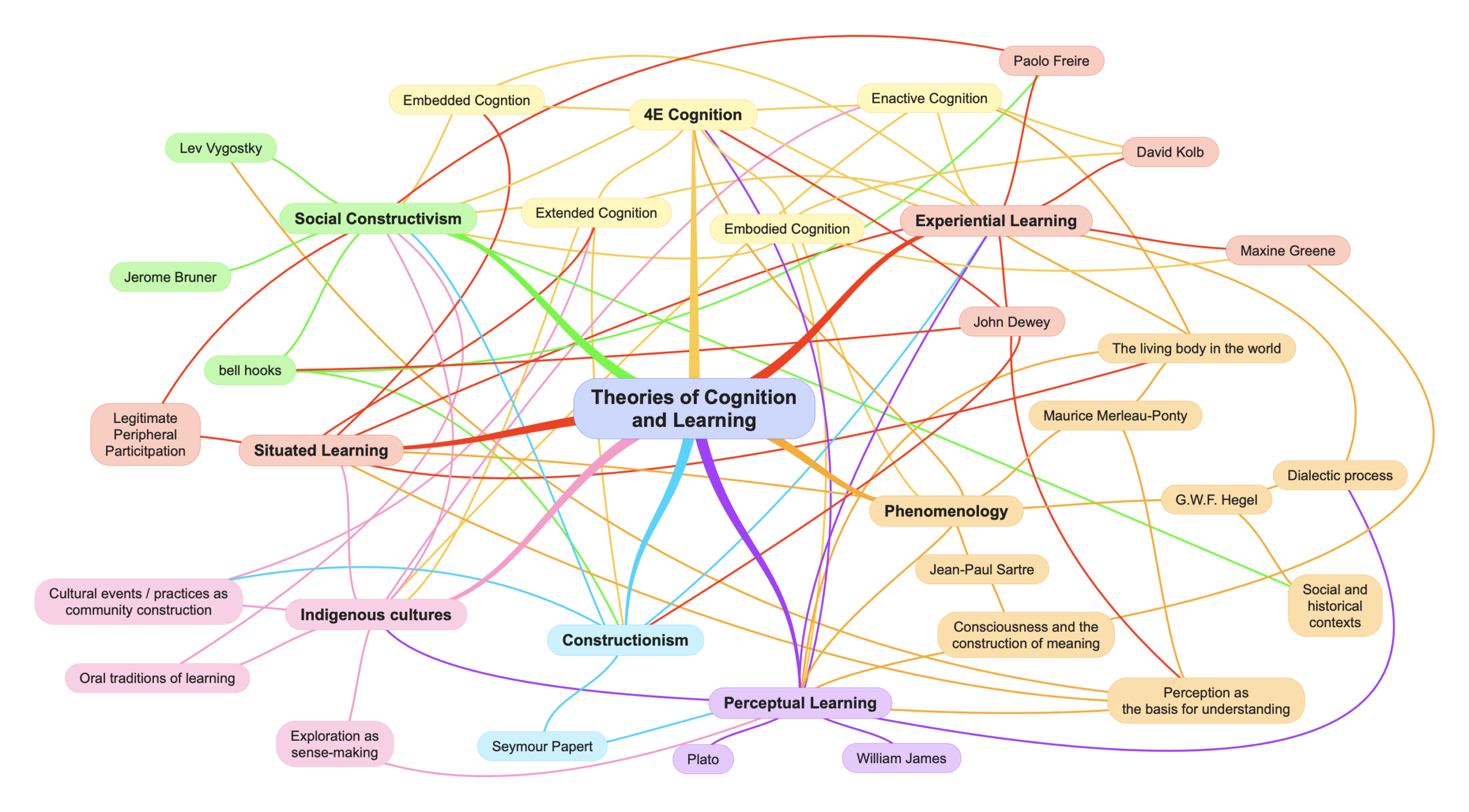
As I’ve written about earlier, I have been studying both Dewey and Vygotsky, and subsequent theorists who have built (and are building) educational theories on or inspired by their work. In this body of work, there is much that is directly relevant to film school — indeed, any practice-based fine art — education. The core is understanding several factors, including:
- The cyclical relationship between practice, experience, reflection, and planning. (Yes, much like Kolb’s learning cycle). Or, as John Dewey wrote: "One does not learn from experience. One learns from reflecting on experience" (How We Think, 1933).
- The social aspect of learning, which includes Vygotsky’s zone of proximal development, and the concept of scaffolding as developed by Bruner et.al. after Vygotsky was translated to English. In other words, what learning theorists know as «social constructivism».
- New theories of cognition, as signalled by theories of embodied and 4E cognition. Understanding cognition is key to understanding how fine arts education can be structured, so as to ensure students learn holistic approaches to their artistic practice involving the interplay of mind, body, and environment.
- Phenomenology and, as a related field, perceptual learning. The arts involve the senses, both in the artistic creation and in the reception, and understanding how our senses work as our primary connection to the world is especially important in artistic education.
- The role of emotion needs to be addressed as well. Not only does art speak to the emotions, but classroom situations and interpersonal dynamics are effected by emotion, which can help or hinder learning.
This is not an exhaustive list, but does reflect the strands I am pursuing now. Reconciling these strands can be challenging, as some of them seem to conflict with the others. For example, one criticism often levelled against the classical learning cycle, and the notion of "reflection in action" as articulated by Donald Schön, is that it treats reflection as something separate from action or experience, even as it seeks to demonstrate the importance they have for each other. In other words, it appears to build on an understanding of mind based on the mind/body dualism. This seems directly at odds with 4E cognition and related theories, which seek to erase the separation of mind and body, and, indeed, our environment.
I am certain there is literature on this, although I have not come across it yet… (If anyone reading knows of any, please do let me know!) But I think regardless that reconciling the cyclical connection between experience and reflection with the extended and embodied mind theses, where a case can be made for certain types of experience — specifically acts of creation — are, by their very nature, reflection and experience.
And so, I am left looking at: reflection on experience, reflection through experience, and reflection as experience. Also, the role of our senses and of emotion in reflection and experience.
Finally, if emotion is emerging as a key for me in understanding arts pedagogy and creativity, what does that say for the role of AI in creative processes? (More on that in a later post; I need to chew on it first.)