
Thinking out loud v.03

Finally getting started…

The students are in place and the semester has started. I’ve done my duty as far as participation is concerned, and now I’m settling in to the home office. It’s time to make a plan and ensure I can keep up with both my pedagogical research and participation in MishMash as that work gets off the ground.

Before the summer I fixed up the home office, so it’s less like a multi-storgage room for all the things we don’t know here to put and more like a working space and home library. I’m pretty pleased with the results, and early indications are that it’s a good space in which to work.
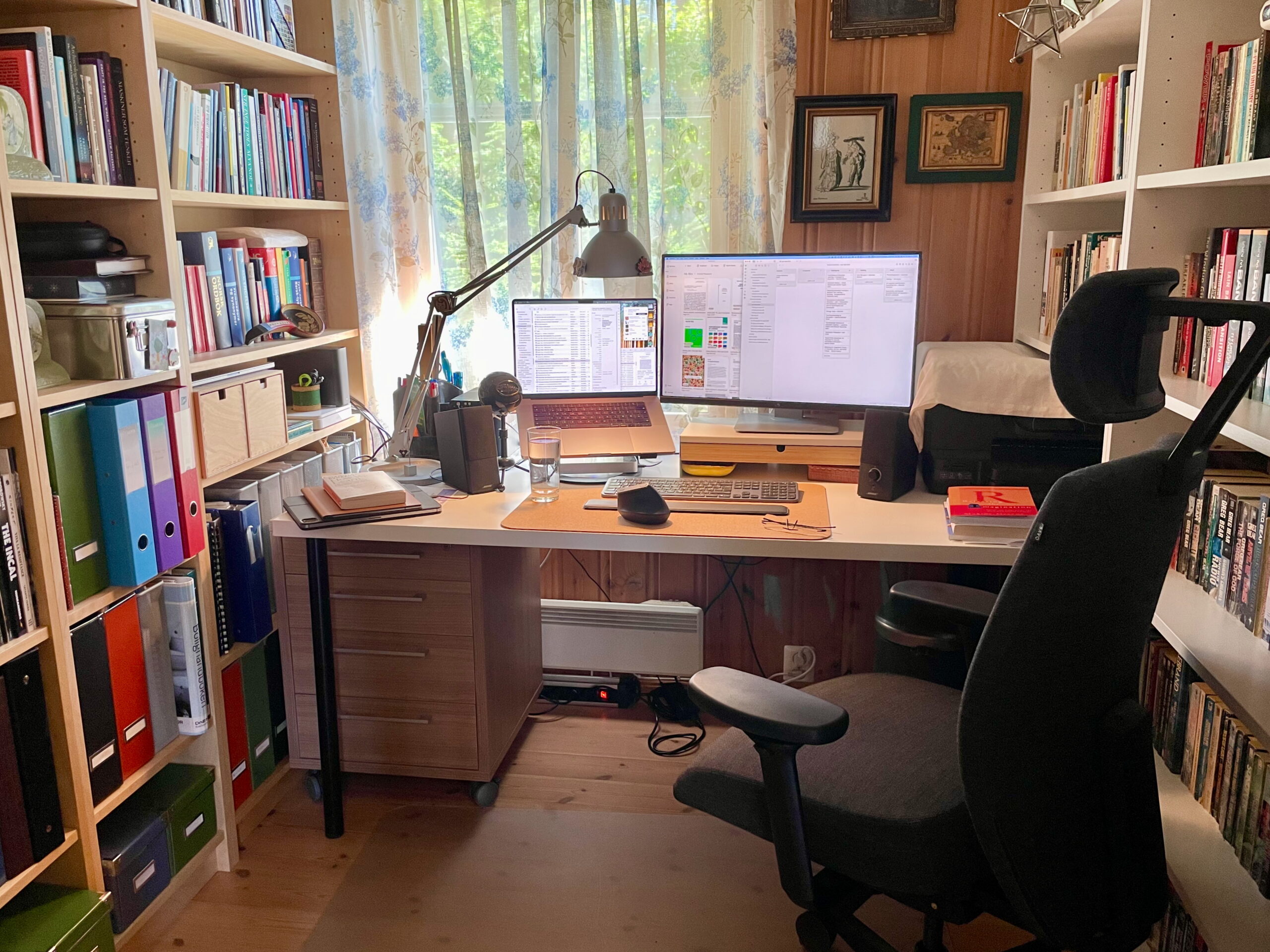
IMG_1441.jpeg

The first order of business is making a prioritised reading list for the coming weeks. I’m currently about a 1/3 of the way through How We Learn by Stanislas Dehaene. The most recent book I completed is The Entanglement by Alva Noë, and the arguments in it informed some of my arguments in the piece on the key role the arts and fine arts education play in society I wrote for Norwegian higher education magazine Khrono a couple of weeks ago (sorry; Norwegian only).

As of now, the next titles on the reading list are:

  • Sourcebook of Experiential Education — part I: Philosophers and Educational Theorists and part III: Psychologists and Sociologists
  • Strange Tools — Alva Noë
  • The Phenomenology of Perception — Maurice Merleau-Ponty
  • Releasing the Imagination: Essays on Education, the Arts, and Social Change — Maxine Greene
  • Unthought: The Power of the Cognitive Nonconscious — N. Katherine Hayles
  • Practicing Embodied Thinking in Research and Learning — Schoeller, Thorgeirsdottir & Walkerden (eds.)
  • Teaching to Transgress — bell hooks
  • Movement Matters — Sheila Macrine and Jennifer Fugate (eds.)
  • Foundations of Embodied Learning: A Paradigm for Education — Mitchell Nathan
  • Toward Wide-Awakeness: An Argument for Arts and Humanities in Education — Maxine Greene
  • The Routledge Handbook of Embodied Cognition — Lawrence Shapiro and Shannon Spaulding (eds.)

I expect this list will develop and change almost daily…

Having music is an important part of how I work. My tinnitus becomes much easier to ignore if I have background music on, and so I spent some time last week organizing my digital music library. Here I suppose thanks are due to Apple, as the Music app for some reason made a mess of the location of my music files which meant I had to rebuild my digital library developed over 25 years completely from scratch… (Who me? Sarcastic? Never!)

I seems all external obstacles are cleared away, and now I have no excuses. I’ll spend about 25-30 hours a week on my research and about 10-15 a week on MishMash — at least for now. I figure out how to adjust that when other things intrude, like the presentation and panel discussion I’m doing at Oslo Pix festival on August 28th. At least, since it’s about AI and the film industry, it’s related to the MishMash work.

Thinking out loud v.01

I have a feeling there will be several of these…

This fall term I will be on a research leave. I am temporarily (and voluntarily!) relieved of all my regular duties in order to spend time doing research — the research I would normally do in my free time, in the moments between meetings, on the weekends… Suddenly that is my main job; I’m not quite sure how I’ll respond once the term starts again, but I’ll do my best to manage.

And what will I be researching? A couple of things:

  1. For the past 15+ years, I’ve been looking at fine arts pedagogy, specifically fine arts pedagogy in film schools. It’s a field where very little research has been done, and while more people have started writing the past 5 or so years, much of what there is is from a an outside and theoretical perspective and not do much from the practitioner perspective. My primary aim is to give practicing filmmakers and film artists a vocabulary to use when discussing what it is they do in the classroom.
  2. The other thing is AI and filmmaking education. I have long been fascinated by they way filmmakers — and all artists — use new technologies in their practice; often in ways that are innovative and surprising. While AI is completely different, in some ways it is no different: filmmakers will use AI, and they will use it in ways that the creators of the tools perhaps did not intend or foresee…

For the pedagogical research: I’ve been reading and thinking a lot over the past few years. Dewey is, of course, a major influence. The statement, «One does not learn from experience. One learns from reflecting on experience.» sums up the ethos I have been trying to enact at the Norwegian Film School ever since I started. It is a practically-oriented school, where the students learn to make film through the practice of making film — but constant reflection on the relationship between process and outcome is an essential part for both individual and collective development.

Vygotsky is another major influence. Filmmaking is a social and collaborative art form, and students (and professionals!) become each other’s most important teachers over time. At the same time, the key challenge for the teaching staff is to create an appropriate Zone of Proximal Learning, where students who come to the school with different backgrounds and experiences can be given challenges that enable their development.

More recently, I’ve been investigating 4E cognition. I firmly subscribe to the idea that cognition is not something limited to the brain, but that our bodies and senses, the tools and technologies we use, and the environments in which we are embedded are part of our cognitive processes. We are not brains in a vat processing input, but are living, breathing bodies in a physical world — and this informs how we interpret our surroundings and how we learn to live in and with the world around us.

I’ve also been reading phenomenology and related philosophy, not to mention perceptual learning. Our bodies, our senses, are our «interface» with the world and each other, and in order to understand how we learn, we need to understand how we sense and how we live. And further from that, how our senses develop and change over time.

Anyway, this is a first brain dump; I intend — or, should I say, hope — to blog regularly about this. I plan to share what I have learned, what I am thinking and see how it changes over time. It’s still July now, so there’s still summer holidays to be had — but by mid-August I should be starting to work at this more dilligently.

Random thoughts

The so-called big questions in life include things like “Why are we alive?”, “Does life have a purpose?” and similar questions that get discussed when one is ones 20s and gathering with friends late at night after enjoying some, shall we say, mind-expanding substances. But I sometimes find myself pondering such things while out in the woods with my dog.

I am not religious; in fact quite the opposite — I believe in rationality, evidence, and science — but there are times I consider what else there is. What came before me, what comes after.

The other day, I listened to two medical ethicists who were discussing assisted suicide on the radio. It’s illegal in Norway, and neither of them was exactly arguing in favour of legalizing assisted suicide but it struck me when one of them talked about fear of death. In his mind, there is nothing to be afraid of in death, because there is nothing. When you are dead, you cease to exist just the way you didn’t exist before you were born.

I thought about this again last night, when I took the dog out and the sky was pitch black (there is very little light pollution around here) and full of stars — and whenever I am lucky enough to see — and almost feel — the universe around me in this way I feel part of something bigger, something eternal (not quite, I know, but so many billions of years it might as well be from a human perspective).

And I find it quite easy to accommodate both those things: we are finite, we exist for a time but have no existence before or after. And, we are connected, almost intimately so, to something (almost) infinitely larger and (nearly) eternal.

Perhaps sometime this week, I’ll be able to get back to reading about creativity and cognition and writing about what I’m supposed to be writing about!

AI and ethical conundrums

I am one of a group of faculty members who have organised a symposium on «AI and Art» at our university on January 12th. It seemed natural for me; I have always been interested in the ways artists explore new technologies, and push them in ways that perhaps was not intended. This was why I led an initiative that leaned heavily into Virtual and Extended Reality, despite some significant scepsisism from many of the filmmakers who teach at the Norwegian Film School.

New technologies always come with baggage; I don’t believe there is such a thing as a completely neutral technology. There is always a worldview, as set of assumptions and values, and both a cost and a benefit to any technology / tool.

But rarely has this been so evident as in the case of the AI tools that have dominated public discourse in the past 18 or so months. These are tools that can do wonderful things (no link; you can find them easily enough if you haven’t seen them already) but they also come with a significant price attached. We’ve seen the reports of the Kenyan content moderators, exposed to the worst the web has to offer for what amounts to slave wages. We’ve seen the examples of racist and sexist biases build in to the tools.

The biases and prejudices built into the tools are one thing. The other side is it became apparent early on that the companies that have created the AI tools have asserted a right of fair use to copyrighted creations on the web, and copyright holders — including writers, artists, musicians, and more — have launched lawsuits asserting their intellectual property (oh, how I loathe that term) has been stolen.

This means every time, or another artist, uses a generative AI tool like ChatGPT or Midjourney, we are, in fact, using works we do not have to right to in order to create our own.

But is it that simple?

I neither know nor understand all the legal implications of this, but I do know that in the art form I work in — filmmaking — artists have been «stealing» from artists they admire almost for as long as there has been a film industry. Would we have a Kurosawa ouevre to admire if he had not stolen from John Ford? Would we have a Star Wars franchise (that never seems to end) if George Lucas had not stolen from Kurosawa (and many others)?

I know there is a difference between artists taking inspiration from others they admire and a corporation almost mindlessly harvesting artistic works in order to make their machine as slick as possible. But it still gives me pause for thought.

2 of 366?

I don’t make New Year’s resolutions, but am motivated to get into a writing habit. Yesterday, I was part of a discussion about it on Mastodon, started by Kate Bowles where I jumped in and suddenly realized — inspired by yesterday’s post — that I want to write. I want to be one of the people who find writing a necessity and something one must do in order to think properly. We’ll see if it actually becomes a daily habit, but for now, I will try.

But why?

Much of it has to do with my field — pedagogy for fine arts filmmaking — and some very interesting things I’ve been reading lately about “4E cognition”1 and especially how it relates to creativity. Also, I’ve been reading a lot about the various so-called AI tools that have appeared in the public eye over the past 18 or so months.

The confluence of these things is an interesting thing to muse about. It also necessitates, I think, a concerted effort to, well, think. Writing, as many people have pointed out, most recently (for me), Sarah Honeychurch, writing is thinking and is the one thing we cannot — must not — outsource to a machine.

Thinking, creativity; these are part of what makes us human, what makes us conscious. And while AI
can help us in many ways2, and become a tool that enables forms of creation we perhaps did not have access to previously, it cannot replace human creativity (at least, not yet!).

Footnotes


Hidden things

Many have thought this before. I’m sure I’ve thought this before. But sometimes, when the half moon is still high in the morning sky, I try my best to see the hidden half. I know it’s there but simply cannot perceive it. When I go down this path, I also begin to think about all the other hidden things, the things we know are there but simply cannot perceive.

That’s it.

P1061535

css.php