
Some notes about my background:
- Lived in Peterborough, Ontario (Canada) and worked in theatre, music, radio, publishing, and journalism from 1984-1992. Studied intermittently — inspired by Mark Twain: "I have never let my schooling interfere with my education." (Or so I told myself.)
- Moved to Vancouver in 1993; worked in arts events administration for visual arts and theatre. Studied filmmaking in 1996 (Vancouver Film School), was sound editor in documentary and picture editor in fiction for final projects.
- As a filmmaker, worked in camera and sound departments, directed two short films, but worked primarily as 1st Assistant Director for television series.
- Moved to Toronto for a management job at the Canadian Film Centre in 2002.
- Came "home" to Norway in 2006; started at the Norwegian Film School in 2009.
- Began a "practical-pedagogic education" in 2008, and was introduced to basic pedagogic theories with an emphasis on constructivism (Piaget) and social constructivism (Vygotsky).
I had a great deal of intuitive and tacit knowledge about the necessity of experience for learning, especially in the cinematic arts, but was introduced to pedagogical theory at NFS, when Danish scholar Heidi Philipsen conducted workshops for the staff in 2010. These workshops built on her PhD-thesis Dansk films nye bølge: Afsæt og aftryk fra Den Danske Filmskole (2004) which, among other things, examined the key role scaffolding and constraints played in the success of the Danish Film School of the 1980s and 90s.
One of the key findings from Philipsen’s research was that the imposition of rules, or constraints, released the imagination and creativity of students;
One of the directors in my research explained that initially he found it very frustrating to be forced to work within constraints, such as in the pen tests. He sought to revolutionize stylistic devices, and thereby to create original films. He would become furious if forced to make a scene with a specific theme, within a specific deadline, and with specific kinds of other conditions concerning the use of camera, actors etc. (this would be a typical example of a pen test). But, in retrospect, he, along with all the other respondents, was grateful that he had learned to work within constraints. They made him feel secure, inspired, and focused; they also made him experiment, because he wished to make his own personal film and not the same kind of film as the other students working under exactly the same conditions. (Philipsen, 2009)
She found these constraints were one of 2 kinds of scaffolding she identified at the Danish Film School — "institution scaffolding (rules ordered by the leader or teachers) and team scaffolding (the use of collaboration)." (Philipsen, 2009) — and these were key methods behind the success of the Danish Film School from the mid-1980s under the leadership of Henning Camre and Mogens Rukov.
The idea of educational scaffolding — creating learning situations which provide learners with challenges they must stretch to achieve but at the same time are not beyond their capabilities — was not new to me at this time, as I had been introduced to it just two years prior. The term is a way of describing what teachers and tutors must to in order to maintain Vygotsky’s zone of proximal development (ZPD).[^1]
Vygotsky emphasized that the creation and maintenance of the ZPD involved at least two factors: there is of course the learner themselves and the active role they take in their own learning and the social and cultural context in which they are learning (which includes both teachers and peers / collaborators). This is mirrored in the scaffolds constructed within the educational setting at a film school, where the role of the institution, the role of the team members, and the (active) role of the individual student all must interact in order for development and learning to occur.
Following this, I began researching experiential education in greater depth, focussing on John Dewey, David Kolb, and Donald Schön. Schön, in particular, was much discussed in Norwegian artistic research circles at the time. His description of the reflective practitioner, as a qualified professional who due to a combination of education or training and professional experience is a able to reflect in the moment and improvise solutions to previously unencountered situations,[^2] resonates with the way artists work. Creating experiential learning situations which can then prepare filmmakers and artist to become this sort of reflective practitioner is key for any art school.
At this time, I also began reading John Dewey, particularly the works Democracy and Education (1916), Experience and Education (1938), and How We Think (1910, 1933). Dewey’s pragmatist philosophy and insistence on education as an essential part of being a member of society, his insistence that "…education […] is a process of living and not a preparation for future living" (Dewey, 1897) resonates both with my own beliefs and, indeed, the Mark Twain quote I started this piece with. Also, it encapsulates the reality of a film school very well, where no filmmaker emerges from school fully taught but rather is sent into an artistic career and work in the industry prepared to learn from new experiences and constantly develop.
The way to achieve this can be summed up in two more examples from Dewey: "Give the pupils something to do, not something to learn; and the doing is of such a nature as to demand thinking; learning naturally results." (Dewey, 1916) and, "We do not learn from experience. We learn from reflecting on experience." (Dewey, 1933). These emphasize both the importance of practical work in any learning process; practical work that will lead to concrete experiences, and the importance of reflecting on experiences in order to internalize and share what learning has come from them.
The role of reflection is, to me, the key to moving from tacit to explicit knowledge. For many, especially in professions where craft plays a sentral role, training new members of the profession has often emphasised demonstration. If, however, experience and reflection are highlighted then the key becomes creating settings where the learner can test, fail, and gain experience combined with reflecting on the consequences of their own choices in any given situation. This leads to deeper learning, and, indeed, faster development.
I also attended an internal pedagogy course at our university college, and quickly concluded that pedagogical theories and techniques aimed at traditional lecturers was not the most relevant for filmmakers coming to teach at a film school with a heavy emphasis on practice-based work. As a result, I proposed a Nordic seminar on film school pedagogy at a NORDICIL-meeting in 2014. This was funded in 2015, and ran as a pilot project from 2016-17 as a collaborative seminar between Norway, Denmark, Sweden, and Finland.
This experience has led to an internal fine arts pedagogy course at our institution, Inland Norway University (INN), which I have led with varying collaborators (Carl Svensson, Christy Dena, Trond Lossius, Kjersti Norman). The course was completed in 2018-19, 2020-21 and 2024-25 and participants who successfully completed it were granted the ects necessary for holding a teaching position in higher education in Norway. In addition to the Norwegian Film School, participants have come from the television and games departments at INN as well as LIMPI, a private songwriting and music production school in Lillehammer.
Through conducting this course, I have found there is a need to a common vocabulary for discussing what it is filmmakers do when teaching. Much has been intuitive and tacit, much as my own, earlier, experience, and perhaps the most fruitful aspect of the courses has been a forum for peer discussions. My own research has shown that while there is a body of literature that describes classroom techniques (or didactics) and there is a vast body of literature on pedagogic philosophy and theories of education, there is very little illuminating the philosophy of the fine arts classroom from the point of view of film practitioners. As a result, we borrow and steal, perhaps especially from music, and make do.
The project I am working on now is to contribute to changing this.
In recent years, I have vastly expanded my research beyond Dewey and Vygotsky to include a greater variety of schools of thought. I am reading various contemporary theorists in the field of 4E cognition and the extended mind theory. I am exploring other forms of experiential learning, including the writings and practices of Paulo Freire and bell hooks. I have recently been introduced to the writings of Maxine Greene on aesthetic education, and will be delving further into these. I am returning, in a way, to phenomenology through the writings of Maurice Merleau-Ponty on the sensory basis for our experience of the world. And I am examining the way our senses themselves "learn" through what has been named perceptual learning and the relevance this has for artists and creators of all kinds.
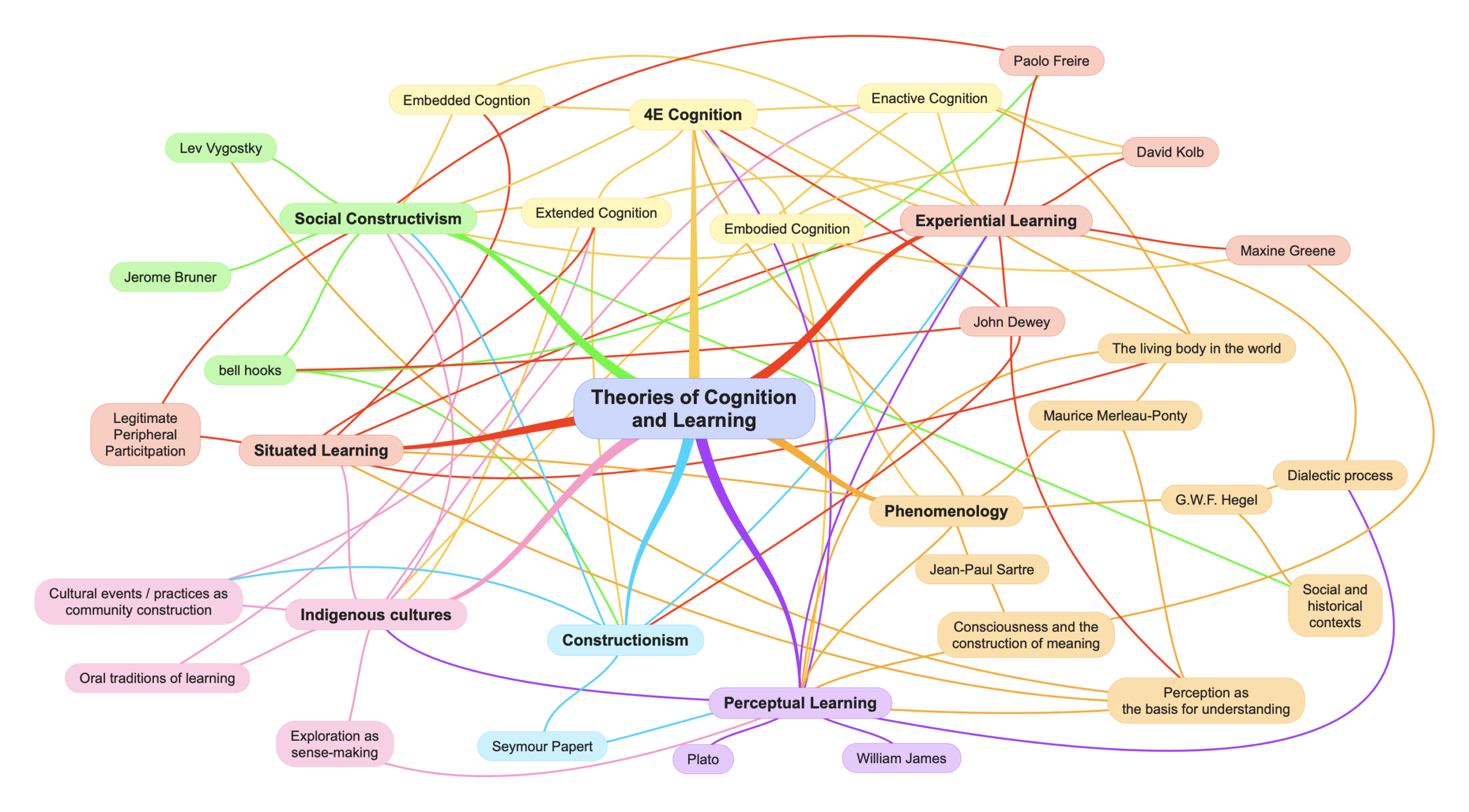
This, of course, is just a selection of the strands I am exploring; the commonality among them is my wish to combine them into a theory of filmmaking and fine arts education. (And, to be clear: not the theory. A theory.) I hope, through this work, to provide a vocabulary for discussing not only what we do, but why we chose to organize our classrooms and workshops the way we do.
Some years ago I wrote a "Handbook for teachers at the Norwegian Film School." It was a very internal and practically-oriented handbook, last updated in 2018. It’s time to look at it anew, and to rewrite it for a broader and international group of educators at film, television, games, and media schools who share a background from professional and artistic practice. And perhaps to give them a tool for discussing their teaching practice with both local and international colleagues.
Footnotes
[^1]: Vygotsky, L. S. (1978). Mind in society. Cambridge, MA: MIT Press.
[^2]: Schön, D. (1983). The Reflective Practitioner: How Professionals Think in Action. Basic Books.
