Three*

Some of the ideas I’ll be exploring in the months — my research semester starts in 18 months — to come.

  • Dewey’s pragmatism, as laid out in Democracy and Education, How We Think, and Art as Experience.
  • Experiential learning, as laid out by David Kolb and critiqued / refined by several others since.
  • Donald Schön’s observations and theories on reflection in action / praxis, with special attention to Lisa Candy’s The Reflective Creative Practitioner.
  • Vygotsky, of course. The zone of proximal learning and scaffolding are key concepts in any educational programme geared towards developing both technical and artistic skills.
  • Seymour Papert’s constructionism. In filmmaking programmes, the students learn best when actually making films, both for purely internal critique but also for public distribution through festivals and the like.
  • Situated learning and «legitimate peripheral participation» as analysed by Jean Lave and Etienne Wenger.
  • And, as I’ve already mentioned, 4E cognition, with special emphasis on how it relates to creativity and craft.

* I’m lousy at titles. I might end up using some variation of the number of the post for 2024. Or not.

2 of 366?

I don’t make New Year’s resolutions, but am motivated to get into a writing habit. Yesterday, I was part of a discussion about it on Mastodon, started by Kate Bowles where I jumped in and suddenly realized — inspired by yesterday’s post — that I want to write. I want to be one of the people who find writing a necessity and something one must do in order to think properly. We’ll see if it actually becomes a daily habit, but for now, I will try.

But why?

Much of it has to do with my field — pedagogy for fine arts filmmaking — and some very interesting things I’ve been reading lately about “4E cognition”1 and especially how it relates to creativity. Also, I’ve been reading a lot about the various so-called AI tools that have appeared in the public eye over the past 18 or so months.

The confluence of these things is an interesting thing to muse about. It also necessitates, I think, a concerted effort to, well, think. Writing, as many people have pointed out, most recently (for me), Sarah Honeychurch, writing is thinking and is the one thing we cannot — must not — outsource to a machine.

Thinking, creativity; these are part of what makes us human, what makes us conscious. And while AI
can help us in many ways2, and become a tool that enables forms of creation we perhaps did not have access to previously, it cannot replace human creativity (at least, not yet!).

Footnotes


So. It’s 2024

Everyone needs to start somewhere, or sometime. On occasion, one might need to start several times before the thing becomes a habit.

Every time I’ve tried blogging, it’s fizzled out pretty quickly, often due to the pressure I put on myself to do it well. The weight of unrealistic expectations, or something like that.

Well. Fuck pressure. Fuck expectations.

I’m going to try just writing. Writing about whatever comes to mind, writing just for the simple reason that I want to get into the habit of writing. That means some of these posts are going to be god-awful, and I’ll have to train myself to live with that — and maybe, just maybe, as time goes on, some of them might be good. We’ll see.

There will be a mix. Sometimes politics, sometimes culture, sometimes philosophy, sometimes pedagogy. And sometimes just a random rant.

And there will be things to write about, as time goes on. I am, and have always been, one who pays attention to what is going on in the world.

I’m concerned about hypocrisy, such as the abject cowardice and hypocrisy shown by the Western world when our governments and thought leaders condemn Russia for their invasion of Ukraina but fail to do the same when Israel invades Gaza and slaughters Palestinian civilians by the thousands.

I am concerned by the rise of the militant and populistic far right in many countries, and often think about the roots of this rise, and how it’s connected to the technocratic centre which arose through the 80s and replaced the democratic control have over their lives with an increasingly regulated market economy where the rules are inflexible for individuals and are rigged to ensure global capital can operate freely. This comes to the fore in the phenomenon of “enshittification” as first identified by Cory Doctorow — a phenomenon I believe applies to many areas of the economy and not just online platforms. Here in Norway, a recent example is the privatization of the railroads, which leads to a worse experience for travellers, a massive increase in high-salaried directors of the many companies and subcompanies that now operate in a field where there previously was just one, state-owned company.

I’m concerned about the fragmentation of and in-fighting between the various groups that make up the left. I consider myself a socialist, albeit one with strong leanings towards the anarchist philosophies of Emma Goldman and Murray Bookchin. As such, I believe that social change and social justice must come as a result of collective organisation and action, and liberalistic philosophies that focus on the individual can become far too self-centred and thus antithetical to a struggle for emancipation and justice. Far too many fights in the so-called “culture wars” seem to be between those who favour collective solidarity and those who favour individual emancipation.

I’ll also be exploring pedagogical philosophies this year. I’m reading theories of creativity and seeing them in relation to the emergence of 4E cognition. I’ll be attempting to incorporate these into my research on fine arts pedagogy and seeing how all this relates to teaching and artistic research in a collective art form like film. It all begins with Dewey…

I think that’s enough for now. I’m sure other, random distractions will pop up (like sports, on occasion) and perhaps I’ll sometimes just jot down something about my dog.

Exploring Situated Learning

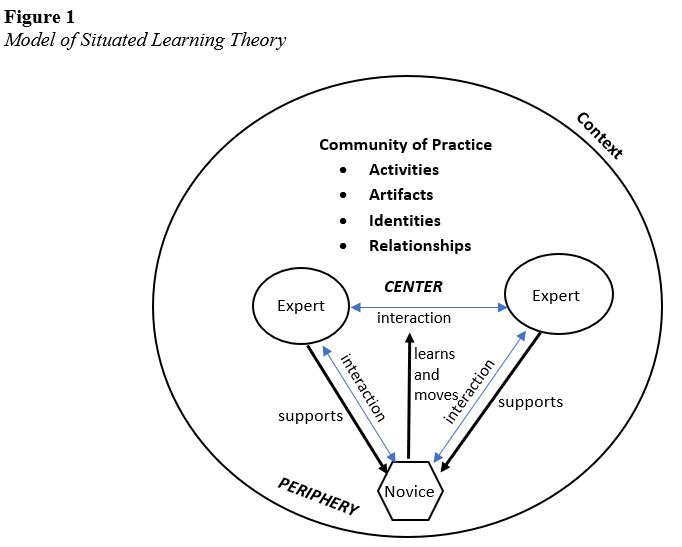
I no longer remember when I first came across the term «situated learning» — likely it was in connection to my exploration of theories of experiential learning, starting with Dewey, and continuing through Kolb and Schön & Argyris. But in the past few days I’ve been reading more closely, starting with the excellent introduction on Infed, Jean Lave, Etienne Wenger and communities of practice.

The notion that learning occurs when the learner is placed in situations that closely resemble the situations where the learning is later to be applied, and that this furthermore is part of bringing the learner into a community of practice resonates with my approach to film school education. Effective education at any practice-based film school will always create situations for the students to learn different aspects of filmmaking through practical work in real-world problems. Furthermore, a school such as ours, where the faculty are also active filmmakers, will ensure the students are not only learning through instruction but also by being included in what is most definitely a community of practice.

One question I am wanting to explore further is how this relates to the other educational theories and pedagogical approaches we employ at the school.

[image from “Situated Learning Theory” by Sandra P. Mina Herrera, https://opentext.wsu.edu/theoreticalmodelsforteachingandresearch/chapter/situated-learning-theory/]

Is it really Foucaut’s fault?

In a thought-provoking op-ed in The Guardian, Mitchell Dean and Daniel Zamora write

We are perhaps living at the end of politics,” Michel Foucault wrote in the late 1970s. With the exhaustion of utopias and radical alternatives to capitalism, what was now at stake, he memorably wrote, was to develop “new types, new kinds of relations to ourselves”. Political advancement is not delivered through “parties, trade unions, bureaucracy and politics any more”, he wrote. Instead, politics has become “an individual, moral concern”.

— and then go on to lay the current trends of self-centred «progressivism» at the philosopher’s feet.

I’m not sure we can blame it all on Foucault, but when they write

Beginning in the late 60s, political change would be reframed as a struggle against oneself, against our “inner enemy”. One had to confront the “fascist within”.

This shift made the self just another market to conquer, with self-help coaches, new age gurus, energy healers, food counsellors, alternative therapists and lifestyle brands all trying to profit off of this turn inwards. Politics, as Christopher Lasch would write, would “degenerate into a struggle not for social change but for self-realization”.

I find myself in complete agreement.

Social justice, socialism, and left-wing politics have, for me, always been about solidarity. It is, most emphatically, not about me but about how I can contribute to making the world a better and more just place. Making it about my improvement, about my consciousness being raised, about my journey to become a woke individual (yes, I see the irony in light of my last post) is an act of selfishness and the opposite of solidarity.

The entire opinion piece is here: https://www.theguardian.com/commentisfree/2021/jun/15/michel-foucault-self-individual-politics. It’s worth a read.

Decolonizing myself?

Decolonizing. As is the case with most people, I hear the word a lot, and I hear it used in different ways and in different contexts. As an educator, I cannot avoid the notion of «decolonizing the curriculum» and, in both my own field of art and in the arts in general, people talk about «decolonizing practice». I see in the film school and art school networks I am a part of that the topic is coming more and more into the forefront.

I must admit I struggle with using the word in this context. Can I «decolonize» myself? Does it mean anything when applied to a process of analysing myself, my own prejudices, and privileges, and working towards becoming a more active participant in the process of breaking down systemic oppression and creating a more just society? The word «decolonize» is ridiculed on many front, particularly by people on the right but also by some on the left. 

I have, however, been engaged in social justice my whole adult life, and cannot avoid the topic. I believe I have — as a white, male academic in Norway with personal, professional, and cultural privilege — a responsibility to examine how I can use my privilege to effect change and create conditions where those voices that have less privilege than I do are lifted to the forefront and can achieve the same power of definition and control that people like me have held for far too long.

I learned, while volunteering in support of Vancouver Rape Relief and Women’s Shelter in the 1990s, the importance of being a political ally by, among other things, letting those who have been the subject of oppression lead the struggle for emancipation and to take their lead as I work actively to support the struggle and use my privilege as a tool in that struggle. I will attempt to apply those lessons to the work I will need to do now.

It will be a journey, and part of the reason I am posting about it here is to hold myself to account — a struggle undertaken in silence and in private will not be as effective as one undertaken in openness and in public.

Zoomed in

A short while ago, I read several articles on the psychological effect Zoom is having on those of us who are using it extensively from our home offices. A good example of the genre is this article from The Guardian, which points to fatigue and other effects of looking at our own image on screen for long periods of time.

I have on average two meetings a day in my working week, and would estimate each meeting lasts between 1.5 to 2 hours. So, as many as 4 hours a day spent looking at myself in a Zoom gallery.

I first used Zoom in 2016 as part of the Nordic collaboration «The Artist as (Film School) Teacher», so it was not an entirely new thing to me when campuses and workplaces were shut down on March 12th, 2020. I did find, however, like so many others that the endless days of Zoom were exhausting but assumed that had more to do with the general weight of trying to keep both myself, my family, and the school going under the Covid-19 pandemic.

Reading that Guardian article, however, led me to try an experiment: this past week I’ve used «hide self view» in all my Zoom meetings, in an effort to see if it’s made a difference.

The experience has been…odd.

In small meetings — one on one, or in a group with 2-4 others — it has made a difference. Not seeing myself makes it easier to concentrate on the others in the meeting, to look at the camera in an effort to give the illusion of eye contact, and has made me less self-conscious.

In larger meetings, however, the effect has been more alienating. All of a sudden I feel more like I am outside the group looking in, and have lost my place in the community. The threshold for participating in the group has become higher, and the temptation to do something else greater.

Very odd.

Hidden things

Many have thought this before. I’m sure I’ve thought this before. But sometimes, when the half moon is still high in the morning sky, I try my best to see the hidden half. I know it’s there but simply cannot perceive it. When I go down this path, I also begin to think about all the other hidden things, the things we know are there but simply cannot perceive.

That’s it.

P1061535

Picking up some threads — film school pedagogy

I’ve got some time on my hands these days, and it’s time to pick up the film school pedagogy thread again. As I’ve posted earlier, I worked with a group of faculty from Nordic film schools in 2015 & 16 to develop a training programme for filmmakers teaching at film schools. Subsequently, I translated this to Norwegian, and completed a first cohort among our own staff in the school year 2018-19. I am now working on taking that experience and developing a curriculum for a second cohort.

The intro module from the Nordic version is still a good starting point, and so I’m posting it here and will endeavour to follow up with some thoughts and new ideas.

The intro module looked like this:

The Artist as (Film School) Teacher

Pedagogical development for filmmakers teaching in higher education

MODULE 1

Introduction to the training programme
mandatory for all participants
1,5 ECTS – 5 weeks – approx. time usage (including own time) is 8-10 hrs. per week.

Introduction

This module will introduce all the participants in the “The Artist as (Film School) Teacher” pedagogical course to several aspects of film school pedagogy, basics of online learning, principles of peeragogy, and to the approaches to teaching practiced at the participating Nordic film schools. The module will combine video hangouts and webconferencing, synchronous and asynchronous online discussions with readings, videos and reflection assignments.

Module 1 is not a standalone course, but serves as the introduction for all the filmmakers working at the NORDICIL schools who need – either due to formal requirements or personal interest – insight into and practice with pedagogy and didactic methods designed for film schools. This first module will introduce the series of modules that make up “The Artist as (Film School) Teacher” and, most importantly, ensure that all the participants have the same level of comfort with the online environments, the vocabulary of film school pedagogy, and the principles of peeragogy.

Completion of this module is a prerequisite for participating in further modules.

Learning outcomes.

By the conclusion of the module, the candidates will have achieved the following learning outcomes:

Knowledge: The candidates will have attained

  • An overview of the approaches to pedagogy practiced at the participating film schools
  • An overview of various tools for online learning and interaction
  • An understanding of peeragogy and the importance of personal learning networks in online instruction.
  • A good understanding of “pedagogy” and “didactics”, “scaffolding”, pragmatist educational practice, constructivist educational practice, other commonly used educational practices.

Skills: The candidates will be able to:

  • Critically reflect over and place own personal approach to education and training within a larger context
  • Choose, setup, and maintain online identities for use in future training modules
  • Build and use a personal learning network (PLN) and personal learning environment (PLE)
  • Support other participants in a PLN
  • Understand the uses of pedagogy and didactics.

General competence:

At the conclusion of this first module, the participants will be prepared for further participation in “The Artist as (Film School) Teacher” by both enabling them to attain a level of comfort with the online tools and environments that will be used and helping them gain insight into the role of the educator as distinct from the filmmaker.

Course Structure

WEEK 1 – Introductions

In week one, the participants will receive an email with instructions on how to create an online account with the chosen PLE for this module[4] . At each of the 8 participating schools there will also be a designated resource person[1] the participants can go to for assistance getting online. Once logged in to the PLE, participants will see the syllabus for the course, will be able to download list of fundamental definitions, and will have access to some readings and videos.

Tasks for the week:

  • Log into the PLE and create a full profile
  • Read and reflect on pedagogical approaches from the different schools
  • Share reflections on own approach to teaching in the PLE
  • Read and reflect on “What is peeragogy?”
  • View and reflect on selected videos (TBA)
WEEK 2 – Environments

In week two, participants will start to become familiar with the various online tools that will be used throughout this and future modules. Several tools will be presented with both pros and cons, and the facilitators will explain why some have been chosen at this point and how they will be used. These include tools for online discussions (eg. Slack, Google+, Twitter, etc.), for video interaction and webinars (eg. Skype, Google Hangouts), and for creating and sharing documents (such as Google Drive, Dropbox, blog tools such as Blogger & WordPress).

In addition, week two will see the introduction of basic learning theories and their application to the training of creative talents in filmmaking. Key questions include “What does it mean to be be developing creative talent and how does this differ from professional training?”, “What is an experience-based educational approach?”, and “To what extent does training artists /filmmakers rely on tacit knowledge, and what are the educational implications of this?” These questions are introduced at this point, but developing answers to them is a project for several modules.

Tasks for the week:

  • Participate in the first video hangout
  • Participate in a synchronous online discussion using Slack, Twitter, or Google+.
  • Comment on reflections from week 1; if necessary update own reflection based on feedback
  • Read selected readings introducing basics of Pragmatism (Dewey), Constructivism (Piaget), and Social Constructivism (Vygotsky). Max. 20 pages total.
  • Start a self-reflection/criticism of the selected readings.
WEEK 3 – The Personal Learning Network

Peeragogy depends, as the name suggests, on interaction with and support from peers, and in this course the peers are film school teachers spread across 4 countries with different languages, representing 8 schools with different approaches in 6 cities. Reliance on online tools for building and supporting a peer network is absolutely necessary and a primary goal for week three is to help all the participants become more familiar and comfortable with using interactive online tools for establishing and building relationships in a learning network.

Tasks for the week:

  • Participate in a video hangout
  • Participate in a synchronous online discussion using Slack, Twitter, or Google+.
  • Search for useful resources related to the week 2 readings and share any found to a central repository.
  • Read selected sections of the Peeragogy Handbook and participate in an online discussion of peeragogy.
  • Continue self-reflection/criticism of the selected readings, and begin referring to the additional resources found by module participants.
WEEK 4 – Towards developing a film school pedagogy

In week one
of the module, participants were asked to read and reflect on the pedagogical approaches of all the participating NORDICIL schools. At this point, they should feel comfortable enough to reflect critically on the approach of their own school and compare it with the other schools. In week four, the expectation is that participants will start to place their own pedagogical practices and thoughts within this larger context and engage in discussions with other participants in order to exchange thoughts and reflections.

Tasks for the week:

  • Post own self-reflection/criticism in a public forum where the other participants can read and comment on it.
  • Read, reflect and comment on the self-reflections of other participants, both from one’s own institution and from other institutions.
  • Participate in online discussions (possible video hangout may be organised).
  • Fill out self-assessment of course progress to date
WEEK 5 – Conclusions and final reflections

Module 1 is the launching pad for the subsequent modules, and a key metric for success is ensuring the participants are comfortable with both the technological environment and the foundational philosophies of peeragogy and film school pedagogy. The contents of week 5 will be very much determined by the results of the self-assessment survey completed at the end of week 4.

The goal for week 5 is to ensure the participants are familiar with their PLN and the tools for interaction and communication, and have developed a critical awareness of their own pedagogical practice and how it relates to a larger community of practice at the Nordic film schools. These are the key competencies that will form the foundation of the further modules in the course.

Tasks for the week:

  • Participate in online discussions summarising the key takeaways from the module
  • Update own self-reflection/criticism based on total feedback from others
  • Complete online skills assessment
  • Identify gaps in skills and knowledge and share a plan for filling these gaps
  • Where applicable, offer peer support to others who share their learning gaps
  • Complete final self-assessment and sign up for next module.

Organisation

Each of the
eight participating institutions has provided a participant in the NORDICIL working group that has developed “The Artist as (Film School) Teacher”. These 8 individuals are also the peer facilitators for Module 1, and will support each other in leading the various elements of the module.

There is no grade, and at the completion of the course participants will receive either a “completed” or “not completed” based on their active participation in all facets of the course over the 5-week period. A mark of “completed” is required in order to continue to the next module.

There’s something about Paris

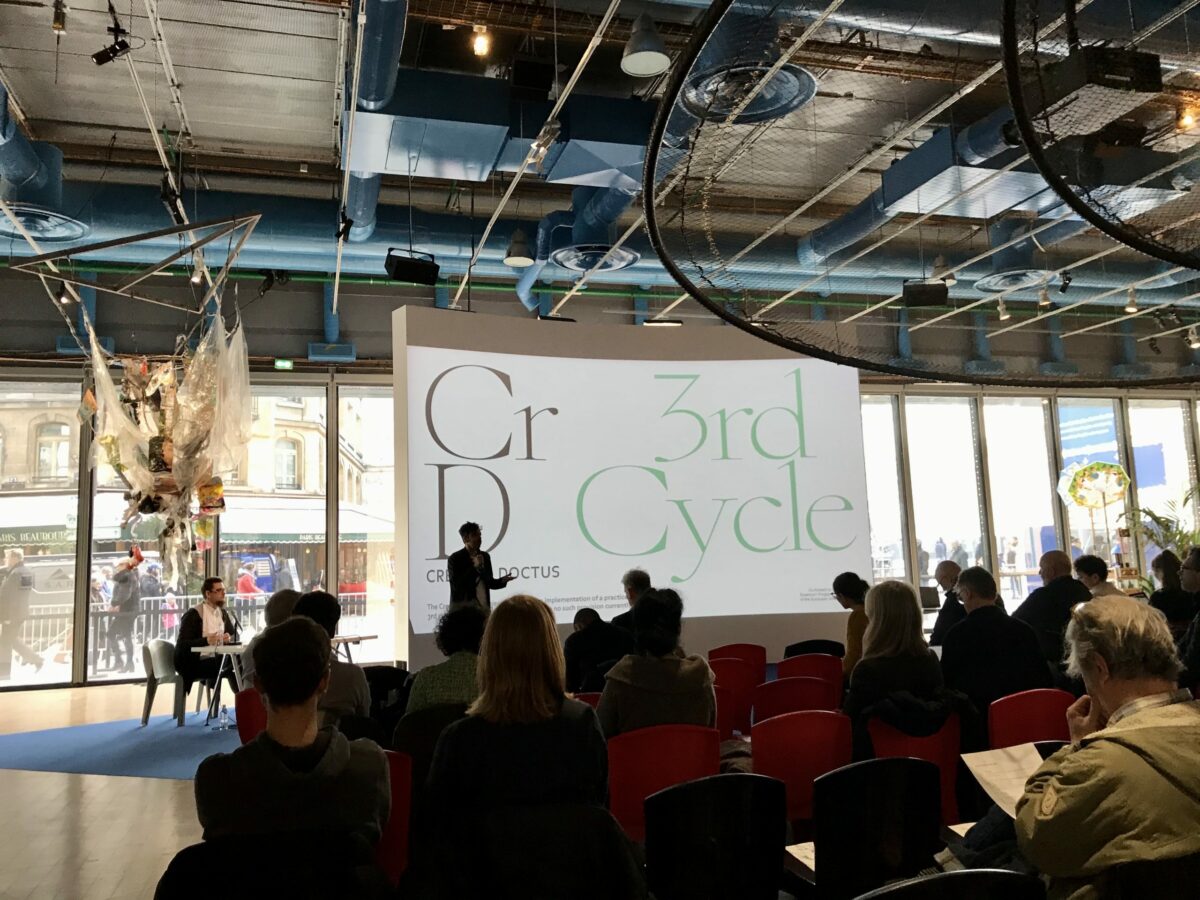
On November 29th and 30th, I attended the 2nd Creator Doctus conference, where a consortium of 7 European fine arts academies presented their ongoing work to establish a formal 3rd cycle alternative for the arts. A key element in the presentations is the focus on creating a doctoral programme where artists are allowed to be artists, and not forced to also be academics.

The programme was a mix of artist presentations, organised in collaboration with the conference venue, the Centre Pompidou in Paris, case studies from each of the 7 participants, highlighting where they are in the work of establishing 3rd cycle programmes today, and some overall presentations of the Creator Doctus initiative and their interim report.

The thing that strikes me in the most positive way, is the fact that more countries are now beginning to see the necessity of a fine arts alternative for 3rd cycle education. The «CrD» — Creator Doctus — is being touted as a defined degree which will mark that the recipient has completed a rigorous body of work in the fine arts that qualifies for a 3rd cycle degree. This avoids the problems inherent in attempting to fit the work of artists into the various PhD models that exist.

In Norway the government has established the «ph.d. i kunstnerisk utviklingsarbeid» — PhD in Artistic Research — as a defined alternative for the arts. It is a good thing in that this is clearly defined as being based on artistic output and not academic work, but the use of the designation «PhD» still has the potential to cause confusion both nationally and internationally.

As has happened in previous discussions around artistic research, I find myself very privileged to be working in Norway, where artistic research does not have to be justified as an activity in higher education, but is rather acknowledged in law (if not always in practice) as an activity that is equal to academic/scientific research and there is a funding programme dedicated to artistic research.

I’ve been involved in the artistic research work og the Norwegian Film School since 2010, and have hear many different discussions on the nature of artistic research. As so often before, I am struck by the divide between those who include an academic writing and publishing component in their artistic research 2nd and 3rd cycle programmes, and those who don’t.

I am most definitely on the side of the second group. As I see it, artistic research as an activity belongs to fine arts education; education where the purpose is to train students and PhD candidates in the methods, practice and reflections that belong to their chosen discipline. To put it bluntly, at the Norwegian Film School we train filmmakers by allowing them to make films and to reflect on their process and result in order to become more confident in their abilities to express themselves artistically through the medium of film (and related audio-visual media).

As students move from BFA to MFA, PhD-level, and ultimately become (in some cases) faculty, they should become, not only more experienced artists, but also more expert at reflecting on their process, placing their work in a broader context and sharing their reflections with the broader filmmaking community. And this is the core of artistic research in the academy. It should consist of

  1. An artistic process, leading to
  2. An artistic result (ie. a work that meets an audience appropriate to the nature of the work)
  3. In combination with a critical reflection that explores the relationships and content of the artist’s intentions with the work(s), their choices of methods and process, and the effect of their choices in relation to the final product
  4. Presented in a way that the critical reflection can become part of the discourse of the professional field of artists working in the field as well as that of the broader artistic community.
css.php